
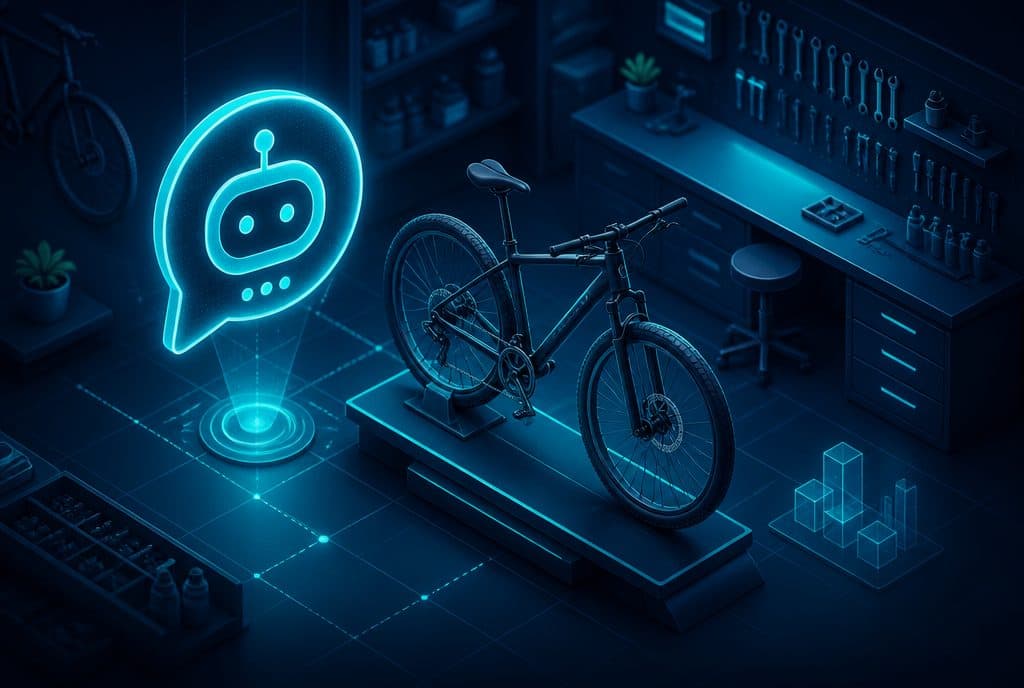
A WhatsApp bot for a bicycle shop is an automation system that automatically answers customer questions about inventory and prices, accepts repair bookings, sends "your bike is ready" notifications, and reminds customers about seasonal checkups — all through WhatsApp, 24/7, without the staff having to manually handle every inquiry. In a shop that receives dozens of inquiries a day, the difference is between a staff buried in messages and a staff focused on repairs and sales.
How does automation help a bicycle shop?
Automation for a bicycle shop addresses three bottlenecks with a single click: repetitive inventory inquiries ("Do you have the Shimano 105 tire?"), scheduling repair appointments which requires back-and-forth messaging on WhatsApp, and sending manual status updates that get forgotten during busy hours. A bot connected to the inventory list answers instantly, a calendar connected to the bot allows the customer to book an appointment independently, and a "ready for pickup" reminder is sent automatically the moment the technician marks the job as complete — leaving the staff free for hands-on work.
Types of inquiries the bot handles
An average bicycle shop receives several types of recurring inquiries day after day:
| Inquiry Type | Manual Handling Today | Automated Handling with a Bot |
|---|---|---|
| Inventory check ("Do you have ___?") | Stopping work, manual check, replying | Instant answer from the inventory list |
| Booking a repair appointment | Series of back-and-forth messages | Customer chooses a date and time themselves |
| Service price inquiries | Manual reply to each question | Automated price list + appointment offer |
| "When is my bike ready?" | Manual check, replying | Customer receives an update upon repair completion |
| Seasonal service reminders | Doesn't actually happen | Customer list + automated sending |
| After-hours replies | Lost lead | Bot answers, captures details, and transfers to the morning |
Four practical scenarios
1. Real-time inventory check
A customer writes on WhatsApp: "Do you have the 29-inch Maxxis 2.4 tire?". Without a bot, the inquiry arrives while the salesperson is busy with a customer in the shop, gets forgotten, and only after an hour does a reply go out — if at all. With a bot connected to an updated product list, the answer is sent within seconds, including the price and an option to order. If the item is out of stock, the bot asks if the customer wants to be notified as soon as stock arrives.
2. Booking a repair service appointment
A customer wants to schedule an annual service for their mountain bike. They send a message, the bot asks for the bike type and the issue (to estimate labor time), and then displays the available slots in the calendar. The customer chooses a time — once confirmed, the appointment is entered into the technician's calendar, the customer receives a confirmation with the address, and an automated reminder is sent 24 hours prior. An entire chain of events without anyone touching it manually.
3. "Ready for pickup" notification
A common problem: the technician finished the repair, the bike is standing ready, and the customer doesn't know. In many cases, someone has to remember to send a message — and that doesn't always happen. With simple automation: when the technician marks "Completed" in the job management system, a WhatsApp message is automatically sent to the customer with their name, details of the work performed, the amount due, and pickup hours. The customer doesn't need to call and ask, and the shop doesn't need to remember to send it.
4. Seasonal service reminders
At the start of the summer season — or before autumn, which marks a decrease in usage — the bot sends a targeted message to a list of customers who haven't visited the shop in over 6 months: "Hi [Name], the new season is here — it's highly recommended to check brake condition, tire pressure, and wheel alignment before heading out to the trails. Would you like to book a spot for a comprehensive checkup?" This is revenue that simply doesn't exist without automation — because no one is going to sit and manually message 200 customers.
What is needed to make it work?
A proper implementation consists of several components:
WhatsApp Business API Account — Not the regular App version, but the official API that allows automation, scheduled messaging, and more. The account is verified by Meta and receives the green checkmark.
The Automation Engine — We work with n8n as the primary automation platform: it connects WhatsApp to the inventory list, the calendar, and the job management system.
Language Model (LLM) — What turns a bot into an AI agent: instead of rigid menus, the customer writes freely and receives a natural response in Hebrew.
Inventory Data Source — A Google Sheets spreadsheet, a manually updated file, or a direct connection to the POS system. The more automated the inventory updates, the more accurate the bot.
What is left for humans?
A bot does not replace the technician or the salesperson — it removes the burden of handling repetitive inquiries from them. There are scenarios that will always be transferred to a human:
- A customer with a complex issue that the bot doesn't recognize ("My bike flew off during a crash, need to see what happened")
- Price negotiations
- An unhappy customer complaint that requires a sensitive service approach
- Any situation where the customer explicitly requests to speak with a human
The bot predefines the transfer rules to an agent — and transfers the chat with a full summary of the conversation, so the staff doesn't have to ask what the problem is all over again.
Privacy Protection Law — What you need to know
Customer details collected through the bot (name, phone, repair history) are protected information under the Israeli Privacy Protection Law. In practice, this means: secure storage of data, deletion upon customer request, and no sharing with third parties without consent. During the implementation phase, we define a data retention policy together that complies with legal requirements.
How to get started?
Step 1: Characterization — What are your most common inquiries? Most shops will find that about 70-80% of inquiries boil down to 5-6 recurring questions. These are the starting point for the bot.
Step 2: Connecting a WhatsApp Business API account — A process of a few days that includes verification with Meta.
Step 3: Defining scenarios — What the bot answers, what it doesn't answer, and what it transfers to an agent.
Step 4: Connecting systems — Inventory list, calendar, job management system.
Step 5: Testing and going live — Testing against real-world scenarios before the launch.
The right approach is to start with the simplest scenario — usually answering inventory questions and sending "ready" notifications — and expand gradually. Start narrow, prove value, and then add capabilities.
Want to understand what a bot can do for your shop? Talk to us and we will build the characterization together — with no obligation.
How much does it cost?
| Component | Price (one-time setup, ex-VAT) |
|---|---|
| AI order-taking agent | ILS 7,500 |
| Payment link and checkout inside the chat | ILS 2,800 |
| Business knowledge base | ILS 3,000 |
| Automatic follow-up sequence | ILS 2,500 |
| WhatsApp Business API setup | ILS 700 |
A complete starting point — a WhatsApp AI agent including the business number, server and agent control room — is from ILS 10,200; an agent with a management system (CRM) from ILS 18,200, a multi-agent system from ILS 25,350. There is no monthly fee; third-party costs (server, messages, AI) of about ILS 100–500 a month are paid directly to the providers. The full component price list: pricing page.
Summary
A bicycle shop and repair lab deal with a heavy load of repetitive inquiries — inventory questions, scheduling appointments, status updates. A WhatsApp bot connected to the shop's systems handles all of these automatically: answers instantly, schedules appointments, sends notifications, and reminds about seasonal services — while the staff focuses on repairs and sales. Implementation starts with a focused characterization and is shortened to weeks, not months. The tools exist; the only question is which scenario to start with.
Further Reading: