
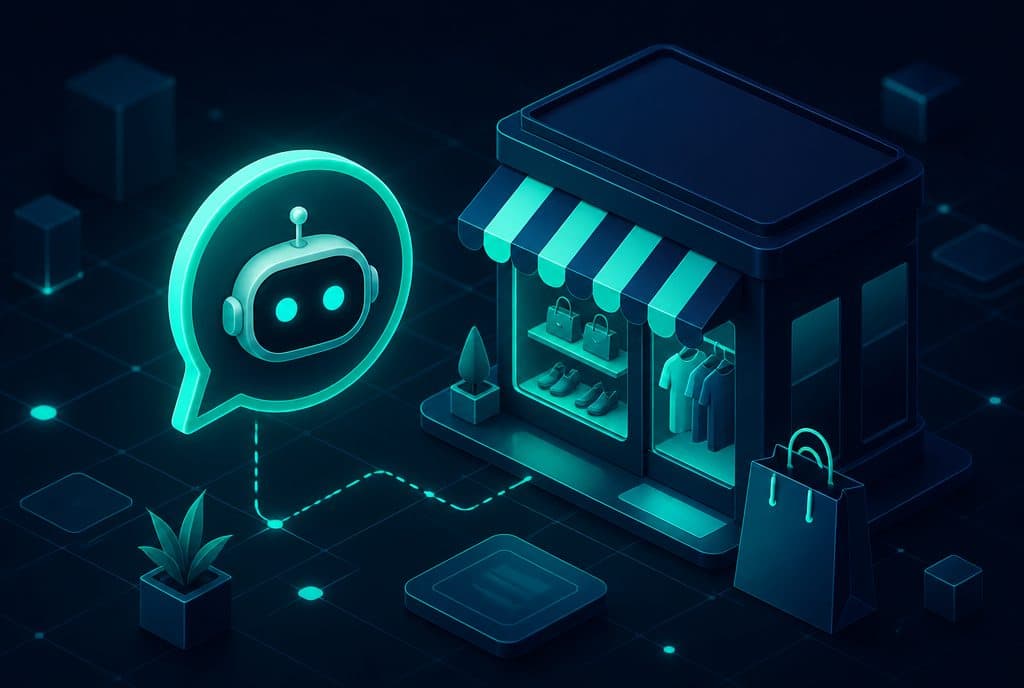
A retail store WhatsApp bot is an AI agent that automatically manages the most common inquiries: Is this model in stock? What is the price? What are the opening hours? Can I reserve it? How many loyalty points do I have? The bot responds in real-time from whichever channel the customer writes to on WhatsApp — 24/7, even when the store is closed — reducing the workload on the team during busy hours.
How does a WhatsApp bot help a retail store?
A retail store WhatsApp bot automatically answers inventory and price questions, allows customers to reserve items before arriving at the store, manages a loyalty program, and sends reminders about promotions and events — all without a human agent, 24/7. The result: fewer routine phone calls, fewer no-shows, and customers who arrive at the store more prepared and committed.
Why does a retail store need a different bot than an online store?
An online store answers the customer directly on the product page — the customer sees the price, stock, shipping time, and makes a purchase with a click. A physical store operates differently: the customer wants to know if it's worth leaving the house, if the item they wanted is available, and if they can guarantee they won't make the trip in vain.
The most common inquiries in a retail store are:
- "Do you have this shoe in size 42?"
- "How much does product X cost?"
- "What are the opening hours on Friday?"
- "Can you save this for me until 17:00?"
- "How many points do I have?"
Each of these questions is not a sale — it is friction that prevents the customer from arriving. A bot that removes this friction does a job that an e-commerce site cannot do: it warms up a customer who is physically close to the store and brings them closer to an actual visit.
What can a WhatsApp bot do in a retail store?
| Capability | What the Bot Does | What It Saves |
|---|---|---|
| Inventory Queries | Checks stock in real-time and replies "In stock / Out of stock / Available at branch X" | Routine phone calls |
| Price Queries | Returns the updated price including active promotions | Manual checks during rush hours |
| Opening Hours | Answers based on the day and even holidays — including exceptions and seasonal changes | No-shows and disappointments |
| Item Reservation | Reserves an item for the customer for a defined period and sends a reminder before expiration | "I arrived and it's gone" — a situation that loses a customer |
| Loyalty Program | Displays points balance, redemption terms, and allows requesting redemption | Repetitive loyalty questions at the cash register |
| Branch Routing | Identifies location and directs to the nearest branch with specific opening hours | Routing errors and disappointments |
| Promo Updates | Sends proactive messages about promotions to relevant customer segments | Advertising budgets on imprecise inquiries |
Real-World Scenarios
Clothing and Fashion Store
A customer writes on WhatsApp at 22:30: "Do you have the gray jacket I saw in your store in size M?" The bot checks the inventory system in real-time and replies: "Yes, we have 2 units in size M. Would you like me to reserve one for you until tomorrow at 18:00?" The customer says yes. The bot reserves the item and sends a reminder at 16:30 the next day. The store gets a committed customer who arrives with a clear purchase intent — not a customer who comes just to check.
Sports and Leisure Store
On a Friday morning, a time when the phone is ringing off the hook, the bot simultaneously manages dozens of questions: "What are the opening hours?", "Are there surfboards in stock?", "Is there a sale on running shoes?" — all with immediate responses. The store staff is free to assist the customers who actually arrived, not answer phone queries.
Electronics Retail Chain
A customer who bought a product three months ago writes: "How many points do I have and when do they expire?" The bot connects to the loyalty program and answers within seconds with the balance and expiration date. The bot adds: "By the way, you have enough points to get a discount on X products — want to hear more?" — this offer comes in context, not as spam.
Integration with Existing Store Systems
The bot does not work in isolation — it delivers real value only when connected to what already exists:
- Inventory System (ERP/POS) — Real-time availability checks, automatic updates when an item runs out.
- Loyalty System — Points queries, post-purchase updates, promotion activation.
- Reservation Calendar — Managing reserved items, reminders, automatic release upon expiration.
- n8n — The platform that connects all systems to the WhatsApp bot.
- WhatsApp Business API — The official version that allows proactive messaging (promotions, reminders) and not just replies.
These integrations are what differentiate a bot that merely "answers" from a bot that takes action. Without them, the bot replies "Check with us at the store" — which is not useful.
What is left for humans?
A proper setup of a retail bot distinguishes between what the bot handles and what is left for a human agent:
The bot handles: Inventory queries, prices, hours, reservations, loyalty, branch routing, sending catalogs, promotion reminders.
A human agent receives: Complaints about defective products, exceptional return requests that deviate from policy, professional consultation questions that require deep dialogue, high-value transactions where it is important for the customer to speak with a person.
The bot transfers the conversation to the agent with a full summary — what the customer asked, what was shown to them, what the issue is — so the agent does not start from scratch.
How to get started?
Step 1: Characterize Common Inquiries
Collect the last 30 questions that came in via phone, WhatsApp, and the service counter. Usually, 5-7 categories cover 80% of the inquiries. These are the bot's starting points.
Step 2: Map Existing Systems
Which systems manage inventory? Is there a loyalty program? Is it possible to query them in real-time? The more integrable the existing systems are, the more valuable the bot becomes.
Step 3: Define Transfer Rules
When does the bot hand over to an agent? What does it not answer? How long is an item reservation valid? These are the business decisions that need to be made before building.
Step 4: Build, Test, Expand
Start with a bot that answers FAQs without inventory integrations — verify that customers actually use it. Then connect inventory, and then reservations. A modular approach reduces risk and allows you to see results quickly.
Not sure where to start? At Automaziot AI, we perform an initial assessment — looking at the inquiries you receive and proposing a practical bot scenario. Contact us and let's build it together.
WhatsApp Bot for a Retail Store vs. an App
A question that often arises: "Why not build an app?"
There is one crucial difference: the customer's hands are already on WhatsApp. The average app is installed, opened once or twice, and forgotten. WhatsApp is opened dozens of times a day. A bot that lives in WhatsApp meets the customer in an environment they already know and use — without the friction of downloading, without usernames and passwords, without updates.
For a retail store selling to returning customers, WhatsApp is the natural channel. An app made sense when there was no alternative — today, an AI agent on the WhatsApp Business API provides the same capabilities without the compromises.
Privacy Protection Law — What You Need to Know
Any bot solution built for a store in Israel operates under the Israeli Privacy Protection Law. In practice, this means:
- You must state to the customer that they are interacting with an automated system (and not a human) when dealing with matters that require it.
- Customer data collected in the chat (name, phone number, queries) is stored solely for service purposes.
- The customer can request the deletion of their data.
We at Automaziot AI build every solution in compliance with Israeli legal requirements — including defining data collection permissions and clear retention policies.
How much does it cost?
| Component | Price (one-time setup, ex-VAT) |
|---|---|
| AI order-taking agent | ILS 7,500 |
| Payment link and checkout inside the chat | ILS 2,800 |
| Business knowledge base | ILS 3,000 |
| Automatic follow-up sequence | ILS 2,500 |
| WhatsApp Business API setup | ILS 700 |
A complete starting point — a WhatsApp AI agent including the business number, server and agent control room — is from ILS 10,200; an agent with a management system (CRM) from ILS 18,200, a multi-agent system from ILS 25,350. There is no monthly fee; third-party costs (server, messages, AI) of about ILS 100–500 a month are paid directly to the providers. The full component price list: pricing page.
Summary
A retail store WhatsApp bot is not a replacement for the physical shopping experience — it removes the friction that prevents customers from getting there. An inventory question answered in seconds at 22:00, a reservation that guarantees the item will be waiting, a loyalty reminder arriving at the right time — each of these is a small touchpoint that changes the customer's decision from "maybe tomorrow" to "I'm going now."
The investment focuses where it delivers value: stores that receive a high volume of questions, stores with diverse inventory that requires checking, and chains where routing to the correct branch is critical. If any of these cases sound familiar — it's time to map it out.
For more details on bots for stores and businesses with a physical presence: WhatsApp Agent Service. For integrated commerce solutions (physical + online): E-commerce Automation. For a comprehensive guide on automation in online stores: E-commerce Automation Guide.