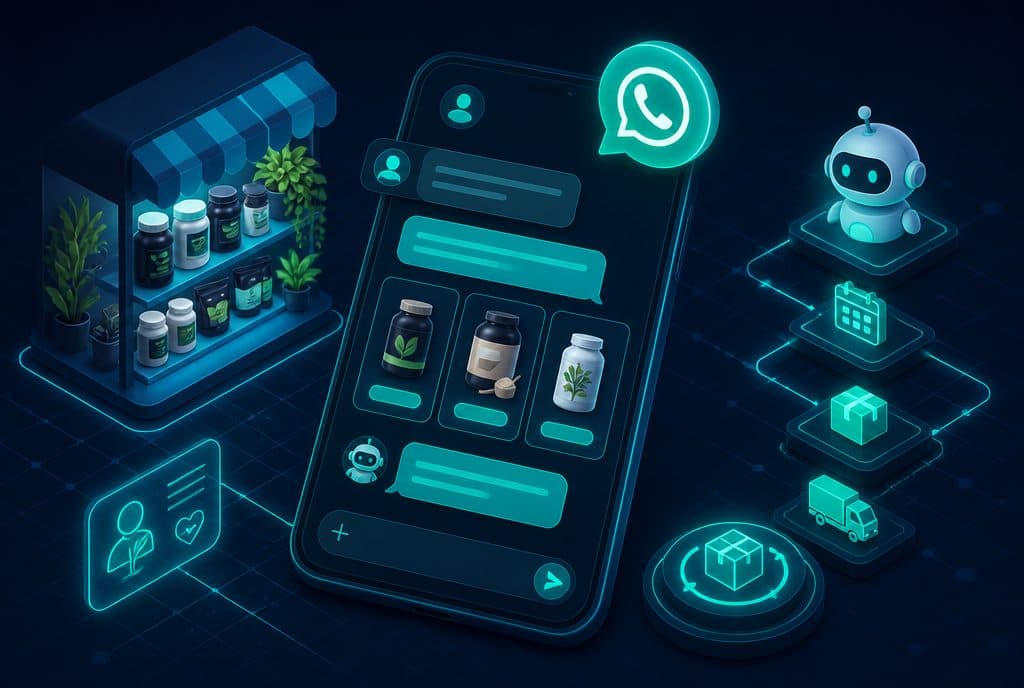

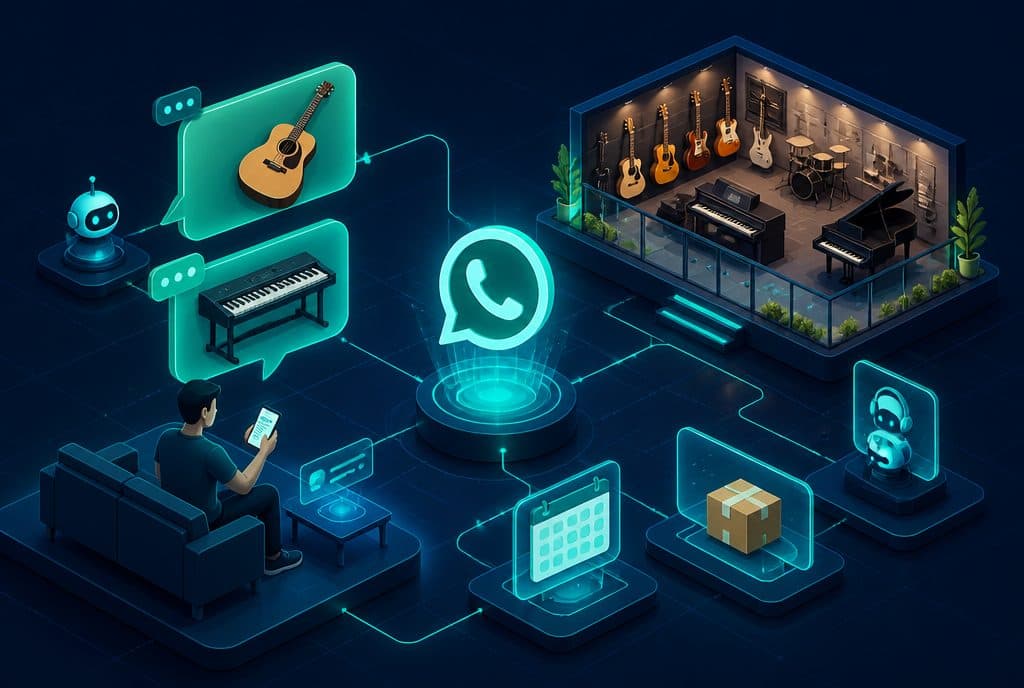
A WhatsApp bot for a musical instrument store is an automated response system that answers questions about inventory, price, and availability, recommends suitable instruments based on skill level and budget, receives repair requests, and refers customers to music lessons—all directly on WhatsApp, 24 hours a day, without a representative needing to manually answer every message. For a musical instrument store in Israel that receives dozens of inquiries a day via WhatsApp, proper automation reduces the workload on the team and improves the customer experience—even in the evening and on weekends.
How Automation Helps a Musical Instrument Store
A WhatsApp bot for a musical instrument store automatically handles inventory, pricing, and recommendation questions—which make up the majority of daily inquiries—leaving the team with only the inquiries that truly require a human: negotiations, in-depth consulting, and complex troubleshooting. The customer receives an immediate response at any hour; the team is freed up for work that generates value.
What Does a Musical Instrument Store Receive on WhatsApp?
Before planning automation, it is helpful to know what comes in. Most inquiries to a musical instrument store via WhatsApp fall into one of five categories:
- Inventory and Price Questions — "Do you have a Fender electric guitar under 3,000 NIS?", "How much does a digital piano for beginners cost?"
- Recommendation Requests — "I'm looking for a first instrument for my 9-year-old daughter, what is suitable?", "What is the difference between a classical and an acoustic guitar?"
- Repair Requests — "My guitar fell recently, can it be repaired?", "My bass isn't outputting sound from the right pickup"
- Teacher and Lesson Searches — "Do you have a piano teacher for a 7-year-old?", "Guitar lessons for adults?"
- Logistics and Shipping — "Do you ship to Haifa?", "What are the self-pickup hours?"
The bot can handle categories 1, 3, 4, and 5 in a fully automated manner. Category 2 (recommendation) can be partially automated: the bot asks filtering questions, presents suitable options, and transfers to a representative only when the customer still cannot decide.
What the Bot Can Do — By Scenario
| Scenario | What the Bot Does | What is Left for a Human |
|---|---|---|
| Price and availability question | Checks inventory in real-time, sends price and image | — |
| First instrument recommendation | Asks: age, budget, music style → presents 2-3 options | Answering if the customer continues to hesitate |
| Receiving a repair request | Collects: description of the issue, photo, contact details → opens a ticket for the technician | The technician approves and prices |
| Referral to lessons | Asks: instrument, age, level → sends teacher details + registration link | — |
| Shipping question | Answers based on region and policy | — |
| Complaint or complex request | Transfers to a representative with a full summary of the conversation | The representative handles with ready context |
How to Start — Three Steps
Step 1 — Characterizing Inquiries
Before building anything, collect the types of inquiries the store receives: What are the recurring questions? What are the recommendation rules? Which instruments are in highest demand? Is there a list of teachers? Is there a defined repair policy? This characterization takes an hour or two of collaborative work and generates the "knowledge" the bot will use.
Step 2 — Building the Bot and Connecting to WhatsApp
The bot is built on the WhatsApp Business API and connected to automation via n8n. The connection includes: a database of inventory (updatable), recommendation rules, lesson and teacher details, and a repair request intake process. In the initial stage, the bot answers the most common questions—and only later do you expand.
Step 3 — Testing, Launching, and Ongoing Updates
Before launching, test all scenarios with real conversations. After launching, perform ongoing monitoring: Where does the bot get "stuck"? Which questions are still falling to a representative that shouldn't have? Every lesson learned gradually improves the bot.
Three Detailed Scenarios
Scenario A — Customer Looking for a First Guitar
A customer writes on WhatsApp: "Looking for a first guitar for my 11-year-old son, budget 1,000 NIS."
The bot asks: "Is he more interested in pop/rock, classical, or doesn't know yet?" — Based on the answer, it presents 2-3 suitable options with images and prices. If the customer chooses, the bot sends payment and pickup details. If they hesitate—it transfers to a representative with all the context already gathered.
The representative receives: "Customer is looking for a guitar for an 11-year-old, budget 1,000 NIS, interested in pop/rock, still hasn't decided between Yamaha F310 and Fender CD60S."
Scenario B — Basic Repair Request
A customer writes: "My bass was damaged, can it be repaired?"
The bot answers: "Of course, we accept instruments for repair. To pass this on to our technician—could you send a photo of the damage and tell us exactly what the problem is?"
The customer sends a photo and description. The bot opens a ticket for the technician with: photo, damage description, name, and customer number. The technician gets back to the customer directly with a price estimate.
Scenario C — Referral to Lessons
A customer writes: "Looking for a piano teacher for my 8-year-old daughter."
The bot asks: "Is she a complete beginner or does she have some background?" — Based on the answer, it sends a list of suitable piano teachers with contact details and availability, and a link to register. If a teacher is fully booked, the bot suggests an alternative teacher.
Important Points for Musical Instrument Stores
Dynamic Inventory. A musical instrument store changes inventory frequently—instruments coming and going, prices changing, models running out. The bot needs to be connected to inventory in real-time (via integration with the sales system) and not work off a static list. This is the biggest technical investment—but also what generates the greatest value.
Privacy Protection Law. In Israel, the Privacy Protection Law applies to any business that collects customer details. The bot collects names, phone numbers, and photos (in repairs)—ensure this data is stored securely and not kept longer than necessary.
Hours and Immediate Response. Most inquiries to musical instrument stores arrive in the evening and on weekends—exactly when the store is closed. A bot that answers immediately at 10:00 PM and Friday afternoon can close deals that otherwise would have "cooled off" by Sunday.
The First Step — Characterization
The right way to start is not to "set up a bot"—but to map out the inquiries. One week of documentation: What is asked? How many times? What is the answer? The result is a clear list of what the bot will handle on day one—and what will be saved for the team.
Want to see how a WhatsApp bot fits your store? Send us a message and we will build an initial characterization together—what is automated, what is left for a human, and what the expected return is.
How much does it cost?
| Component | Price (one-time setup, ex-VAT) |
|---|---|
| AI order-taking agent | ILS 7,500 |
| Payment link and checkout inside the chat | ILS 2,800 |
| Business knowledge base | ILS 3,000 |
| Automatic follow-up sequence | ILS 2,500 |
| WhatsApp Business API setup | ILS 700 |
A complete starting point — a WhatsApp AI agent including the business number, server and agent control room — is from ILS 10,200; an agent with a management system (CRM) from ILS 18,200, a multi-agent system from ILS 25,350. There is no monthly fee; third-party costs (server, messages, AI) of about ILS 100–500 a month are paid directly to the providers. The full component price list: pricing page.