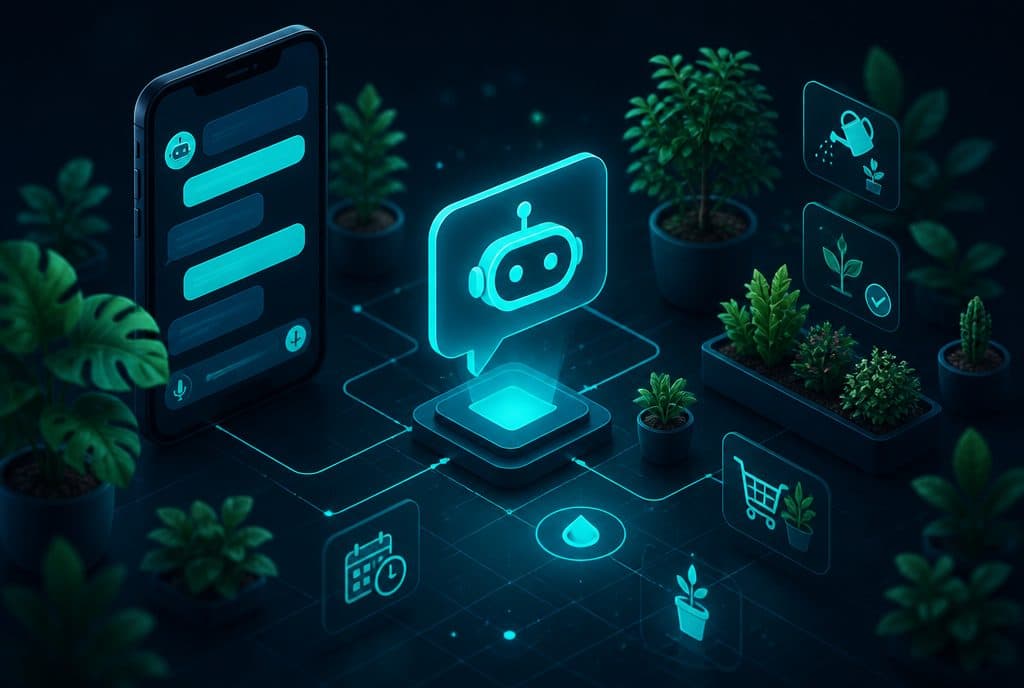
A WhatsApp bot for a nursery answers care questions, checks if the plant the customer is looking for is in stock, accepts orders for self-pickup or delivery, and sends seasonal reminders to customers — like "it's time to prune the hedge" or "now is the time to plant bulbs" — all automatically, 24/7, without the team having to handle each inquiry individually. For a nursery or plant shop that receives dozens of repetitive questions a day, this is the difference between keeping up with everyone and losing customers due to slow response times.
How Automation Helps a Nursery
Automation for a nursery is a system that handles three major bottlenecks without manual intervention: repetitive care questions (when to water? how much sun? what soil?), stock checks ("do you have a weeping fig?"), and coordinating orders and deliveries. The bot responds instantly on WhatsApp, at a time convenient for the customer, and routes to manual handling only those inquiries that truly require expertise — such as diagnosing complex diseases or large-scale landscaping advice.
Real Problems of Nursery Owners
Nursery owners and plant sellers know: inquiries don't only arrive during opening hours. A customer who remembered they need to fertilize at 21:00 on Friday night, or who found whitefly on their lemon tree on Saturday morning, won't wait until Sunday. They will send a message on WhatsApp — and if they don't get a response, they will turn to another shop.
In addition, the most common questions repeat themselves: "How many times a week should I water a cactus?", "What do I do when the leaves turn yellow?", "Do you have purple geraniums?", "How much is delivery to Ra'anana?". These are questions the team answers dozens of times a day, and which a trained bot can answer instantly — accurately, in Hebrew, without tiring anyone out.
What a WhatsApp Bot Can Do for a Nursery
| Scenario | What the Bot Does |
|---|---|
| Care question | Answers instantly based on a knowledge base built by the nursery: watering, fertilizing, light, soil |
| Stock check | Connected to the inventory system and answers whether the plant is in stock and in what size |
| Order for self-pickup | Receives the request, confirms availability, and schedules a pickup time |
| Order for delivery | Collects address and payment details, calculates delivery cost, and confirms |
| Seasonal reminder | Sends a proactive message to customers based on the Israeli gardening calendar |
| Plant recommendation | Recommends what fits based on the garden description (light, area, climate) |
| Disease diagnosis | Basic: asks about symptoms and guides; complex → routes to a human |
| Price and delivery questions | Answers regarding price lists and delivery zones |
Common Scenarios — How It Looks in Practice
Scenario 1: A customer looking for a specific plant
Customer sends: "Hi, do you have orange bougainvillea in a pot?"
The bot instantly checks the inventory and replies: "Hello! Yes, we have orange bougainvillea in a 25-liter pot. Would you like to pick it up or have it delivered to your address? The price is ₪89, delivery is extra depending on the area." The customer orders, the details are recorded automatically, and the team sees the order in the morning.
Scenario 2: A care question at an inconvenient hour
Customer sends at 22:30: "How many times a week should I water a Ficus Lyrata in winter?"
The bot: "Ficus Lyrata in winter — less watering than in summer. Check that the soil is dry between waterings, usually once every two weeks is enough. Important: avoid direct cold water, let it sit to reach room temperature. Do you have another question?"
Scenario 3: Proactive seasonal reminder
At the end of September, the bot sends to customers who purchased the previous year: "Hi! September is the perfect time to plant bulbs for spring — daffodil, tulip, sea onion. We have a great selection this week. Want to hear more?" — an outreach that drives customers to return on their own, without manual marketing effort.
Scenario 4: Availability check and delivery coordination
A large customer (a private gardener) asks about an order of 20 pots for a project. The bot collects the details, sends them to the team with a full summary, and replies: "We have received your inquiry. Someone from the team will get back to you in the next few hours to confirm the final price and delivery date."
How to Get Started — 4 Steps
1. Mapping FAQs — Gather the 20-30 most frequently asked questions: care, price, stock, delivery. This is the foundation of the bot's knowledge base.
2. Connecting to inventory — The bot connects to the existing management system (Haly, Priority, or a synchronized Excel sheet) to answer stock questions in real-time. If there is no system — start with a simple table that is updated manually.
3. Building conversation scenarios — Define the flow for each type of inquiry: what the bot answers, what it asks back, and when it hands over to a human. For a nursery: care questions — instant answer; ordering — collects details; complex diagnosis — transfers to an agronomist.
4. Gardening calendar — Pre-define seasonal reminders: what to send, when, and to whom (based on what they purchased). The bot sends them automatically at the right time. With /en/blog/2025-03-n8n-complete-guide you can build this entire flow in an organized and measurable way.
What Should Be Kept for a Human
A bot does not replace expertise — it filters and routes. These are the inquiries that remain for a human:
- Disease diagnosis that requires photos and expertise (sent to an agronomist)
- Consulting for an entire garden (generates a lead for a consultation call)
- Complaints about a purchased product (customer service handling)
- Large B2B orders (handed over to a sales representative)
The goal: the team arrives in the morning and receives a list of inquiries that actually need them — not dozens of "how much to water" questions.
Connection to Relevant Services
A [/en/services/whatsapp-agent](WhatsApp bot for business) is the foundation — where the conversation infrastructure, WhatsApp Business API connection, and chat management are built. For a nursery that also sells online, [/en/services/ecommerce](e-commerce automation) adds a layer of order management and shopping cart integration. For any inquiry that comes from the bot and continues to a sales process, [/en/services/lead-management](automated lead management) ensures that no lead is lost — documenting, nurturing, and sending follow-ups at the right time.
For further reading on automation for Israeli retail businesses: [/en/blog/2026-06-whatsapp-bot-retail-stores](WhatsApp bot for retail stores).
FAQ
Can the bot understand what a customer wants even if they phrase it in a non-standard way? Yes. An AI language model-based bot understands intent, not just keywords. "Do you have something good for a shady garden that also blooms?" is a legitimate question that the bot can analyze and make recommendations based on.
What happens if the bot doesn't know how to answer? The bot admits it doesn't know and immediately transfers to a human representative with a summary of the inquiry, without the customer feeling abandoned.
Can the bot send photos of plants? Yes — the bot can send photos from a pre-defined database, such as photos of the plant before purchase.
How much does it cost?
| Component | Price (one-time setup, ex-VAT) |
|---|---|
| AI order-taking agent | ILS 7,500 |
| Payment link and checkout inside the chat | ILS 2,800 |
| Business knowledge base | ILS 3,000 |
| Automatic follow-up sequence | ILS 2,500 |
| WhatsApp Business API setup | ILS 700 |
A complete starting point — a WhatsApp AI agent including the business number, server and agent control room — is from ILS 10,200; an agent with a management system (CRM) from ILS 18,200, a multi-agent system from ILS 25,350. There is no monthly fee; third-party costs (server, messages, AI) of about ILS 100–500 a month are paid directly to the providers. The full component price list: pricing page.
Summary
A nursery and plant shop have a natural inquiry structure for automation: repetitive questions, stock checks, and defined seasonal timing. A WhatsApp bot trained on the nursery's specific knowledge — plants, climate, care tips — can handle a large portion of daily inquiries, freeing up the team for real consulting and preventing customer loss during hours when there is no response. Our recommendation: start with one clear scenario — for example, care questions and stock checks — prove that it works, and then expand.
Want to understand how such a bot would look for your nursery? Talk to us on WhatsApp — we will map out the scenarios together and tell you what fits your business size.