
RPA (Robotic Process Automation) is a technology that mimics repetitive manual actions a human performs on a computer — clicks, copying data, filling out forms — to execute them automatically and quickly. An AI agent, on the other hand, understands natural language, makes decisions, and handles situations that were not predefined. At Automaziot AI we work with both approaches, and in this guide, we will explain to Israeli businesses when each of them is the right choice.
The word "automation" today covers a variety of technologies that are very different from one another. A business looking to save time on a manual process that requires multiple clicks between systems, and a business looking to answer customer inquiries on WhatsApp — are talking about completely different problems and completely different solutions. The confusion between RPA and an AI agent often leads to purchasing the wrong tool, resulting in disappointing outcomes.
What is RPA?
RPA (Robotic Process Automation) is software that mimics repetitive manual actions a human performs on a graphical interface: clicking buttons, reading fields from a screen, copying data from system to system, and saving files — all according to a fixed, predefined sequence of steps. The "robot" acts exactly like a human hand on the keyboard and mouse, but with speed and without fatigue.
Why does RPA even exist?
Not every business system has an open API. Legacy systems, government software, websites that have not exposed a programming interface — all can be automated through RPA because the robot sees the screen exactly like a human and knows how to act on it. This is the main advantage: RPA works even when there is no other option.
The classic example: an employee who extracts a report from management software every morning, copies data to Excel, and then uploads the Excel to a separate reporting platform. These three steps — each of which repeats in exactly the same way — can be fully automated using RPA.
What is an AI Agent?
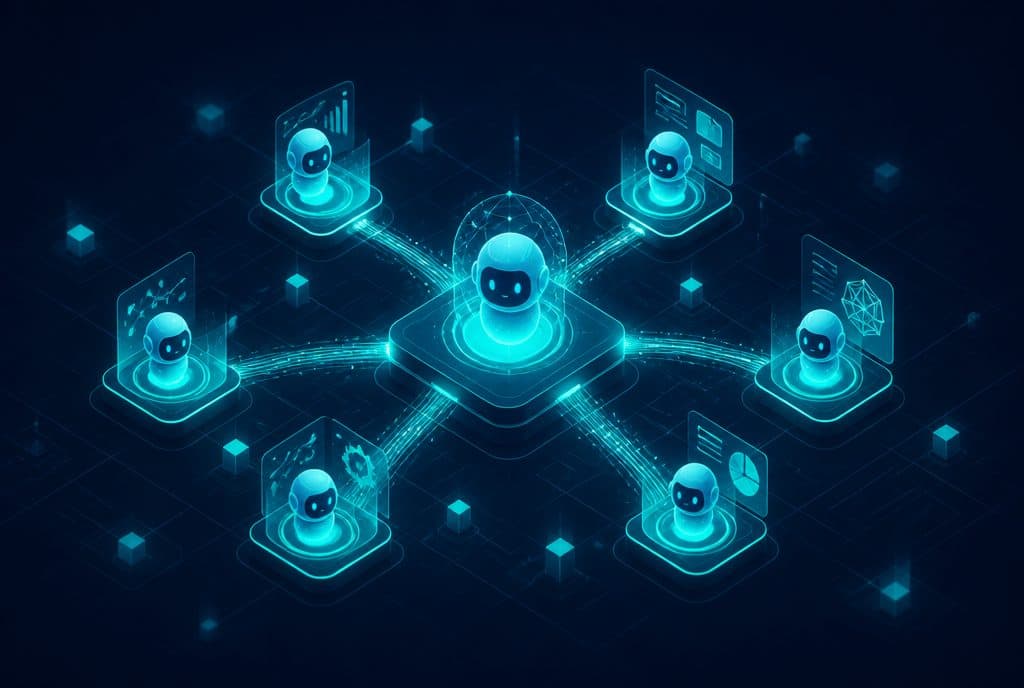
An AI agent is a system that uses a Large Language Model (LLM) to understand natural language, remember context, make decisions, and perform actions by connecting to the business's systems. The agent does not operate according to a rigid sequence of steps — it understands what the customer or the process needs, and decides accordingly.
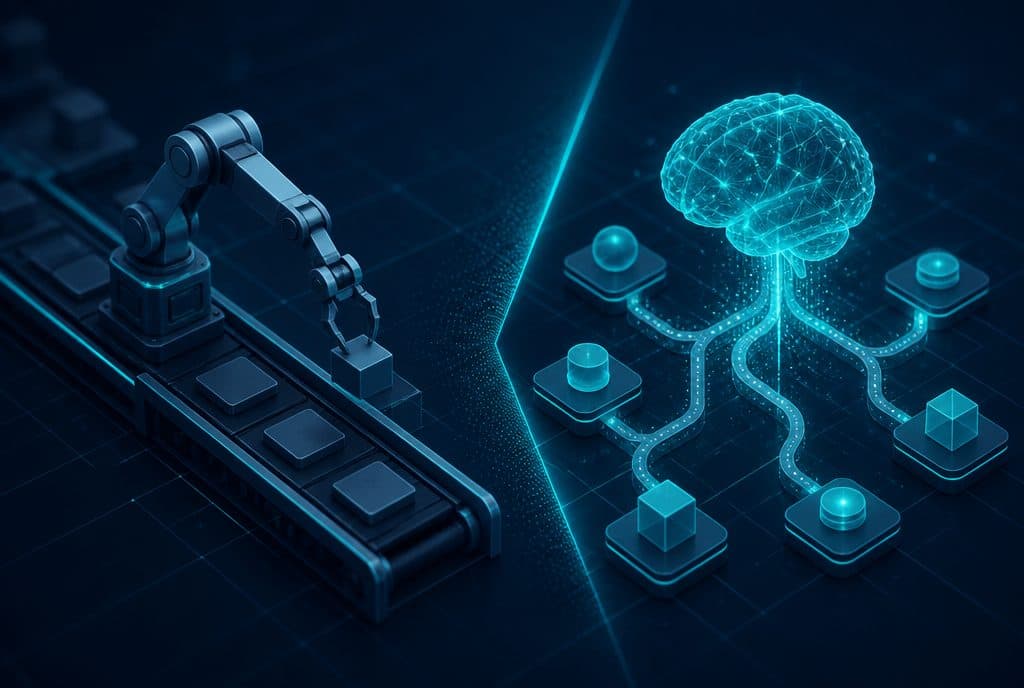
The fundamental difference: RPA does not understand anything — it executes. An AI agent understands — and then executes.
Full details in the guide: What is an AI Agent for Business? The Complete Guide.
RPA vs. AI Agent — Comparison
| RPA | AI Agent | |
|---|---|---|
| How it operates | Mimics manual actions on a graphical interface | Understands natural language and makes decisions |
| Flexibility | Operates exactly as programmed — a small change on the screen = malfunction | Handles exceptions and unexpected situations |
| Natural Language | No — only structured data | Yes — Hebrew, Arabic, English |
| Context Memory | None | Remembers the entire conversation and its context |
| System Connection | Works with graphical interfaces (even without API) | Mainly through APIs and defined integrations |
| What happens on exception | Gets stuck or sends an error | Handles it, asks for clarification, or hands over to a human |
| Best suited for | Structured and stable processes, interfaces without API | Customer inquiries, decisions, processes with variations |
When is Each One Suitable?
When RPA is the Right Choice
Choose RPA when:
- The process repeats in exactly the same way every time — no judgment, no exceptions
- There is no API available for the system that needs to be accessed (government software, legacy systems)
- The data is structured and uniform: numbers, dates, clear fields
- The system's user interface is stable and does not change frequently
Business Examples:
- Extracting data from a government form and saving it to an Excel sheet
- Sending a fixed daily report built from multiple sources
- Entering orders from an e-commerce site into an inventory management system that has no API
- Checking bank account balances and creating a daily backup file
When an AI Agent is the Right Choice
Choose an AI agent when:
- There is natural language involved in the process — customer inquiries, WhatsApp messages, emails
- The process includes a variety of situations that cannot all be anticipated in advance
- A decision needs to be made based on context ("Is this lead qualified? Should we schedule a meeting now?")
- The customer is supposed to experience a natural conversation, not a menu
Business Examples:
- A WhatsApp agent that answers customer inquiries, filters leads, and schedules meetings — see Smart Agent for WhatsApp
- Automated lead management: receiving an inquiry, initial evaluation, sending information, and registering in the CRM — see Automated Lead Management
- Processing documents that arrive in different formats (invoices, forms) with content interpretation
- Answering frequently asked questions from customers with the ability to escalate unusual cases to a human representative
What Happens When You Combine Them?
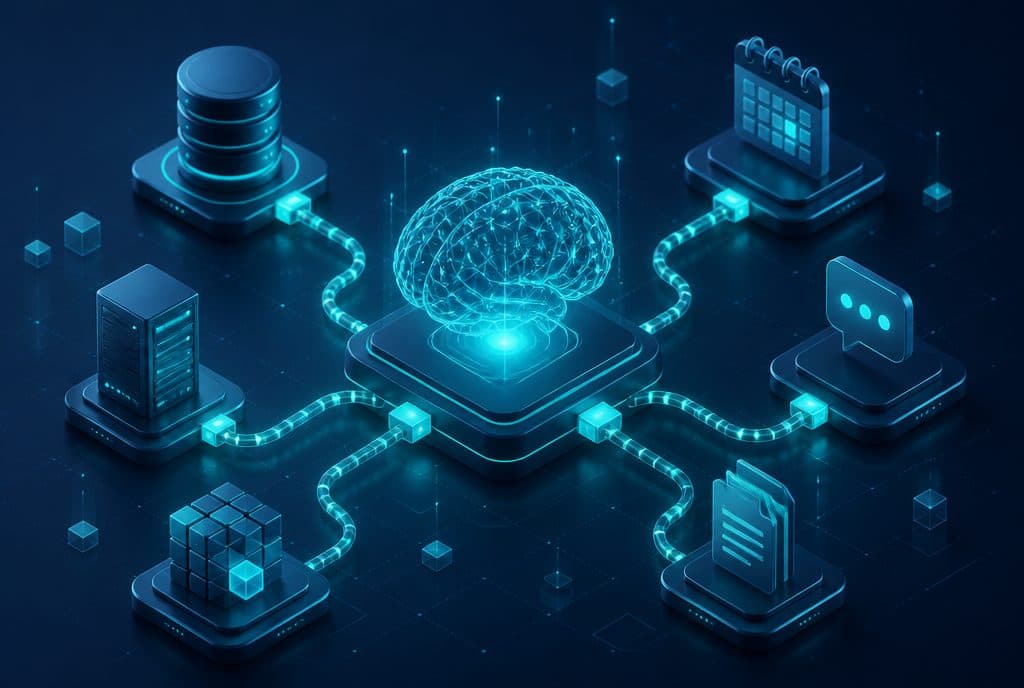
Quite a few complex business processes are multi-staged: there is a part that is completely mechanical (suitable for RPA), and there is a part that requires understanding and judgment (suitable for an AI agent). In practice, modern businesses combine integration tools like n8n with AI agents — n8n connects systems and manages processes, while the agent makes the decisions that require understanding.
What about n8n — Is it RPA?
Not exactly. n8n is an integration and workflow automation tool that works primarily through defined APIs, not by mimicking a graphical interface. It is suitable for connecting systems that already expose an API — CRM, email, calendar, WhatsApp Business — and creating processes that flow data between them. At Automaziot AI, we use n8n as the foundation for most of our automation projects, adding an AI agent layer on top when needed.
What is Right for a Small to Medium Israeli Business?
In practice, most small to medium-sized businesses in Israel that meet with us do not need classic RPA. The reason: most of the tools they already use — CRM system, calendar, WhatsApp Business, e-commerce platform — expose APIs. Integration through n8n, in most cases, is faster and more efficient than an RPA project.
Questions to ask before choosing:
- Does the system I want to streamline have an API? If yes — n8n and direct integration are preferable.
- Does the process include decisions, natural language, or exceptions? If yes — an AI agent is the tool.
- Is it a completely mechanical process, with an old graphical interface and no API? If yes — RPA is relevant.
Want to understand what fits your specific process? Talk to us and we will map out the right solution together — without pushing technology that doesn't fit.
Summary
RPA and AI agents solve different problems: RPA replaces mechanical and repetitive manual actions on graphical interfaces; an AI agent replaces judgment, conversation management, and handling changing situations. For small to medium Israeli businesses, the right starting point is a simple question: Is the process I want to streamline completely mechanical — or does it involve language, decisions, and customers? The answer points to the right tool.
If you are still not sure, we at Automaziot AI are happy to assist in mapping: which process fits which approach, and what the expected ROI is in each case.