
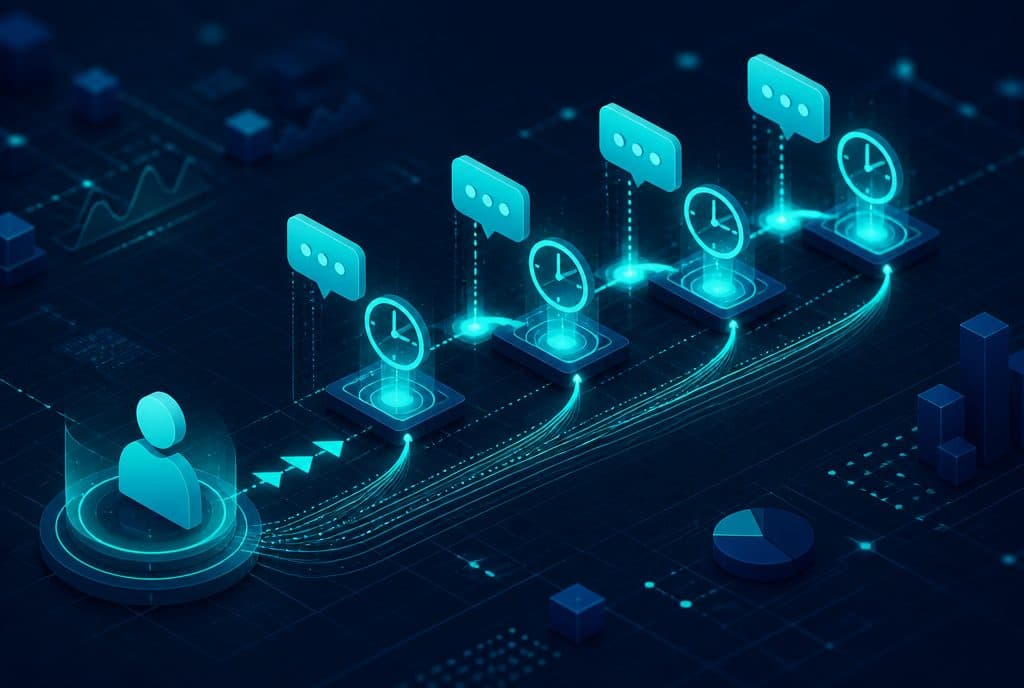
Follow-up automation sends a message, reminder, or quote to a lead at exactly the right moment — without anyone on the team having to remember to do it. Leads that came in and didn't receive a timely response, quotes that were sent and received no reply, forgotten appointments — all of these are solved with automated follow-ups. At Automaziot AI, we build follow-up systems connected to your CRM, WhatsApp, and every relevant business channel, triggering the right sequence based on what actually happens in real life.
What is Follow-Up Automation?
Follow-up automation is the proactive sending of a message — WhatsApp, SMS, email — triggered automatically in response to a specific event: a lead that came in and wasn't answered, a sent quote, a completed visit, or an expiring payment. The system checks the status, decides when to send, and what to write — without human intervention at every step.
Why Leads Vanish — and Where the Leak Occurs
Small and medium-sized businesses lose deals not because their offer is bad, but because communication falls between the cracks. The person supposed to "chase" the quote forgot, is overloaded, or simply isn't sure when to reach out again. The lead, on the other hand — reached out, received an offer, and when they heard nothing back, assumed the business wasn't interested (or found one that did reply).
The most common points where leads vanish:
- After sending a quote — Haven't heard from you in 48 hours? They are already with the competitor.
- After visiting a gallery, studio, or clinic — A "we'll get back to you" said face-to-face that never got a follow-up.
- After filling out a lead form — A lead coming from Facebook or Google that enters an Excel sheet no one checks.
- After booking an appointment — A client who booked but received no confirmation and reminder, and didn't show up.
- After a subscription ends — An expired subscription that wasn't reminded — and went looking for an alternative.
Each of these points is where follow-up automation converts a "maybe" into a "yes".
Examples of Automated Follow-Ups in Israeli Businesses
| Scenario | Trigger Event | Automated Message | Timing |
|---|---|---|---|
| Plumbing Quote | Quote sent, no response | WhatsApp: "Hi [Name], we sent a quote yesterday — any questions?" | 24 hours after |
| Showroom Visit | Visit logged in CRM | SMS: "Thanks for visiting! Do you have any more questions before deciding?" | 2 hours after |
| Clinic Appointment Booking | Appointment booked in system | WhatsApp: "Tomorrow at 10:00 — confirm?" + reminder on the day of the event | 24 hours before |
| Unclosed Proposal | 5 days without response | Email: "Still here to help — do you have any questions?" | 5 days after |
| Monthly Subscription | Charge failed | WhatsApp: "There was an issue with the payment, to avoid service interruption..." | Immediately after failure |
| After Closing a Deal | Deal closed | WhatsApp: "How are we progressing? Glad to update!" | 7 days after |
How Automated Follow-Up Works Behind the Scenes
It usually consists of 3 components working together:
1. Trigger — What starts the sequence An event in the system: a new lead, a sent quote, a booked appointment, a status change in the CRM. The trigger doesn't have to be manual — it is predefined and activated the moment the condition is met.
2. Logic — What happens at each step The system checks: Did the customer reply? Was the deal closed? If yes — stop the sequence. If no — proceed to the next step. This ensures you don't send a follow-up to someone who has already responded.
3. Execution — Message in the right channel WhatsApp is the channel that works best for Israeli businesses — high open rates, reaches the mobile directly, feels human. SMS is a good backup. Email is suitable for more formal processes (invoices, complex quotes).
The automation platform we primarily work with is n8n — allowing us to build complex follow-up sequences with full logic, without writing explicit code.
What's the Difference Between Good Follow-Up and Spam?
Everyone has received a chain of messages that made them block the sender. Automated follow-up done right does not look like that. The distinguishing principles:
- Limited number — 2-3 messages in a series, not 10.
- Sensible timing — A day after a quote, not an hour after. A week after, not again the next morning.
- Human language — "Do you have any questions?" not "!!!SPECIAL OPPORTUNITY FOR THE FAST-ACTING!!!"
- Stop on reply — The moment the customer replies — positively or negatively — the sequence stops.
- Opt-out option — Always. It is both basic courtesy and complies with the Israeli Privacy Protection Law.
How to Start — A Practical First Step
Don't start with the system. Start with the question: Where are our leads vanishing?
In 80% of cases, the answer points to one of these areas:
- Unclosed quotes
- Online leads that didn't receive a fast enough response
- Customers who booked an appointment and didn't show up
Once you have a clear answer — that's where you start. Build one simple follow-up, measure it, and then expand.
Initial scoping to do before talking to any provider:
- Write down 3 stages in your sales process where leads drop off.
- Check how many days on average pass between sending a quote and closing — and what happens in between.
- Check if your CRM (or spreadsheet) is documented enough to know who has already replied and who hasn't.
With these answers, scoping the follow-up system takes an hour — not a week.
Integration with Lead Management and Sales
Automated follow-up doesn't work in a vacuum. It is part of a complete lead management system — from the moment the lead enters, through qualification, to closing the deal. The better documented and connected your CRM is, the smarter the automated follow-up: it knows who already replied, who asked to wait a week, and who didn't open the quote at all.
In Automated Sales and Customer Service, we build the full sequence: from the moment the lead enters until the deal is closed — including follow-ups, scheduling meetings, and status updates.
See also: Automated Lead Management — The Complete Guide
Summary
Automated follow-up is one of the most targeted improvements a business can make — it doesn't require changing the entire process, just closing the gaps where money currently falls through the cracks. Leads that don't close because no one "chased" them at the right time is a solvable problem, not a twist of fate.
Want to build a follow-up sequence tailored to your sales process? Talk to us — we will map out where your leads are vanishing and suggest what to build first.