
Claude Code is an AI agent that specializes in writing and running code autonomously. For a business owner looking for custom automation—connecting systems, a repetitive process that cannot be solved with a standard platform—this means a complete solution can be built faster, with fewer human development hours. It is not a tool that completely replaces the technical team, but rather a tool that enables building things that, until two years ago, would have required a much larger development budget. At Automaziot AI, we integrate this technology into business automation and AI agents projects to deliver tailored solutions to clients within realistic timelines.
Over the past year, tools called "code agents" have entered the market—AI agents that do not just suggest code but write it, run it, observe the results, and fix errors. Anthropic's Claude Code is one of the most prominent in this category. This article explains what it actually is, how it differs from other AI tools you might know, and when this approach helps an Israeli business that wants automation tailored to its needs—rather than a generic template.
What is Claude Code?
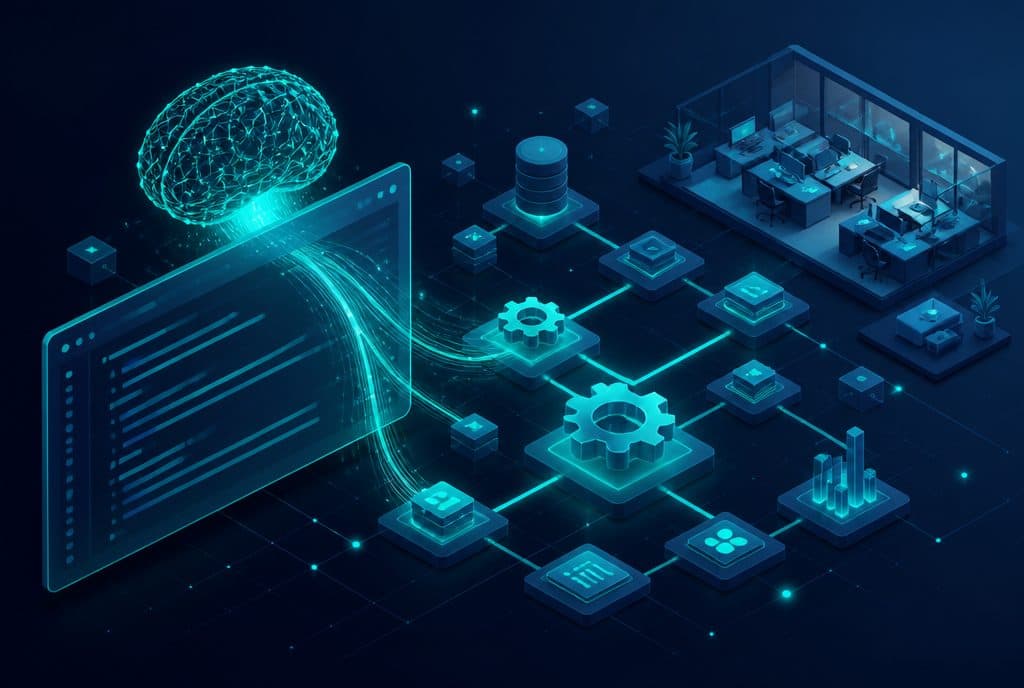
Claude Code is an AI agent designed for the development environment: it reads files, writes code, runs commands and tests, and fixes errors—all autonomously, inside a real project. Unlike chat interfaces that provide text answers, Claude Code operates directly on the project and makes actual changes.
This distinction is important. When someone asks "ChatGPT, write me a Python script to import a lead from Google Sheets to the CRM," they receive text with code that someone needs to take, add, run, see what is broken, and fix. Claude Code, on the other hand, operates within the environment itself: it opens the project, writes the code, runs it, identifies that the API connection failed because a field is missing, fixes it—and reports when everything is working. This loop of "write → run → fix" happens without a human developer needing to sit through every step.
Why is this relevant for a business looking for automation?
Most Israeli business owners who contact us are not looking for software development—they are looking for a solution to a problem: "Every lead that comes in from Facebook needs to enter the CRM and receive a WhatsApp message within a minute. Right now, this is done manually." Or: "We have an old order management system that does not interface with the new website. Data is copied manually every day."
These solutions require custom code. Visual automation platforms like n8n handle a large portion of cases—and at Automaziot AI, we build on them in every project where they are suitable. But there are cases where the logic is too complex, the third-party API is non-standard, or the data requires processing that cannot be built in a visual interface. That is where custom development comes in. And that is where AI code agents like Claude Code significantly shorten the path.
The idea is not that the computer "understands your business" and solves everything on its own. The idea is that a human developer working with such tools can build, test, and improve a solution faster—because a large part of the repetitive work (writing API connection code, handling errors, writing tests) is handled by the agent.
What is the difference between Claude Code and other tools?
| Chat Tools (ChatGPT, Claude.ai) | Claude Code | |
|---|---|---|
| Where it operates | In the browser, in a conversational interface | Inside the project, on the files themselves |
| What it outputs | Code suggestion as text | Code that is actually written and executed |
| Who runs it | The developer, manually | The agent, in an autonomous loop |
| When is it useful | Explanations, design, content writing | Technical building, integrations, automations |
| Suitability for SMBs | High for content and marketing | High for technical projects |
It is important to note: Claude Code is a tool for a technical team—not an interface that a business owner opens directly. What it changes is the ability of the team working on your behalf to build more complex solutions, in less time.
How does it work in a real project?
Suppose a business wants every lead coming from a website form to receive full processing: information is saved in the CRM, a follow-up call is scheduled in the calendar, and an automatic WhatsApp message is sent with details relevant to the lead type. All of this within two minutes of submitting the form.
In the traditional approach: a developer designs the architecture, writes connections to each system's API, handles all edge cases (what if the CRM is unavailable? what if the phone number is invalid?), writes tests, and debugs. A process that takes days to weeks.
In the approach with a code agent: the agent receives the specification, writes the initial code, runs it, identifies that the CRM API returns a 401 error due to an incorrect Auth configuration, fixes it, runs it again, adds error handling, and adds logs. The human developer supervises, makes business decisions (what do we do when a lead does not enter?), and approves each step. The result: the same work, fewer manual hours.
It is not "the AI does everything"—it is a collaboration where the agent takes on the repetitive work, and the developer focuses on decisions that require human judgment.
When is this approach right for your business?
Not every automation needs custom development, and it is important to understand when a visual platform like n8n is sufficient and when you need more.
A visual platform (n8n and similar) is sufficient when:
- The systems you want to connect support ready-made integrations
- The logic is relatively linear and simple
- The volume is relatively low and there are no strict performance requirements
- You want to reach an initial result very quickly
Custom development (where AI code agents contribute the most) is required when:
- One of the systems is not supported and requires manual API integration
- The logic is complex: filtering, calculations, edge-case control
- Compliance with Israeli privacy protection laws is required with control over data location
- Data arrives in different formats from various sources and requires normalization
- There is a need for automated testing and monitoring of process health
In our projects, the combination is usually the most effective: n8n for scheduling and flow logic, custom code for everything the platform does not cover, and AI agents for parts that require natural language understanding.
What does this mean for you as a business owner?
Three practical things:
1. Access to solutions that were previously too expensive. When development costs decrease—because a large part of the work shifts to the agent—projects that were previously not economically viable become possible. Connecting an old system to a new one, integrating with a unique API, or a process you want to streamline but is "not standard enough" for a generic platform.
2. Realistic timelines. "We'll get back to you in three months when we finish the backlog" is a common answer from overloaded IT teams. An integration project that took a month with a traditional approach can take two weeks with an approach that integrates code agents. This is not magic—it is realistic efficiency.
3. Less dependence on manual decisions. Automation built correctly—with error handling, logs, and testing—operates without anyone needing to "remember" to run it, check if it is running, or fix it manually when something goes wrong.
Limitations to keep in mind
An honest approach also requires transparency about what does not work:
AI code agents, including Claude Code, do not understand your business—they understand code. The specification, the business decisions, the definitions of "what is the edge case"—all of these still require a person who knows the project. The agent is a tool in the hands of the team, not a replacement for them.
In addition, code written quickly needs review. Part of what an experienced human developer brings is judgment regarding security, long-term structure, and what will happen as the system scales. Code agents do not always address this unless explicitly told to do so. Therefore, the combination—an agent + a senior developer supervising—is the correct model.
Summary
Claude Code and its peers represent a shift in the tools available to teams building automations. Not a revolution that replaces people, but an upgrade that allows people to build more, faster. For an Israeli business owner, the practical meaning is that projects that were out of reach—because they were too expensive or took too much time—become possible.
If you have a repetitive process, a missing connection between systems, or an automation you knew you wanted but did not know where to start—our automation service and our agent projects are built exactly for this. We start with a brief discovery phase to understand the actual problem, and deliver a solution that works.
Want to understand if your project is suitable? Contact us and we will tell you what is realistic and what is not—free of charge.