

AI consulting and implementation for businesses is a structured process that begins with process diagnostics, continues with quick wins, and ends with a realistic, long-term roadmap. For small and medium-sized businesses in Israel — whether a service provider, store, clinic, or professional office — the question is not "whether AI," but "which AI, in which process, and in what order." At Automaziot AI, we guide businesses through this exact process.
What is AI Implementation Consulting?
AI implementation consulting is a service where an expert maps out existing business processes, identifies where artificial intelligence and automation can save time and costs, and defines a clear roadmap — which tools to use, in what order, and what results to expect. The goal is not to sell technology, but to ensure that what is implemented solves a real business problem and yields measurable results.
Unlike buying off-the-shelf software, professional implementation begins with the question: "What is causing you to lose time, money, or customers?" and only then looks for a solution.
Why Now? The Opportunity for Israeli Businesses
In 2026, AI tools are more accessible than ever — in terms of cost, simplicity, and Hebrew language support. Automation platforms like n8n allow you to connect systems without writing code. Large Language Models (LLMs) conduct conversations in natural Hebrew. AI agents are already answering inquiries, filtering leads, and updating CRMs — without a human representative having to touch them.
Businesses that adopt AI correctly today build a real competitive advantage: faster response times to leads, fewer errors in repetitive processes, and freeing up the team to do what humans do best — build relationships, sell, and solve complex problems.
But there is another side: a market flooded with promises. Tools sold as "revolutionary AI solutions" that do not fit a small business. Integrations sold easily that do not work with existing systems. Proper consulting protects you from this path.
The Right Process: From Diagnostics to Roadmap
Step 1 — Process Diagnostics
Before anything else, we understand what is happening today. This means listing — usually in a single one-hour conversation — the repetitive processes in the business:
- What happens when a new lead arrives? Who handles it? How much time passes before a response?
- Which customer questions keep coming up repeatedly?
- How much time is allocated to administrative work — scheduling meetings, following up on proposals, sending reminders?
- Where do manual errors occur — typing, transferring information between systems?
A good diagnosis yields a prioritized list: Which process has the highest volume? Where is the most money falling through the cracks? This is where you find the right starting points.
Step 2 — Quick Wins
A quick win is a solution that can be set up within a week or two and proves value immediately. Examples:
- Automated WhatsApp responses — An AI agent that answers common questions, collects contact details, and logs them into the CRM.
- Initial lead management — Automation that receives a lead from any channel, sends an initial response, and flags it for handling.
- Meeting reminders — Automated scheduling and booking that reduces no-shows.
The quick win serves two purposes: it proves that the technology works in your specific context, and it justifies moving forward.
Step 3 — The Roadmap
After the first quick win is working, we build a three-to-six-month roadmap: which additional processes to streamline, in what order, and which tools to add. A good roadmap takes into account the budget, internal capabilities, and the growth rate of the business — rather than trying to optimize everything at once.
What to Streamline First?
A simple rule of thumb: start with processes that have three characteristics:
- High volume — Occurs frequently (daily, weekly)
- Clear rules — Has a consistent logic that can be described
- High cost of non-execution — A lead that doesn't get a response, a reminder that wasn't sent, a document that isn't processed
For most small and medium-sized businesses in Israel, the correct order is:
- First: Response and Communication — Incoming inquiries, leads, repetitive questions
- Second: Data Management — CRM, data entry, tracking
- Third: Coordination and Logistics — Meetings, appointments, bookings
- Fourth: Reporting and Follow-up — Sending updates, reminders, follow-ups
Common Mistakes — When Not to Buy AI
"Because everyone else is doing it"
Market pressure is a terrible reason to adopt technology. If a process works well manually and has no measurable problem, there is no reason to automate it.
"Because the tool looked cool in the demo"
A demo always looks good. The question is how it works with the systems you already have — your CRM, WhatsApp, order management system. Poor integration negates the entire benefit.
"We will implement everything at once"
Trying to optimize ten processes simultaneously ends in an endless project, with an exhausted team and people going back to manual work because the automation "doesn't work." Modularity comes before ambition.
"We hired someone to build it for us — and now we are dependent on them"
Automation you cannot maintain or change is an asset that becomes a liability. Good consulting ensures your team understands what was built and that the system can be managed in-house — even without writing code.
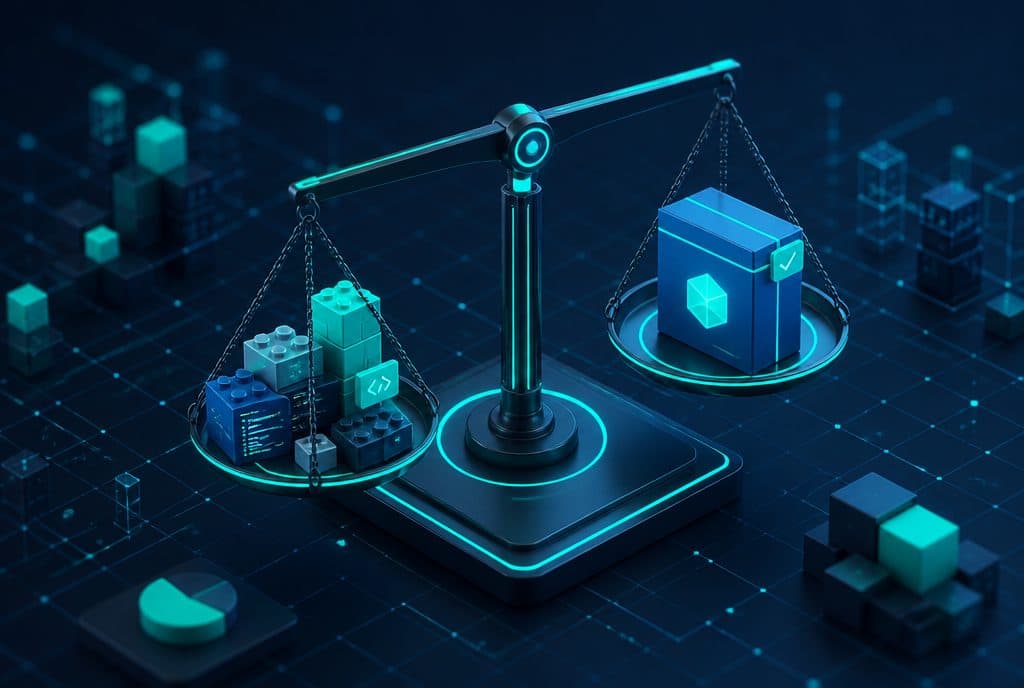
DIY vs. Implementation Partner
The "Build vs. Buy" question in the context of AI for small businesses touches on two dimensions:
Time: Building automation on your own, without experience, takes a lot of time — and meanwhile, the business stops doing what it does best. An implementation partner shortens the path and prevents common mistakes.
Knowledge: Knowing what to optimize and how to connect the right systems is experience gained from working with dozens of businesses, not knowledge acquired by watching YouTube.
Long-term cost: Poorly built automation has to be rebuilt. An experienced implementation partner does it right the first time.
However, not every business needs full guidance. Businesses with internal technical capabilities can start with focused consulting — diagnostics + roadmap — and handle some of the building themselves. This flexibility is part of what our consulting service offers.
What if You Are a Business Providing AI Services to Others?
A rapidly developing new field is businesses that lecture, consult, or teach AI — and are themselves looking for an implementation partner to enable them to provide high-quality service to their own clients. If you are a consultant, coach, or company offering AI solutions — a consultation call will allow us to see if there is a basis for collaboration.
How to Get Started?
Just one step: a diagnostic call. No presentation, no blind quote — a 30-45 minute conversation where we will ask you about your processes, identify where the biggest pain point is, and decide together if there is a fit and what the right next step is. If not — we will tell you honestly.
Want to know where to start in your business? Schedule a diagnostic call — free of charge, no obligation. Let's build a practical direction together.
Summary
AI implementation consulting is not a luxury for large corporations — it is a practical tool for small and medium-sized businesses that want to save time, reduce manual errors, and respond to leads faster. The right process starts with honest diagnostics, continues with a quick win that proves value, and builds a realistic roadmap — not theory.
The important thing to remember: AI does not replace business judgment. It replaces the repetitive work that prevents you from exercising it. Start there — and let the results speak for themselves.
Further reading: What is an AI Agent for Business? The Complete Guide — The difference between an AI agent and a chatbot, and how it actually works.