
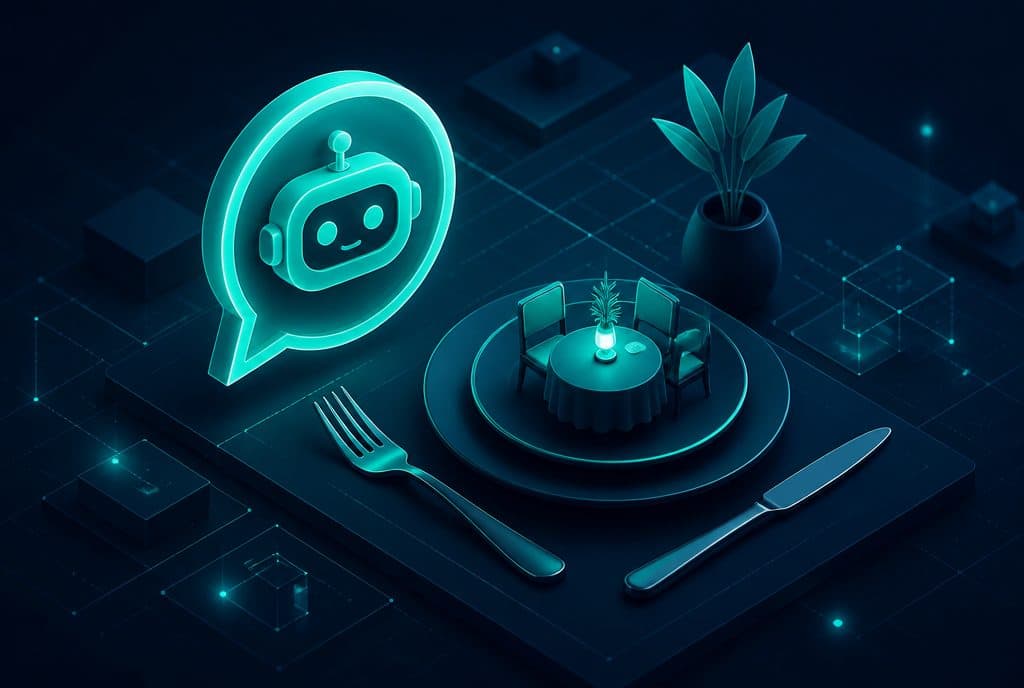
A WhatsApp bot for restaurants is an AI agent that manages reservations, menu inquiries, and routine customer questions directly on WhatsApp—24/7, in natural language, without overloading your staff. A customer writing at 11:00 PM, "I want a table for 3 on Friday," receives an immediate confirmation, a reminder the day before, and the option to cancel—all without anyone at the restaurant touching a phone. This guide explains what the bot actually does, which scenarios it solves, and how an Israeli food business can start setting one up.
How Does a WhatsApp Bot Help a Restaurant?
A WhatsApp bot helps a restaurant by automatically answering all routine inquiries—table reservations, menu and price checks, hours and location questions, booking confirmations, and cancellations—and transfers only those inquiries requiring human judgment to a live representative. The staff stops answering "What are your hours?" and frees up time for things that truly require a human presence.
What the Agent Does for a Restaurant — Table
| What the Customer Sends | What the Agent Does |
|---|---|
| "I want a table for 2 on Friday at 8:00 PM" | Checks availability, confirms, records it in the calendar, and confirms to the customer |
| "What vegetarian options do you have?" | Sends the menu categorized by preferences |
| "How much is the schnitzel?" | Answers with the current price from the menu |
| "How late are you open today?" | Sends updated hours based on the day of the week |
| "Where are you located?" | Sends the address + Google Maps link |
| "I want to cancel my reservation" | Confirms the cancellation, frees up the table, and sends a confirmation |
| "Do you have parking?" | Answers based on the configured information |
| Complaint / Special request for a large event | Transfers to a representative with a summary of the conversation |
The table illustrates a simple rule: anything that can be predefined—the agent handles. Anything that requires a human—goes to a human.
Why WhatsApp Specifically, and Not a Website Form?
Israeli restaurants live on WhatsApp. The customer is already there; they don't want to open a website, fill out a form, and wait for an email. When someone wants a table, they send a message—and the WhatsApp bot is right there, responding in seconds.
Another advantage: the bot preserves conversation history. A customer who booked three weeks ago writes, "I want the same table again"—and the agent understands the context, offering them the same floor and time.
Common Scenarios in the Food Industry
Scenario A: Late-Night Table Booking
A customer writing at 11:30 PM, "Is there room for 4 people on Friday at 7:30 PM?"—without a bot, the message waits until morning. With a bot, they receive an immediate confirmation (or an alternative if the place is fully booked) and a booking number. The day before—an automatic reminder with the option to confirm or cancel with a click. No-show rates drop, and tables that would have been "forgotten" get refilled.
Scenario B: Menu Inquiries Before Visiting
A customer looking for kosher, vegetarian, or gluten-free food sends a question before arriving. Without a bot, the staff answers during busy hours between services. With a bot, the customer gets a clear answer within seconds and arrives ready to order.
Scenario C: Cancellation Management
Canceling a table with a simple WhatsApp message—the agent confirms, marks the spot as available, and updates the management interface. The manager doesn't need to check the phone between shifts.
Scenario D: Routine Inquiries
"How late can we arrive for lunch?" / "Do you have a large dessert option?" / "Can we reserve a table in the garden?"—all these inquiries repeat dozens of times a day. A properly configured bot answers them instantly and consistently, without the staff ever touching a phone.
What the Bot Doesn't Do — An Important Distinction
A bot does not replace human judgment. A complaint about a bad experience, a large booking for a private event, or a request for a special menu that doesn't exist—these are automatically transferred to a representative, along with a summary of what was said in the chat. The staff gets full context without having to search through the history.
The boundaries are predefined based on what the restaurant decides: what the agent handles, and what goes to a human.
How to Get Started — Practical Steps
Step A: Characterization & Requirements
Before writing any code, map out the recurring inquiries: Which questions does the staff answer multiple times a day? What are the booking rules (minimum guests, hours, cancellation policy)? What happens when there is no availability? These answers become the "knowledge base" the agent works with.
Step B: Building and Integrations
The agent is built on the WhatsApp Business API and connected—as needed—to your existing booking management tool (Google Calendar, table management system, spreadsheet). The build is typically done using n8n as the automation engine.
Step C: Defining Scenarios and Boundaries
Define exactly what the agent answers, what it sends, and what gets transferred to a representative. This is also where you define operating hours (does the bot run 24/7 or only during specific hours) and what the Privacy Protection Law requires: consent for data storage, and the option to delete data.
Step D: Gradual Rollout
Start with a single scenario—usually table reservations—and test it. Add scenarios gradually as needed. A modular approach ensures the agent works as expected before expanding.
Related Links
If you've reached this point and are still wondering about the difference between a bot and an AI agent—The Complete Guide to AI Agents for Businesses explains the distinction in detail. For details about our WhatsApp bot service, see our WhatsApp Agent Service Page. For restaurants that also want queue and event management, Automated Scheduling is highly relevant as a second phase.
How much does it cost?
| Component | Price (one-time setup, ex-VAT) |
|---|---|
| AI booking agent — simple | ILS 8,000 |
| Calendar link and meeting booking | ILS 2,000 |
| Appointment reminders and confirmations | ILS 1,750 |
| Automatic follow-up sequence | ILS 2,500 |
| WhatsApp Business API setup | ILS 700 |
A complete starting point — a WhatsApp AI agent including the business number, server and agent control room — is from ILS 10,200; an agent with a management system (CRM) from ILS 18,200, a multi-agent system from ILS 25,350. There is no monthly fee; third-party costs (server, messages, AI) of about ILS 100–500 a month are paid directly to the providers. The full component price list: pricing page.
Summary
A WhatsApp bot for restaurants is not a "nice gadget"—it is an operational tool. Staff stop answering "What are your hours?" and free up time for face-to-face service. Customers get answers even when the restaurant is closed. Reservations that would have slipped through the cracks are automatically confirmed. The right starting point is a simple characterization: which inquiries repeat the most for you—and what would happen if they were answered instantly, without human touch.
Want to understand if a WhatsApp bot is right for your restaurant? Send us a message and we will build an initial characterization together—free of charge.