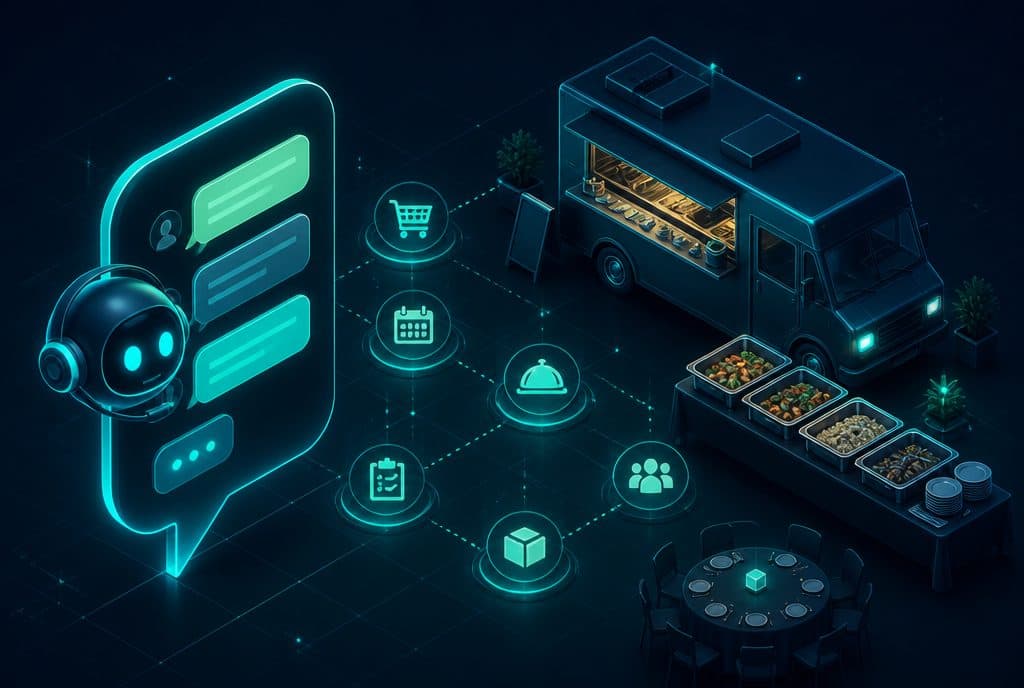
A food truck that works six days a week, standing in line and serving simultaneously, cannot pick up the phone every time someone asks, "How much does a meal cost for an event of 80 people?" or "Where will you be on Friday?" A smart WhatsApp bot answers these inquiries instantly—at two in the morning just like at two in the afternoon—sends a menu, confirms availability, takes pre-orders, and transfers to a representative only when human judgment is needed.
At Automaziot AI, we build bots for food trucks and mobile food businesses that handle all types of recurring inquiries—without the team distracting themselves from the service itself.
How Automation Helps a Food Truck
A WhatsApp bot for a food truck handles the three most common types of inquiries—menu and pricing, events and catering, pre-orders and location updates—automatically and instantly. The customer gets a response a second after they ask; the team continues serving; and no lead "falls between the cracks" because someone was busy serving.
What is Unique About Food Truck Inquiries?
Inquiries to a food truck differ from inquiries to a regular business in several characteristics:
- They are one-time and urgent — someone who sees you at the flea market asks immediately; if they didn't get an answer within minutes, they went to the next stall.
- They are repetitive and cumulative — "What's on the menu?", "Are you kosher?", "Will you be at the North Market on Friday?" — the same questions, dozens of times a day.
- They have very different financial values — a person ordering two schnitzels is very different from a company that wants catering for 200 people. Without filtering, the team wastes equal time on both.
Smart automation distinguishes between inquiries, answers the simple ones immediately, and filters the large ones to a representative with all the details already organized.
Four Key Scenarios and How the Bot Handles Them
1. Menu and Pricing Questions
The most common inquiry. A customer writes "What do you have?" or "How much does a dish cost?" — the bot instantly sends the updated menu (image, PDF, or organized text), including information about allergens, kosher certification, and vegetarian/vegan options. If the price depends on quantity (for example: a dish for an event vs. a single purchase), the bot asks one focused clarifying question and responds accordingly.
2. Inquiries for Events and Catering
A person who wants a food truck for their event sends a message like "How much does it cost to book you for a wedding?" — the bot conducts a short screening conversation: number of guests, date, area, type of event, estimated budget. At the end of the conversation, a complete lead record is created and automatically enters lead management. The representative receives an alert with all the details and calls at a convenient time to close the deal—not from scratch, but when all the data is already in front of them.
3. Pre-orders
Food trucks that work according to a route schedule can allow pre-ordering: a customer who knows the truck will be at Science City on Wednesday can order as early as Monday, pay a deposit (integration with the cash register is possible), and receive confirmation with precise details. The bot manages all of this—including an automatic reminder an hour before pickup—without a representative needing to manually track dozens of orders.
4. Location Updates and Route Schedules
"Where are you today?" is a question every food truck gets every day. The bot sends the current location, operating hours, and a navigation link—automatically and instantly. You can update the location through a simple interface at the beginning of each shift, and any customer who asks will get the most up-to-date data.
Capabilities Table: What the Bot Does and What is Left for a Human
| Inquiry | The Bot | Human Representative |
|---|---|---|
| Menu and allergen questions | Answers instantly + sends file | — |
| Price question for a small event | Asks number of guests and date, sends price list | — |
| Large / custom catering | Initial screening, summary for representative | Closes the deal |
| Basic pre-order | Receives, confirms, and sends reminder | — |
| Change an existing order | Identifies, asks what to change, updates | Only if complex |
| Service complaint | Receives, apologizes, transfers immediately | Handles later |
| Location and hours question | Answers instantly | — |
| Request for contract / agreement | Transfers to representative with details | Conducts negotiation |
How to Get Started — Three Steps
Step 1: Characterizing Inquiries — In the first week, we go over all types of messages the food truck receives on WhatsApp, sort them into categories, and define for each one: whether the bot answers on its own, whether it closes a transaction, or whether it filters and transfers to a representative. This is the stage that ensures the bot will fit your specific business—not a generic solution.
Step 2: Building and Integration — The bot is built on the WhatsApp Business API and connected using n8n to all the tools the food truck works with: route schedule, ordering system, and a simple CRM if needed. At this stage, clear transfer rules are also defined: what the bot does on its own and what reaches a representative.
Step 3: Deployment and Fine-Tuning — A week or two of monitoring real conversations and updating the bot according to what customers actually ask. For inquiries that the bot failed to handle in the first week—we add a scenario and improve.
Want to see what such a bot looks like in practice? Send us a message and we will build an initial characterization tailored to your food truck—including defining inquiries, filtering rules, and how long it will take to set up.
Questions to Ask Before Getting Started
Before setting up a bot, it is worth answering a few practical questions:
What are the five most common inquiries you receive? A short list of recurring inquiries is the starting point of any good characterization. If you don't know yet—a week of manually recording all WhatsApp messages by category will give a clear picture.
What does a customer need to know before deciding to order? Any information that blocks a decision (price, kosher status, operating area, minimum order for an event) should be available in a click. The bot can send all this information in an organized format within seconds.
What stops you from responding to inquiries faster? If the answer is "We are busy serving"—the bot is the direct solution. If the answer is "Not sure what to answer on large requests"—that's where a characterization of the proposal path for a large client is also required.
Connection to Lead Management and Why It Matters
An inquiry for a large event is a lead, in every sense. Without organized management, a lead that arrived on Friday afternoon (when the truck is busy) will be forgotten until weeks later, and in the meantime, the customer has turned to others. The bot allows an immediate response that warms up the lead and transfers to a representative after all the details are already available—which significantly shortens the closing time. The details automatically enter the lead management system, where you can track every inquiry, send a follow-up, and make sure no one is forgotten.
For more advice on managing inquiries and events, see also Automation for Events and Catering.
How much does it cost?
| Component | Price (one-time setup, ex-VAT) |
|---|---|
| AI order-taking agent | ILS 7,500 |
| Payment link and checkout inside the chat | ILS 2,800 |
| Business knowledge base | ILS 3,000 |
| Automatic follow-up sequence | ILS 2,500 |
| WhatsApp Business API setup | ILS 700 |
A complete starting point — a WhatsApp AI agent including the business number, server and agent control room — is from ILS 10,200; an agent with a management system (CRM) from ILS 18,200, a multi-agent system from ILS 25,350. There is no monthly fee; third-party costs (server, messages, AI) of about ILS 100–500 a month are paid directly to the providers. The full component price list: pricing page.
Summary
A food truck works hard on the product—the food, the location, the logistics. It shouldn't waste energy on answering the same ten recurring questions throughout the day. A WhatsApp bot handles common inquiries, filters event inquiries for a ready representative, and allows pre-orders effortlessly—all while complying with Israeli privacy protection laws and without changing the way the customer already communicates (the WhatsApp they already know).
At Automaziot AI, we build bots tailored to the specific activity of the food truck—not a generic solution—and accompany the adjustment until the bot works exactly as it should.