
A building materials store receives dozens of questions a day about inventory, prices, deliveries, and repeat orders—from contractors, plumbers, and electricians who need an answer now, not tomorrow morning. An AI-powered WhatsApp bot answers 24/7, checks inventory in real-time, handles B2B orders, and drives purchases—without burdening the staff. Here is how to do it right in the Israeli market.
How Automation Helps a Building Materials Store
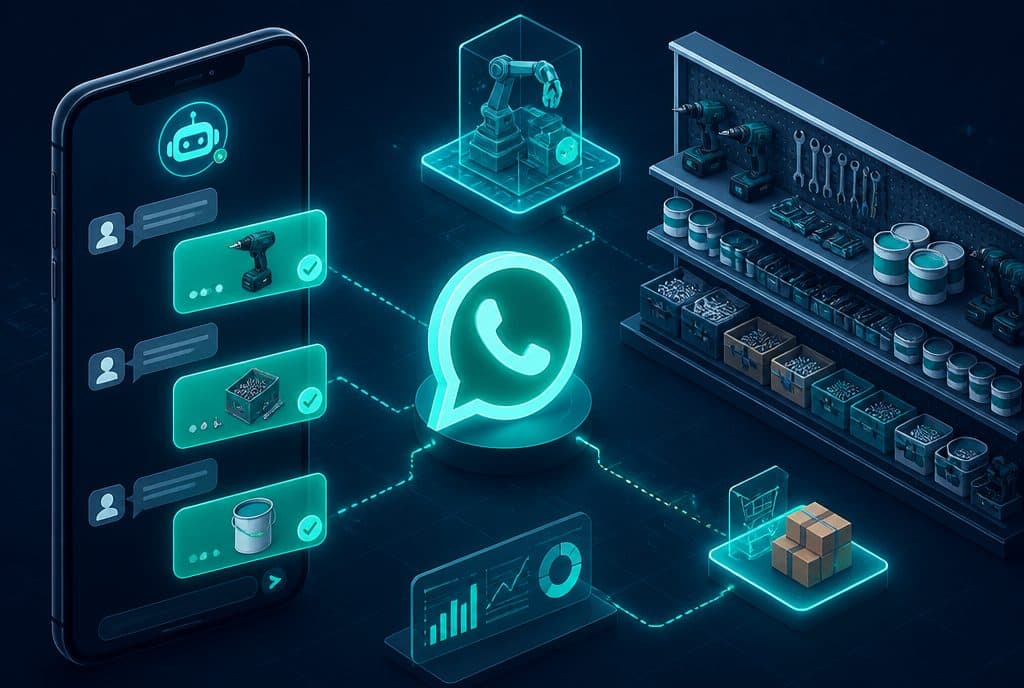
WhatsApp automation for a building materials store makes it possible to answer inventory, price, and delivery questions 24/7 without an available representative, receive B2B orders from contractors and wholesale buyers, send automated order confirmations and delivery updates, and trigger repeat order reminders for regular customers—all connected to the inventory system and CRM, without manual typing.
Why Do Building Materials Stores Need Specific Automation?
The building materials industry operates at a different pace than standard retail. The typical customer is a contractor ordering equipment for an active site, a plumber who needs materials before 8:00 AM, or a warehouse manager placing a weekly repeat order. Inquiries arrive at irregular hours, relate to a massive catalog of thousands of items, and require precise answers about actual inventory—not "maybe we have it."
Store staff are used to answering the same questions over and over: "Do you have 3-inch steel pipes in stock?", "What is the price per ton of B30 concrete?", "When is the delivery I ordered on Tuesday arriving?"—each question takes a minute or two, and on a busy day, this adds up to hours that could have been spent on high-value customer service.
In addition, B2B customers—such as contractors working on account—expect personalized pricing agreements, minimum order volumes, and credit terms. Automation that recognizes each customer's profile can provide precise answers to these inquiries as well.
What a WhatsApp Bot Can Do in a Building Materials Store — Capabilities Table
| Scenario | What the Bot Does | Value to the Store |
|---|---|---|
| Inventory Inquiry | Pulls real-time data from the inventory system | Saves repeat phone calls |
| Price Inquiry | Displays official price / regular customer price | Answers even outside business hours |
| New B2B Order | Captures order details, sends confirmation, enters into CRM | Reduces manual typing and errors |
| Delivery Update | Sends status and estimated arrival time | Relieves pressure on the staff |
| Repeat Order | Identifies existing customer and displays previous order list | Accelerates the purchasing process |
| Spec Inquiry | Returns technical spec sheet / manufacturer PDF | Supports the purchasing decision |
| Complex Inquiry | Transfers to a representative with a full summary | Saves "tell me again" frustration |
Four Key Scenarios
1. Real-Time Inventory and Price Inquiries
A contractor texting at 7:00 AM, "Do you have 200 units of 19 cm hollow blocks?" won't wait until the store opens. The bot is connected to the inventory system, pulls the available quantity, and answers instantly. If the quantity is low, it suggests an alternative delivery date or a substitute product. If the customer is registered as an account customer, the bot displays their agreed price—not the standard retail price.
2. Capturing B2B Orders from Contractors
A regular customer can send an order list directly to WhatsApp—items, quantities, site address, and required date. The bot parses the list, verifies availability, sends a numbered order confirmation, and enters the data into the CRM and logistics system. If an item is out of stock, it explicitly notes this and suggests a replacement, rather than leaving the customer guessing.
3. Delivery Tracking and Proactive Updates
When the shipment leaves the warehouse, the automation system (for example, via n8n) sends a WhatsApp message to the customer with an estimated arrival time and order number. If there is a delay, the customer receives a proactive update before they call to ask. This significantly reduces the volume of "where is my delivery?" calls reaching the staff.
4. Repeat Orders and Purchase Reminders
Many contractors work with a fixed list of materials that is renewed every week or two. The bot remembers each customer's last order and can send a reminder: "Hi Yossi, based on your order from two weeks ago—would you like to renew it?" The customer clicks "Yes" and confirms or updates quantities. The order is recorded without any human intervention required.
Two Layers: Retail vs. B2B Customers
A building materials store typically serves two types of customers with different needs:
Retail Customers (homeowners renovating)—ask simpler questions, do not expect custom pricing agreements, and are usually first-time buyers. The bot conducts a brief sales conversation with them, answers basic questions, and directs them to the branch or a representative to close the deal.
B2B Customers (contractors, business owners, wholesale buyers)—expect speed, accuracy, and personalized pricing. The bot identifies them by phone number, pulls the customer profile from the CRM, and acts accordingly—including access to unique price lists and agreed payment terms. It is worth reading more about e-commerce automation alongside our smart WhatsApp agent service to understand the full range of solutions.
Two Questions Worth Asking
Does the bot replace a sales representative? No. The bot handles all repetitive questions, standard orders, and status updates—and routes to a human representative only what truly requires human judgment: a large deal, a new customer, or an account issue. The representative receives the full context of the conversation and continues from there—without having to ask everything all over again.
What happens when the bot doesn't know how to answer? This is defined in advance. For any question outside the bot's scope—special pricing, unusual account status, or an invoice dispute—it transfers the conversation to a representative along with a summary. It never leaves the customer hanging.
How to Get Started?
The right approach is not to implement everything at once. Start with what hurts the most:
- Mapping & Specification—Map the types of inquiries coming into the store, identify the top ten repetitive questions, and define what the bot answers versus what gets transferred to a representative.
- Data Integration—Examine existing systems (inventory, CRM, logistics) and how to connect to them via API.
- Pilot—Launch the bot with a small group of customers, test the quality of the answers, and fine-tune before a wider rollout.
- Expansion—Gradually add scenarios: once order capturing is working, add repeat reminders; once deliveries are automated, add a digital catalog.
Each step stands on its own and delivers measurable value before moving to the next. Read more about this approach in automation for import and wholesale.
How much does it cost?
| Component | Price (one-time setup, ex-VAT) |
|---|---|
| AI order-taking agent | ILS 7,500 |
| Payment link and checkout inside the chat | ILS 2,800 |
| Business knowledge base | ILS 3,000 |
| Automatic follow-up sequence | ILS 2,500 |
| WhatsApp Business API setup | ILS 700 |
A complete starting point — a WhatsApp AI agent including the business number, server and agent control room — is from ILS 10,200; an agent with a management system (CRM) from ILS 18,200, a multi-agent system from ILS 25,350. There is no monthly fee; third-party costs (server, messages, AI) of about ILS 100–500 a month are paid directly to the providers. The full component price list: pricing page.
Summary
A building materials store that provides an immediate response to a contractor texting at 6:00 AM doesn't lose the deal to another supplier. A WhatsApp bot connected to inventory, CRM, and logistics systems handles the routine work—checking availability, capturing orders, confirming, and updating deliveries—freeing up the staff for conversations that truly require human judgment. The result is B2B customers who buy more because the process is simpler, and a team freed from answering the same question twenty times a day.