
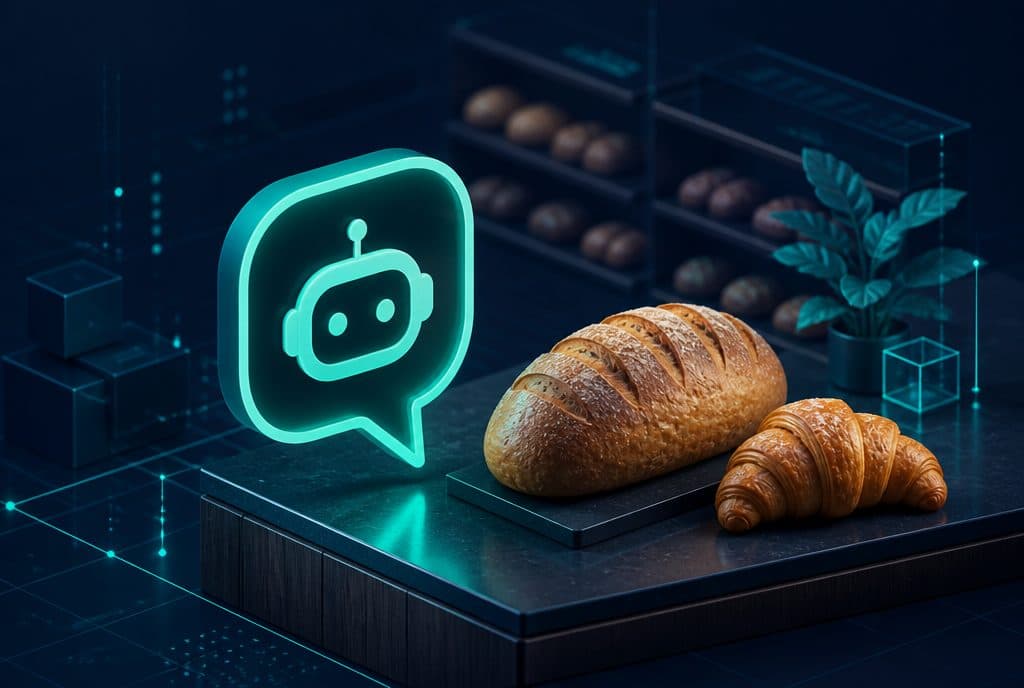
A WhatsApp bot for a bakery is an automated system that takes custom cake orders, coordinates pickup and delivery times, answers menu and pricing questions, and manages holiday pre-orders—all through WhatsApp, 24/7, without stopping production in the kitchen. For a bakery or patisserie receiving dozens of inquiries a day, this kind of automation means fewer phone calls mid-work and more successfully closed orders.
The average Israeli bakery receives WhatsApp inquiries throughout the day: "Can I get a Bat Mitzvah cake for next Saturday?", "What's the price for a size L cheesecake?", "Do you have gluten-free options?". Every such question arriving while the baker is standing by the oven forces them to wipe their hands, open their phone, and type. A WhatsApp bot doesn't stop any cake—it replies the moment the customer sends a message, gathers all the details in an organized way, and hands the baker a ready-to-approve summary.
How Automation Helps a Bakery
Bakery automation connects the customer looking for a cake with the kitchen that needs organized information: the bot receives the order details (flavor, size, design, date, allergens), confirms availability based on the production schedule, sends the customer a summary for approval, and transfers the formatted order to internal management—without the baker stopping for a single second.
What a WhatsApp Bot Actually Does in a Bakery
Here are the actions that can be run through a WhatsApp bot for a bakery or patisserie:
| Scenario | What the Bot Does |
|---|---|
| Custom Cake Ordering | Asks for flavor, size, design, date, allergens—collecting everything in a natural conversation |
| Pickup Coordination | Displays business hours, confirms the time slot, sends a reminder the day before |
| Menu & Pricing Inquiries | Answers FAQs 24/7 from an updated knowledge base |
| Holiday Pre-orders | Opens an order form with a cutoff date and quantity limits |
| Delivery Management | Checks delivery area, preferred time, cost—and hands it off to logistics |
| Post-Order Follow-up | Asks about satisfaction + requests a Google review |
Four Common Scenarios—What Happens With and Without Automation
1. Custom Cake Ordering
Without Automation: A customer writes "Can I get a Bat Mitzvah cake?" on Friday afternoon. The baker is busy. She waits. An hour later, he replies "Sure, what are you looking for?"—and a long, 10-message conversation begins that could have been wrapped up in 3.
With a Bot: The bot replies within seconds. It asks: What's the event? When is it? How many servings? Any flavor preferences? Any allergens? Within 5 minutes, there is an organized summary waiting for the baker's approval—which he reviews after stepping away from the oven.
2. Menu and Pricing Questions
Without Automation: "How much is a size L cheesecake?"—a question repeated 15 times a day. Every single time, someone has to answer.
With a Bot: The menu database is set up once. The bot answers instantly, adds a photo if available, and asks "When would you like to pick it up?"—potentially turning a simple price inquiry directly into an order.
3. Holiday Pre-orders
Without Automation: In the days leading up to Passover, the phone doesn't stop ringing. Every call takes 3-5 minutes. Some customers lose patience and go to a competitor.
With a Bot: The bot initiates the pre-order process: the customer selects a holiday product from the list, chooses the quantity, and confirms the pickup date. The order is automatically logged. If the item is sold out, the bot announces that stock has run out and offers to add them to a waitlist.
4. Reminders and Follow-ups
Without Automation: A customer forgets they have a cake to pick up. A bakery that could have asked for a Google review—but didn't.
With a Bot: An automatic reminder is sent the day before pickup. A "How was the cake?" message is sent two days later. A review request with a direct link is sent at the perfect moment.
What the Bot Doesn't Do (And Why It Matters)
A WhatsApp bot is not a replacement for human judgment. When a customer requests something complex—a custom design that needs to be reviewed, a last-minute change to an existing order, or a product complaint—the bot hands off the conversation to a human representative along with the entire chat history. The baker doesn't get a sudden phone call; they receive an organized summary and read it whenever it's convenient for them.
How to Get Started: The First Steps
Step 1 — Discovery & Definition: Which inquiries repeat the most? Orders? Price questions? Availability checks? Start there.
Step 2 — Knowledge Base: Prepare the information the bot needs—products, prices, business hours, ordering policies, common allergens. This is the foundation the bot uses to answer.
Step 3 — Defining the Order Flow: What details need to reach the kitchen from each order? What does the customer need to approve? What goes into which internal spreadsheet?
Step 4 — Connecting to the WhatsApp Business API: The bot runs on the bakery's existing WhatsApp number. Customers continue writing to the same number they already know.
Step 5 — Testing & Going Live: Test all scenarios, including edge cases, before launching to customers.
The right approach is to start narrow: a bot that answers FAQs and collects order details—this alone saves an hour or two a day. Once it's up and running and proves itself, you can add layers: schedule coordination, pre-orders, delivery management.
Questions Bakeries Ask Us
"Will my customers feel like they are talking to a machine?" The bot is configured according to the bakery's brand voice—it can be set to a warm, informal tone, using emojis if appropriate. Most customers feel like they are talking to "someone" rather than "something." When necessary, the bot transfers the chat to a human.
"What happens to the customers' data?" All collected information is stored in accordance with the Israeli Privacy Protection Law. Customers can request data deletion at any time. We build privacy into the system from the start—not as an afterthought.
"Is it complicated to update the menu?" No. A new product, a price change, a seasonal menu—updating the knowledge base is a simple task. We can set it up so the bakery updates it independently, or we can do it for you upon request.
Why Exactly Now?
In 2026, WhatsApp is the primary channel for business communication in Israel. Customers expect a fast response—and when they don't get it, they move on. A bakery that replies within seconds—even at 11:00 PM when someone suddenly remembers a birthday tomorrow—provides a level of service that a bakery replying "only during business hours" simply cannot match.
Ready to see what a WhatsApp bot looks like for your bakery? Talk to us and let's build a practical roadmap together—what to launch first and what to add later.
How much does it cost?
| Component | Price (one-time setup, ex-VAT) |
|---|---|
| AI order-taking agent | ILS 7,500 |
| Payment link and checkout inside the chat | ILS 2,800 |
| Business knowledge base | ILS 3,000 |
| Automatic follow-up sequence | ILS 2,500 |
| WhatsApp Business API setup | ILS 700 |
A complete starting point — a WhatsApp AI agent including the business number, server and agent control room — is from ILS 10,200; an agent with a management system (CRM) from ILS 18,200, a multi-agent system from ILS 25,350. There is no monthly fee; third-party costs (server, messages, AI) of about ILS 100–500 a month are paid directly to the providers. The full component price list: pricing page.
Summary
A WhatsApp bot for a bakery solves a concrete problem: inquiries arriving when you can't answer, repetitive questions, and orders that could have been closed—but weren't because no one replied in time. The solution doesn't require the bakery to change how it works—it simply adds an automated layer that handles inquiries, organizes information, and leaves the baker and staff with the decisions that truly require a human touch.
See also: