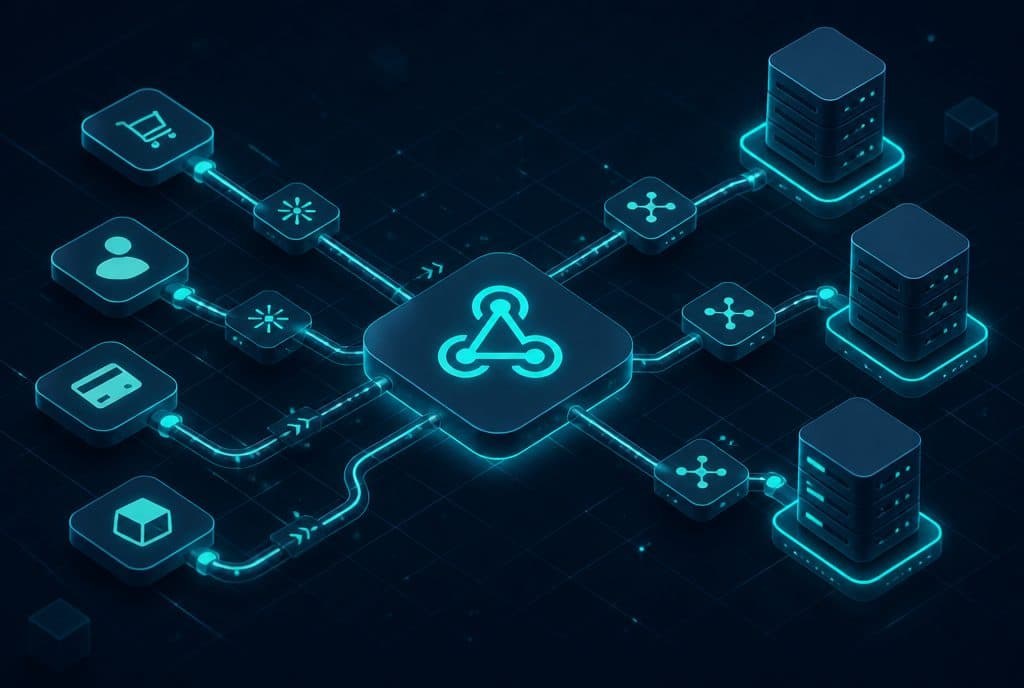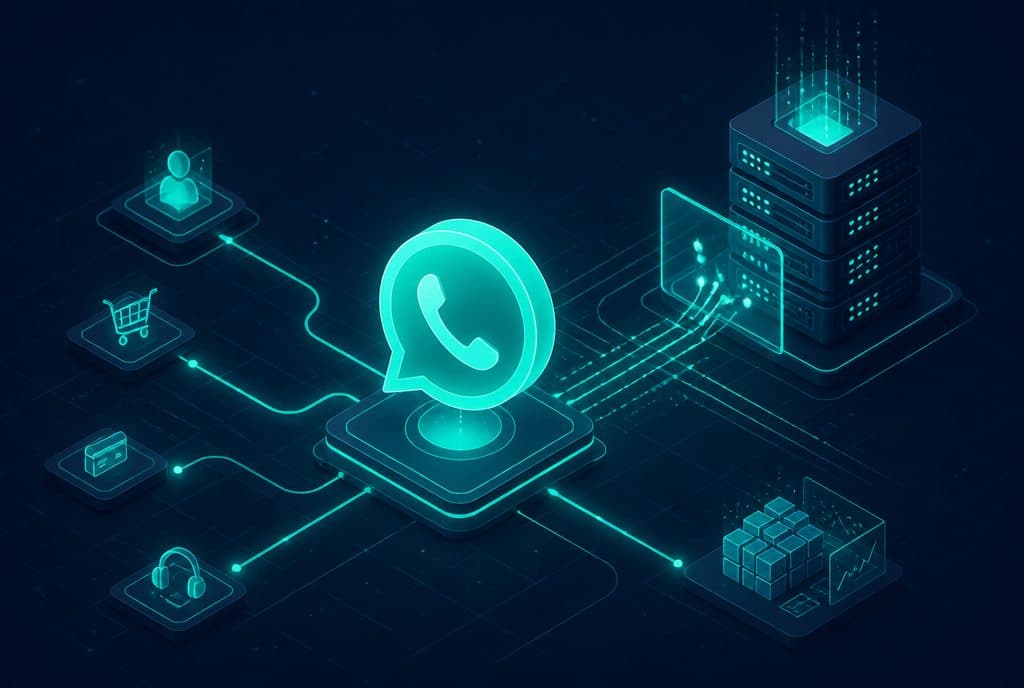

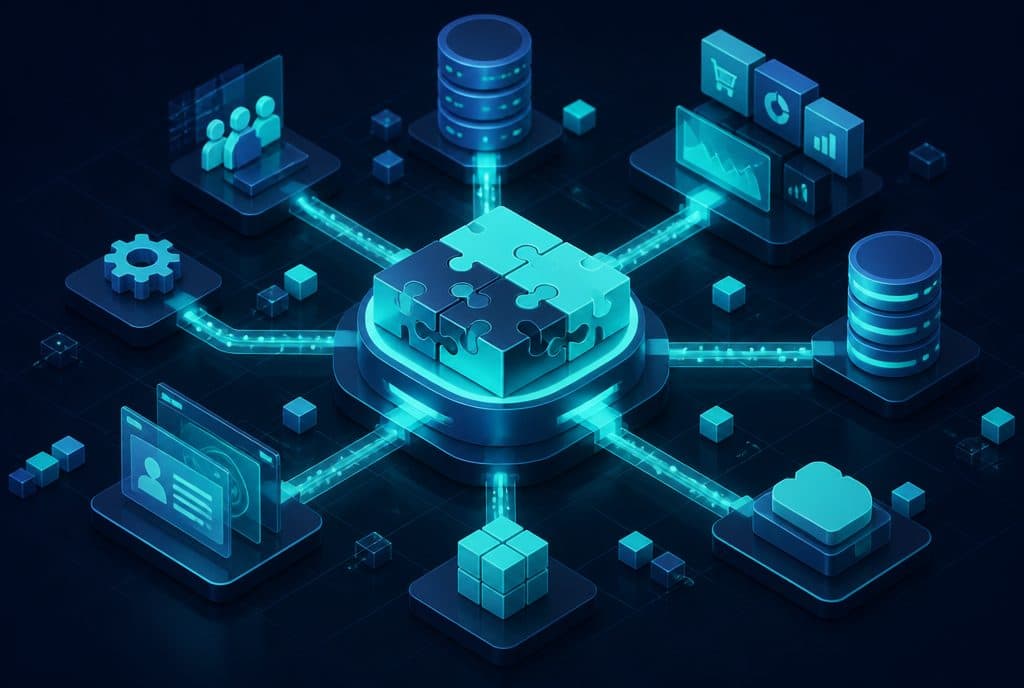
System integration is a technological connection that allows different business software programs—CRM, WhatsApp, calendar, accounting system—to talk to one another and transfer data automatically, without a human having to copy and paste data between screens. Without this connection, any "automation" stops exactly at the point where one system ends and another begins—and the one left to bridge them is you. At Automaziot AI we build integrations between systems for Israeli businesses and see every day how much this step is the foundation of any working automated process.
What is System Integration?
System integration is a two-way connection (usually via API) between two or more business software programs, so that data flows between them automatically according to rules you define in advance—without manual intervention. The customer sends a WhatsApp message, a lead is opened in the CRM, a meeting is scheduled in the calendar, and after closing, an invoice is generated from the accounting software. All of this happens in fractions of a second, without you touching the keyboard.
The Difference Between "System" and "Integration"
Small and medium-sized Israeli businesses usually work with four to eight software programs simultaneously—WhatsApp for communication, CRM for customer management, Google Calendar for scheduling, an accounting system (Priority, Hashavshevet, Zoho), email, lead forms, and more. The problem: each of them sits in a separate bubble.
| Without Integration | With Integration |
|---|---|
| Inquiry on WhatsApp → Manually copied to CRM | Inquiry on WhatsApp → Automatically entered into CRM |
| Meeting closed → Manually entered into calendar | Deal closed in CRM → Meeting opened in calendar |
| Customer paid → Manually typing invoice | Payment approved → Invoice sent automatically |
| Follow-up → Physical reminder in calendar | Lead did not answer → Follow-up sent automatically after 48 hours |
The difference is not a matter of convenience—it is a matter of volume. When there are five leads a day, manual copying is tolerable. When there are fifty—all failures multiply: forgetfulness, typing errors, leads falling between the cracks, follow-ups that never went out.
Why Integration is the Foundation of True Automation
The automation people imagine—"everything happens on its own"—requires every step in the process to pass through a continuous pipeline from one system to another. A typical structure of an automated sales process looks like this:
- Lead enters (website form / WhatsApp / Facebook)
- Registered in the CRM with all details + lead source
- Confirmation message is sent to the lead automatically
- AI agent conducts a screening conversation and gathers information
- Meeting is scheduled in the calendar with a link sent
- After the meeting: status is updated in the CRM and a follow-up goes out
- Upon closing: invoice is generated from the accounting system
Every arrow in this diagram is an integration. If one is missing—the process breaks there, and a human must intervene. This is exactly where you realize that automation is worth nothing without connections.
Real-World Examples: Connections Israeli Businesses Make
- WhatsApp ↔ CRM — Every inquiry enters automated lead management, the conversation is documented, and the lead receives a priority score.
- Lead Forms (Meta / Website) ↔ CRM + WhatsApp — A lead filling out a form receives a message within seconds, and a full record is opened for them.
- CRM ↔ Google Calendar / Calendly — A deal in the "meeting" stage → a calendar invitation is generated without human touch.
- CRM ↔ Accounting System — A customer moves to "closed/paid" status → an invoice is generated in Priority/Hashavshevet.
- Email ↔ CRM — Every incoming email from an existing customer is automatically added to their timeline in the CRM.
- WhatsApp ↔ Calendar — A customer sends "I want to schedule" → automated scheduling without a human representative.
n8n and the Connection to Integrations
When we connect systems at Automaziot AI, we work with n8n—an open-source automation platform that allows building complex processes in a graphical interface. n8n acts as the "engine" sitting in the middle: listening to events from one system, processing them according to the logic we defined, and sending the data to the next system.
Several practical advantages of n8n for an Israeli business:
- Logic flexibility — You can add conditions, filters, branches ("if lead is from Tel Aviv → send to representative A; otherwise → send to representative B").
- Hundreds of ready-made integrations — Chatwoot, Google Sheets, Gmail, Slack, WhatsApp Business API, Priority, and more—no need to develop from scratch.
- Logic that remains yours — The flows are documented and can be understood, modified, and expanded.
- Self-hosting option — For businesses sensitive to customer data regarding privacy protection laws, n8n can run on your own server.
See also: What is a webhook and API and why are they the basis for any connection?
Common Mistakes in Connecting Systems
Connecting too much at once. The correct approach is to choose the biggest pain point (usually: incoming lead → CRM) and prove value there. Then, expand.
Neglecting data integrity. If the customer's name enters each system differently, the integration will produce a mess. Before connecting—you need to clean up and agree on what the "database of truth" is for each field.
Not defining what happens when something fails. Network down? API returned an error? A mature integration system includes error handling, alerts, and retries—it doesn't just "believe" everything will go smoothly.
Choosing the wrong tool for the volume. For a business with dozens of leads a day, a simple no-code tool with a monthly action limit will get stuck. You need to plan according to realistic future volume.
When Should You Start Connecting Systems?
There are several clear symptoms:
- Data duplication: the same customer exists in three different lists.
- "We forgot to update the CRM" as a reason for losing a lead.
- An employee spends more than an hour a day moving information between screens.
- Follow-up doesn't go out because "it wasn't put in the calendar".
- An invoice went out late because "they didn't know it was closed".
Each of these is an indicator that there is an "integration gap"—a place where a human is doing work that a machine could do. Our technological consulting starts exactly by mapping these gaps.
Ready to close the gaps? Talk to us and we will map out together the connections that will give you the greatest value—fast.
Summary
System integration is not an "extra feature"—it is the infrastructure on which every automated process stands. A CRM disconnected from WhatsApp, a calendar disconnected from CRM, accounting disconnected from everything—cannot turn into real automation; they are just separate software programs that you connect manually. With a tool like n8n and proper planning, you can build a pipeline that flows: from the customer's first inquiry to the invoice—without typing errors, without forgetfulness, and without working hours swallowed up in copy-paste. At Automaziot AI, we specialize in exactly this, working with small and medium-sized businesses across Israel. Start with one pipeline, prove value—and then expand.