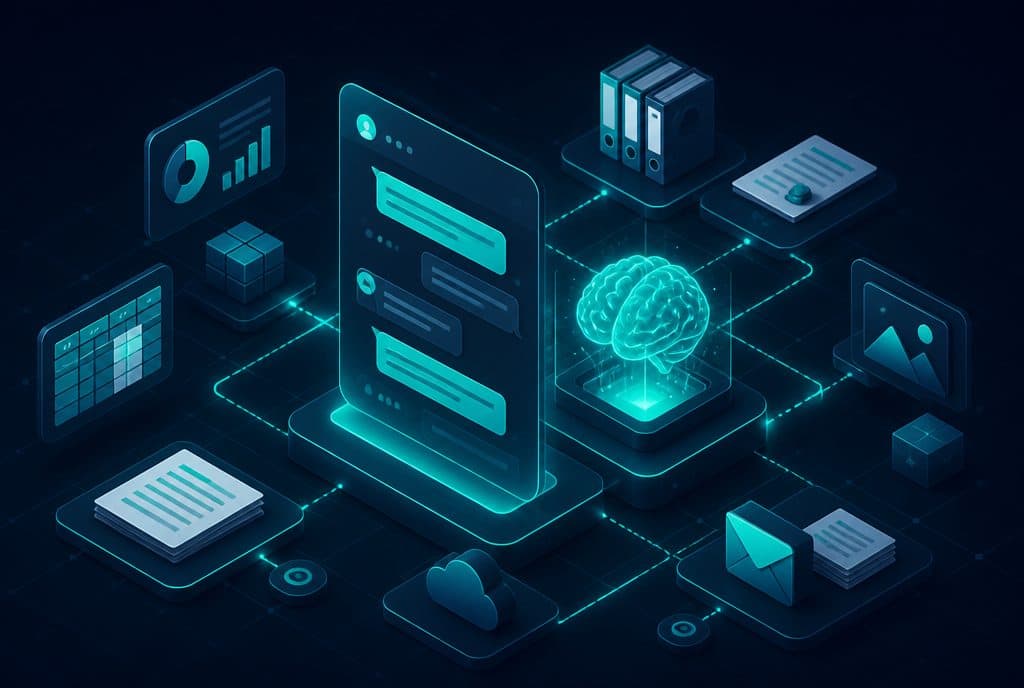

Conversational AI is a technology that enables software to conduct a natural conversation in human language — in text or voice — and understand the intent behind the words, not just the vocabulary. Unlike sorted menus or rule-based chatbots, an AI-powered conversational system responds to free-form phrasing, remembers context throughout the conversation, and manages a dialogue that feels human — even though it is software. At Automaziot AI, we implement Conversational AI in Israeli businesses across WhatsApp, phone, and chat.
What is Conversational AI?
Conversational AI is a software system based on Large Language Models (LLMs) that enables software to understand free human language — in text or voice — remember the conversation context across multiple turns, and respond in a natural and relevant way. It does not work according to a rigid script: it understands what the customer intends to say, even when phrased in a way that was not pre-programmed.
The transition from "software that understands commands" to "software that understands language" is a fundamental shift. A menu is a tool of interface; a conversation is a tool of understanding.
The Technical Components of Conversational AI
For a conversational system to work, several components must operate together:
| Component | Role | Example |
|---|---|---|
| NLU — Natural Language Understanding | Analyzes the input and identifies intent | "What is the price?" = request for cost information |
| Language Model (LLM) | Generates a natural and relevant response | Builds phrasing that matches the business's style |
| Context Management | Remembers what was said earlier in the conversation | Links "Never mind, tell me about service B" to the previous question |
| Dialogue Management | Decides the next step in the conversation | To ask a clarifying question, answer, or hand off to an agent |
| Integrations | Connects to actual business actions | Writing to the CRM, opening a calendar, sending a link |
When all components work together, you get a system that manages a dialogue that looks and feels human — and drives a business outcome.
Conversational AI vs. Traditional Chatbots
This is the distinction that is most commonly confused, and the most important to understand:
| Traditional Chatbot | Conversational AI | |
|---|---|---|
| Logic | Rigid decision tree ("If X → Answer Y") | Intent understanding in free language |
| What happens when it doesn't understand | "I didn't understand, please choose from the menu" | Asks a clarifying question or offers an alternative |
| Conversation Memory | Each message stands on its own | Remembers everything said in the conversation |
| Languages and Phrasing | Fixed strings only | Natural Hebrew, varied phrasing |
| Content Updates | Requires reprogramming | Can be fed new knowledge without code |
| Handoff to Agent | After X failed clicks | When the system detects a human is needed — with a summary |
A traditional chatbot is essentially an automated menu. Conversational AI is a real conversation that leads to action.
Common Business Use Cases
Automated Response on WhatsApp and Chat
The most common use case: a customer sends a message on Friday night — "How much does service X cost?" — and the system understands, answers fully and relevantly, asks what they are looking for and when is convenient to talk, and enters the lead details into the CRM. On Sunday morning, the representative finds a summarized and organized inquiry — not a short, cryptic message that needs deciphering. For more details: AI Agent for Businesses.
Automated Voice Agent
Voice Conversational AI (Voice AI) answers incoming calls, filters the reason for the call, gathers initial details, and transfers to the appropriate representative — with a full summary. Customers who wait long minutes in an old voice menu get a natural conversation that gets straight to the point instead. See: AI Voice Agent.
Hot Lead Qualification
A conversational system can manage a qualifying dialogue — asking relevant questions, understanding the need and timeline, and transferring only the leads that passed initial screening to the representative. The human agent enters the conversation already knowing what the customer is looking for and what their budget is.
24/7 Customer Service
Repetitive questions — "Where is my order?", "What are the opening hours?", "How do I cancel?" — are handled automatically at any hour. The system is connected to the business's systems and can retrieve real-time information: order status, appointment availability, policy details.
Appointment and Booking Scheduling
A customer who writes "I want to schedule a meeting" receives available times from the calendar, chooses, and receives confirmation — with no human touch. See: Automated Appointment Scheduling.
Questions Before Implementation
Before choosing a Conversational AI solution, it is worth answering a few practical questions:
What does the system answer? — A clear definition of the knowledge domain: Questions about price? Information about services? Lead qualification? The clearer the definition, the better the performance.
What happens when the system doesn't know? — Every conversational system needs a handoff protocol to a human agent, along with a summary of the conversation. This is not a failure — it is proper design.
On which channel? — WhatsApp, phone, website chat, or a combination. The choice affects the technology, cost, and usage.
What does the Privacy Protection Law require? — According to the Israeli Privacy Protection Law, you must state to the customer that they are conversing with an automated system, and allow access to and deletion of the collected data. It is highly recommended to ensure the chosen solution covers this aspect as well.
How Long Does It Take, and Where Do We Start?
The approach that works: One specific scenario before expanding.
A basic response to common questions on WhatsApp — with handoff to an agent when needed — is usually ready within about a week. A full system that manages a conversation, qualifies leads, and connects to the CRM is typically built within 2-4 weeks, depending on the volume of scenarios and number of integrations.
The right starting point is not "which technology?" — but rather "which recurring inquiry annoys us most because we cannot answer it fast enough?" The answer to this question is the first scenario you should implement.
Want to understand how Conversational AI fits your business — and which scenario is best to start with? Talk to us for an initial consultation at no cost.
Related Links
- What is an AI Agent for Business? The Complete Guide — The difference between Conversational AI and an AI agent that performs actions
- What is a Chatbot for Business? — Understanding the basics before moving forward
- AI Voice Agent — Voice Conversational AI for phones
- AI Agents for Businesses — Our solutions for Israeli businesses
Summary
Conversational AI is the next generation of automated customer communication: moving from rigid menus and scripts to a natural conversation that understands, remembers, and drives results. For an Israeli business receiving recurring inquiries on WhatsApp, phone, or chat — this is not just another nice-to-have feature, but a tool that allows answering every inquiry with the speed and quality that previously required a human representative. The recommendation: start with one scenario, measure the results, and decide on the next step based on reality, not theory.