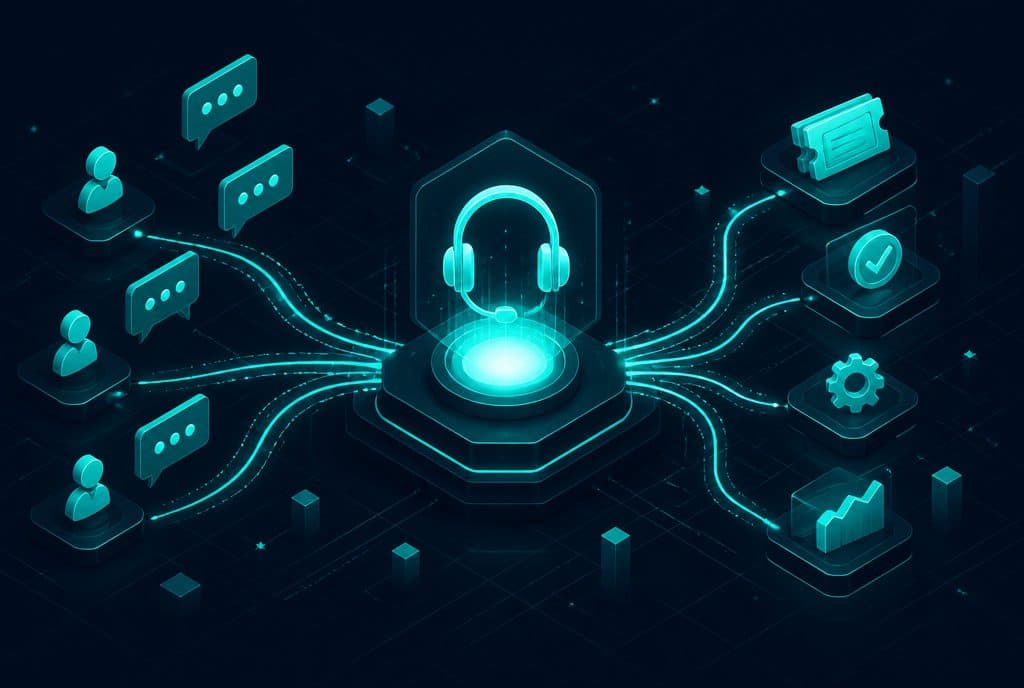
Customer service automation with AI allows any Israeli business to respond to inquiries on WhatsApp, phone, and email around the clock—without hiring additional representatives. An AI agent understands the inquiry, responds in natural Hebrew, filters, schedules meetings, and writes to the CRM; inquiries requiring human judgment are forwarded to a representative with a full summary. It can be set up within 2-4 weeks, at a cost tailored to the business size. At Automaziot AI, we specialize in exactly this.
What is Customer Service Automation?
Customer service automation is the use of AI agents and orchestration tools to handle incoming inquiries—questions, requests, complaints, and scheduling—without requiring a human representative to be there at every moment. The agent understands what the customer wants, decides on the right next step (answering, asking, scheduling, transferring), executes the action in the business systems, and documents everything—so that human representatives only step in when their presence adds real value.
Why Has This Become Relevant for Small and Medium Businesses Right Now?
Until a few years ago, reliable automated response was the domain of corporations with large IT teams and matching budgets. What changed in 2025-2026:
- Language models have become good enough for Hebrew—responses that sound human, not robotic.
- Tools like n8n allow connecting the agent to WhatsApp, CRM, and calendars without custom code.
- WhatsApp Business API is accessible—small businesses can run a legal, professional bot on WhatsApp.
- The cost has dropped—a properly built solution costs much less than an additional hire.
The result: an inquiry arriving on Friday night gets an immediate, warm, and documented response—instead of being forgotten until Sunday when the customer has already turned to a competitor.
What the Agent Can Actually Do—and What It Can't
Before choosing a solution, it's important to understand the boundaries:
| Capability | Can the Agent Do It? | Note |
|---|---|---|
| Answering FAQs | Yes | In natural Hebrew, tailored to the business |
| Lead qualification and data collection | Yes | Structured questions within the conversation |
| Scheduling meetings in the calendar | Yes | Connection to Google Calendar / Calendly |
| Writing and updating the CRM | Yes | Via API |
| Sending documents / catalogs | Yes | Direct file / link |
| Transferring to a representative with a summary | Yes | According to rules you define |
| Judgment on complex cases | Partially | The agent identifies and transfers—the human decides |
| Handling complex emotional complaints | No | A human representative is preferred |
| Professional advice (medical, legal) | No | A field that requires a human |
The simple rule: anything repetitive, structured, and predictable—the agent does well. Anything that requires deep empathy, expert judgment, or the authority to make an exceptional decision—the human does better.
How It Works—From Inquiry to Result
Here is what happens when a customer writes to the business on WhatsApp at 10:00 PM:
- Reception—The agent receives the message via WhatsApp Business API.
- Understanding—The language model analyzes: What is the customer asking? What is the context? Is it a new lead or an existing customer?
- Decision—The agent chooses: answer directly, ask a qualifying question, schedule a meeting, or transfer to a representative.
- Action—Through system integration (n8n + API): writes to the CRM, opens a calendar event, sends a catalog.
- Documentation—The entire conversation is saved with tags (topic, channel, outcome)—so that in the morning, the representative looks at a summarized inquiry, not a long WhatsApp conversation they have to read from the beginning.
The orchestration tool we work with is n8n—an open-source platform that allows building complex workflows without being dependent on a single vendor.
Who It's For—and Who It's Not
Particularly suitable for businesses that receive:
- Repetitive inquiries with similar questions ("What are your hours?", "How much does it cost?", "Is it in stock?")
- Inquiries during off-hours—evenings, nights, weekends
- Leads from multiple channels (website form, Facebook, WhatsApp) that need to be consolidated into one place
- Meeting scheduling that takes up representatives' time
Industries seeing great results: Real estate, clinics and medical practices, retail and e-commerce, service providers (plumbers, electricians, coaches), professional services (CPAs, lawyers, consultants), education and training.
Less suitable (for now) for businesses where:
- Every inquiry is fundamentally different and requires deep professional consultation
- The product/service requires a physical demonstration before any conversation
- The customer base is not accustomed to digital interaction and expects phone calls only
Comparison: Manual Response vs. AI Agent
| Criterion | Manual Response | AI Agent |
|---|---|---|
| Operating Hours | Working hours only | 24/7 |
| Response Speed | Minutes to hours | Seconds |
| Consistency | Depends on the representative | Always consistent |
| CRM Documentation | Depends on the representative | Automatic |
| Cost per Inquiry | High (salary + overhead) | Low after setup |
| Ability to handle many inquiries simultaneously | Limited | High |
| Human Judgment | Full | Partial—transfers to representative when needed |
The conclusion is not that the agent replaces the representative—but rather that it filters and prepares the inquiry so that the representative focuses on what is truly worth their time.
How to Get Started—A Modular Approach
The common mistake is trying to optimize everything at once. The approach we recommend:
Step 1—Mapping: Gather a list of the 10-15 most repetitive inquiries that come into the business. These are the foundation for the first agent.
Step 2—Basic Agent (about a week): An agent that answers FAQs, collects contact details, and writes to the CRM. Immediate results, low risk.
Step 3—Expansion (2-4 weeks): Adding meeting scheduling, lead qualification based on scenarios, calendar integration, and representative transfer rules.
Step 4—Ongoing Optimization: Analyzing conversations, identifying inquiries the agent misses, and continuous improvement.
Questions to Ask Before You Start
Before any setup, you should answer these:
- What does the agent answer and what is left for a human?—This definition is critical; ambiguity here generates complaints.
- What happens when the agent doesn't know?—There must always be a clear path to transfer to a representative, not just "Sorry, I didn't understand."
- How is the data stored?—In accordance with the Israeli Privacy Protection Law: minimal data, encryption, and transparency.
- How is success measured?—Not "how many messages were answered" but "how many leads reached the CRM," "how many meetings were scheduled automatically."
Summary
Customer service automation with AI is not just another "chatbot asking questions." It is a system that allows an Israeli business to answer every inquiry—at any hour, on any channel—without expanding the team. The agent handles the repetitive and predictable inquiries; your team handles what truly requires a human.
Start by mapping repetitive inquiries, define what the agent answers and what it doesn't, and build a narrow, controlled agent first. See results—and then expand.
Want to build an AI agent for your business's customer service? Contact Automaziot AI and let's build a practical direction together—which scenario to start with and what the expected return is.
Related Articles: