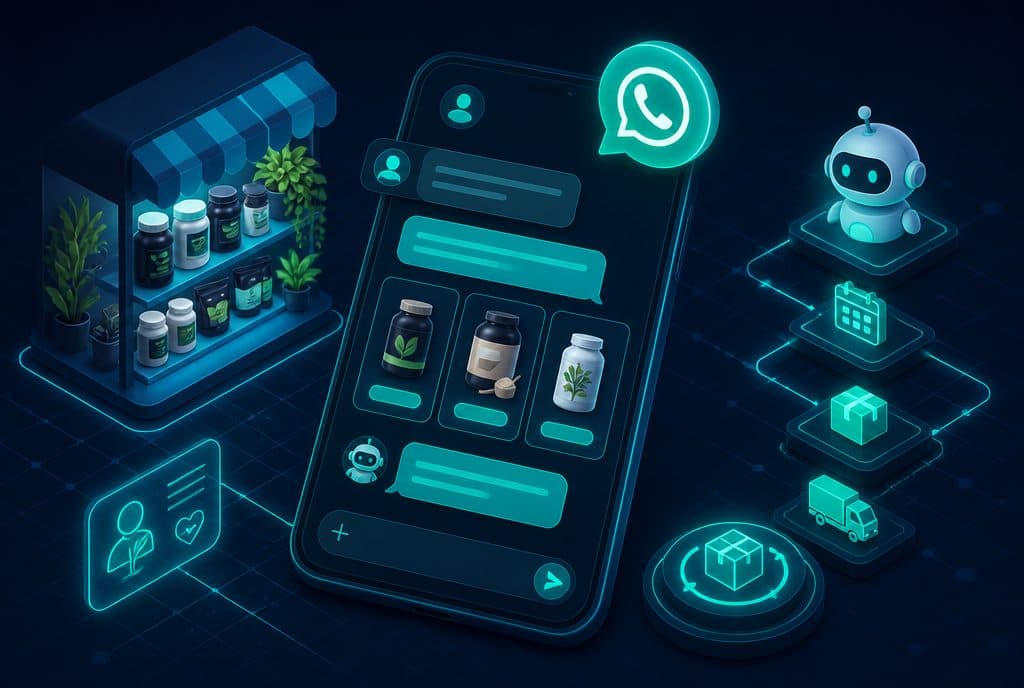

An agricultural business—whether it is a vegetable farm, a nursery, a packing house, or an export supplier—receives inquiries from all directions: buyers wanting to know what is available, B2B clients placing orders via WhatsApp, input suppliers waiting for approval, and logistics changing from day to day. All of this is usually managed manually—by the farm owner, by an employee who is also doing ten other things, or by no one during hours when it is impossible to be near the phone. Business automation and an AI WhatsApp bot can cover a large portion of this stream—receiving orders, confirming availability, coordinating delivery, and answering repetitive questions—without increasing the team size.
How does automation help an agricultural business?
Automation for an agricultural business connects existing communication channels (mainly WhatsApp and email) into an automated workflow: receiving an order, checking availability, confirmation, and coordinating delivery—all without human intervention for routine inquiries. The team only handles what requires human judgment.
What are the real challenges an agricultural farm faces?
Before talking about tools, let's be precise: what are the people in the field actually wasting time on?
- Orders arriving via personal WhatsApp—a buyer sends "Morning, do you have tomatoes?" and waits for an answer. If there is no response within a short time, they move on to someone else.
- Repetitive questions—pricelist, minimum order, delivery days, delivery areas. Everyone asks the same questions over and over.
- Delivery coordination—who arrives when, what needs to be prepared, who received confirmation, and who hasn't answered yet.
- Supplier tracking—ordering inputs, reminders, delivery confirmations.
- Communication with B2B buyers—retail chains, export, wholesale markets—a type of communication that repeats in a clear pattern.
Each of these challenges is an excellent candidate for automation—because it has a clear pattern, it is repetitive, and most cases require the same information.
Key Capabilities: What automation can do for an agricultural business
| Area | What the automation does | Common Tools |
|---|---|---|
| Receiving Orders | Buyer sends a message on WhatsApp, the bot checks availability and confirms | WhatsApp Business + n8n |
| FAQ | Automated response regarding pricelist, availability, delivery days | AI Agent + Knowledge Base |
| Delivery Coordination | Sending schedules to drivers/buyers, updating on changes | Automation + Google Sheets |
| Supplier Tracking | Automated reminders, delivery confirmations, delay alerts | n8n + Email/WhatsApp |
| B2B Communication | Updating buyers on crop availability, price quotes in a fixed format | Bot + Inventory Sheet |
| New Lead Management | New lead → Automated CRM → Follow-up | Automated Lead Management |
Concrete Scenarios: How it looks in practice
A nursery selling to landscapers and retail customers
A buyer writes on WhatsApp: "Do you have Ficus 120 cm? How much?". Without automation—someone needs to check the inventory, look up the price, and make a phone call. With an AI bot, the bot identifies the inquiry, checks the inventory sheet, replies with the price and minimum order, and asks "How many units? What is the delivery address?". A buyer who is ready to order right away finishes the order directly in the chat. The bot adds the order to the delivery log and sends a confirmation.
A vegetable supplier to retail chains
Coordination with retail chains involves many repetitive questions: "What is available this week?", "Price per kg of watermelon?", "When is the next delivery?". A bot connected to the weekly availability sheet answers all these inquiries without human intervention. When there is a change—a drop in quantity, a delayed crop—the bot proactively sends an update to the relevant buyers list.
An exporter working with international buyers
An international buyer sends an email with a price inquiry. The automation captures the email, extracts the inquiry details, adds them to the CRM, and sends an initial response with the catalog and updated pricelist—within minutes, not days. When a serious order arrives that requires negotiation, it is forwarded to the salesperson with all the context ready.
A vegetable farm selling directly to the public
Questions like "What do you have this week?", "What are the opening hours?", "Do you deliver?" are repeated dozens of times a day. A bot connected to the current crop list answers automatically, directs to a map, and sends a link for pre-ordering. During closed hours—the bot is still working, capturing inquiries and saving them for the morning.
Supplier Tracking: The part that is always forgotten
One of the streams that receives the least attention in agricultural businesses is communication with input suppliers. Ordering seeds, packaging, fertilizers—all of these involve a lot of repetitive communication: sending an order, requesting confirmation, reminding before delivery date, checking receipt.
Business automation can manage this entire sequence: an order is sent automatically according to a defined schedule, a reminder is sent 48 hours prior, and if there is no confirmation—an alert is sent to the purchasing manager. No need to track manually.
FAQs: An AI bot knows how to answer them
A large portion of the questions reaching an agricultural business are identical from person to person:
- What is the price for...?
- Is there a minimum order?
- Which areas do you deliver to?
- What are the delivery days?
- Is there a volume discount?
- When is the next arrival of...?
An AI agent connected to the business's knowledge base (pricelist, delivery areas, commercial terms) answers all of these accurately and up-to-date—even at 22:00 when the farm owner is already at home.
What automation does not replace?
Let's be direct: automation does not replace judgment in the field, relationship management with long-time buyers, or decisions on pricing and business strategy. It handles everything that is repetitive and can be clearly described—freeing up the team to focus on what truly requires a human.
Connection to the Privacy Protection Law
When dealing with the collection of buyer and customer data on WhatsApp and automated systems, the data must be managed in accordance with the Israeli Privacy Protection Law. In practice: saving customer data in a secure system, requesting clear consent before sending marketing messages, and allowing the customer to request removal. All of this can be built into the automation from the very beginning.
How to start?
The right approach is not to start with "I want to streamline everything." You start with characterization:
- Mapping the streams—which inquiries come in the most? What takes up the most time?
- Choosing the first scenario—incoming orders? FAQs? Delivery coordination?
- Building the narrow solution—one agent, one scenario, with clear measurement.
- Gradual expansion—after the first scenario works, add the next one.
A common first scenario for agricultural businesses: A WhatsApp bot that answers availability and price questions, connected to a sheet that is updated daily. This alone saves dozens of manual inquiries a week.
Want to know which scenario fits your business? Talk to us on WhatsApp—we will do a quick characterization and suggest where it makes sense to start.
Relevant Links
- Business Automation — Full Service
- WhatsApp Bot for Business
- Automation for Import and Wholesale Businesses
How much does it cost?
| Component | Price (one-time setup, ex-VAT) |
|---|---|
| WhatsApp AI sales agent | ILS 9,000 |
| Lead intake from Facebook / Instagram / website | ILS 2,000 |
| Connection to an existing system (CRM / Sheets / Monday) | ILS 2,500 |
| Automatic follow-up sequence | ILS 2,500 |
| WhatsApp Business API setup | ILS 700 |
A complete starting point — a WhatsApp AI agent including the business number, server and agent control room — is from ILS 10,200; an agent with a management system (CRM) from ILS 18,200, a multi-agent system from ILS 25,350. There is no monthly fee; third-party costs (server, messages, AI) of about ILS 100–500 a month are paid directly to the providers. The full component price list: pricing page.
Summary
An Israeli agricultural business—a farm, nursery, or export supplier—manages a high volume of repetitive communication: orders, availability questions, delivery coordination, supplier tracking. Most of this stream can be streamlined with an AI agent connected to WhatsApp, the work sheet, and existing systems—without fundamentally changing how the business operates. The result: fewer inquiries falling between the cracks, less time spent on routine communication, and more time to spend in the field. The right starting point is one clear scenario—not a revolution.