
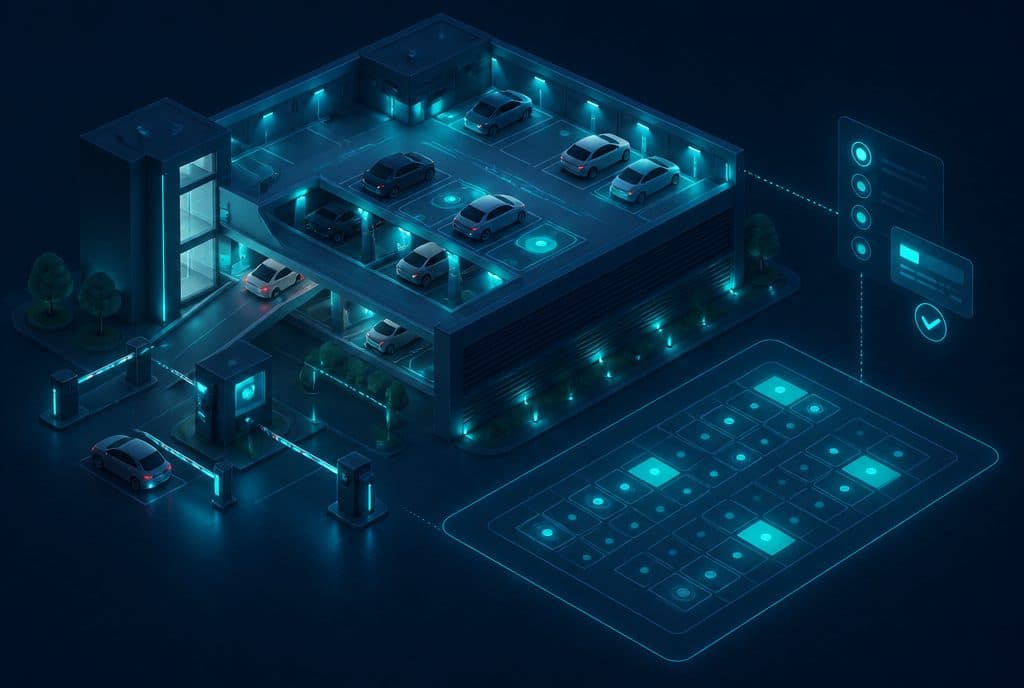
A parking lot or parking garage receives dozens, and sometimes hundreds, of inquiries a day: "Is there space for 6 hours?", "How much is a monthly subscription?", "Can I extend?", "Send me a payment link." During peak hours, the representative is busy, at night and on weekends there is no one to answer — and a customer who doesn't get a response looks for the next parking option. An AI bot for parking lots solves exactly this: it answers any question instantly, transfers bookings to the system, and sends payment reminders — 24/7, without a representative, in the language the customer chooses.
How Automation Helps Parking Lots
An AI bot for parking lots manages the entire lifecycle of basic inquiries: it answers availability and price questions, records bookings and integrates them into the management system, sends payment reminders before a subscription ends, and directs the customer to a renewal link — all automatically via WhatsApp, SMS, or the website. The human representative only receives inquiries that truly require human judgment: exceptions, complaints, and unique deals.
What Inquiries Reach a Parking Lot on a Regular Day?
Before deciding what to automate, it is worth identifying the inquiry patterns. Most parking lots report the same recurring categories:
- Availability questions — "Is there space for a heavy vehicle?", "Is it free right now?"
- Pricing inquiries — Hourly, daily, weekend rates, business contracts
- Subscriptions — Subscription details, joining, changing vehicles, cancellation
- Renewal and payment — "My subscription is ending, how do I renew?", non-receipt of invoice
- Pre-bookings — Securing a spot for an event, a flight, a medical procedure
- Logistical questions — Entrance height, opening hours, accessibility, charging stations
The first categories — availability, price, subscription, renewal — are prime candidates for automation: the answers are fixed, can be documented, and do not require special judgment.
What an AI Parking Bot Does in Practice: Capabilities Table
| Scenario | What the Bot Does | What is Left for the Representative |
|---|---|---|
| Availability question | Answers based on real-time system data | Edge cases (special event, exception) |
| Price question | Sends price list and explains options | Proposal for a large contract |
| Joining a subscription | Collects details and registers request | Final approval if required |
| Sending an invoice | Sends automatically with payment confirmation | Complex billing issue |
| Renewal reminder | Sends X days before subscription ends | Customer requesting a postponement |
| FAQ questions | Answers from the database (hours, height, disabled parking) | Question not in the FAQ |
| Pre-booking | Captures date and schedules in the system | Demand exceeding capacity |
| Complaint | Captures and transfers to representative with a summary | Handling and closure |
Three Key Scenarios in Depth
Scenario 1: Inquiry About a Monthly Subscription
A customer sends a WhatsApp message: "What is the price for a monthly subscription for an SUV?" The bot responds within seconds with the rate details, asks if the customer wants to proceed with the registration process, and if so — collects name, vehicle number, and payment information, and enters a request into the system. A renewal reminder is automatically sent 7 days before the subscription ends.
Scenario 2: Customer Who Didn't Receive an Invoice
"I paid but didn't receive an invoice." The bot verifies against the payment system, resends the invoice directly to the email provided by the customer — without waiting for a representative. If the record is not found, the bot opens a ticket and transfers it to a representative with all the details.
Scenario 3: Pre-booking for an Event
"I am coming for a medical procedure on July 10th, can I secure a spot for 3 hours?" The bot checks availability for the requested date, confirms, and sends a booking confirmation with a unique code and a payment link. A reminder is sent the day before the event.
Subscription Reminders: The Easiest Value to Prove
Subscriptions that do not renew are the silent leak of any parking lot. Setting up an automated reminder — a WhatsApp or SMS message 7 days before a subscription ends, and a second reminder the day before — significantly reduces the churn rate without a representative having to track each customer individually. The bot can also send a direct renewal link, so the action takes only a single click.
Automated FAQ
A good FAQ is one of the simplest components to automate — and also one of the most effective. Any question asked more than once a week is worth putting in the bot's FAQ. Common examples for parking lots:
- What is the maximum entrance height?
- Is there disabled parking?
- Are there charging stations for electric vehicles?
- What are the hours when staff is physically present?
- Do you accept cash payments?
- What happens if I exceed the end time?
Once the FAQ is defined, the bot answers it instantly at any hour — without waiting and without typing errors.
Privacy and Legal Compliance in Israel
When the bot collects customer details (name, vehicle number, payment details), these transactions are subject to the Israeli Privacy Protection Law and the regulations enacted under it. During the characterization stage, we define: what data is collected, how long it is kept, who is authorized to access it, and how a deletion request is implemented. Automaziot AI handles the technical aspects of compliance — secure storage, consent documentation, and deletion mechanisms — as a standard part of every project.
Connecting to an Existing Management System
Most parking management solutions (ParkingEye, EasyPark, EncorePark, and equivalent Israeli systems) expose an API or at least a structured data export. During the characterization stage, we check:
- What data can be pulled in real-time — availability, subscription list, payment status
- What actions can be written — registering a booking, updating a subscription, opening a support ticket
- What remains manual — actions that the system does not expose via API
When there is no API, export-based automations (a daily CSV file) can be built to synchronize subscription data — with a pre-known refresh limitation. n8n serves as the central integration layer connecting the bot to the end systems.
How to Get Started?
Our working approach is modular: we start with a narrow, controlled segment, prove value, and expand.
Step 1 — Characterization (3–5 business days): Mapping common inquiries, the initial FAQ list, identifying end systems, and checking the API. At the end of this stage, there is a clear specification: what the bot does, what it does not do, and where the boundary with the human representative lies.
Step 2 — Development and Testing (1–3 weeks): Building the bot, connecting to the WhatsApp Business API, integrating with the management system, setting up FAQ and booking scenarios. Testing with real scenarios from the parking lot.
Step 3 — Launch and Learning: Going live with conversation monitoring. Every two to three weeks, we add another scenario based on actual inquiry patterns.
If you manage a parking lot or a chain of parking lots and want to understand what can be automated in your business — talk to us on WhatsApp and we will perform an initial characterization together at no cost.
How much does it cost?
| Component | Price (one-time setup, ex-VAT) |
|---|---|
| AI customer-service agent | ILS 9,400 |
| Business knowledge base | ILS 3,000 |
| Connection to an existing system (CRM / Sheets / Monday) | ILS 2,500 |
| Alert to the team / owner | ILS 800 (per alert) |
| WhatsApp Business API setup | ILS 700 |
A complete starting point — a WhatsApp AI agent including the business number, server and agent control room — is from ILS 10,200; an agent with a management system (CRM) from ILS 18,200, a multi-agent system from ILS 25,350. There is no monthly fee; third-party costs (server, messages, AI) of about ILS 100–500 a month are paid directly to the providers. The full component price list: pricing page.
Summary
A parking lot is a business that runs on repetitive and predictable inquiries — and that is exactly where automation proves itself most clearly. An AI bot that answers availability and price questions, handles subscription requests, and sends renewal reminders does work that a representative does dozens of times a day — but 24/7 and without typing errors. The human representative is freed up for what truly requires them: negotiating a large contract, handling a complex complaint, ongoing management of the facility. The recommendation: start with FAQs and subscription reminders — two scenarios with clear value and fast implementation — and build from there.
For further reading on AI agents for businesses: What is an AI Agent for Business? | WhatsApp Agent for Business | Business Automation