
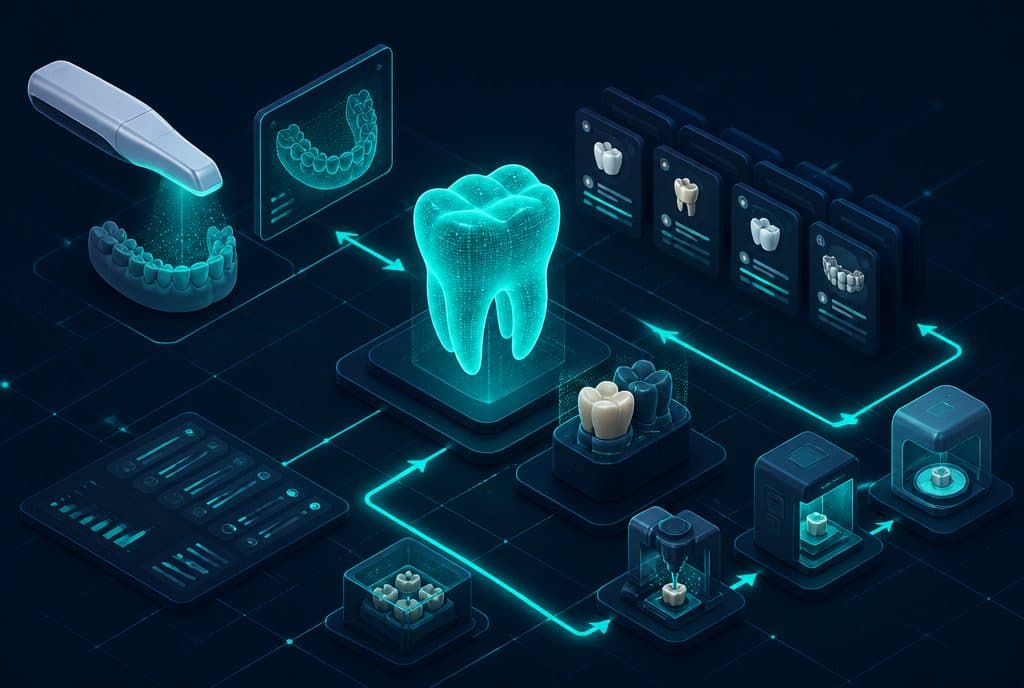
A dental laboratory receives dozens—sometimes hundreds—of inquiries from clinics every week: new work orders, status updates, delivery postponement requests, last-minute specification changes, and material reorders. Most labs still manage all of this via phone, private WhatsApp, and Excel. An AI agent connected to the order intake and production management process can handle the vast majority of this ongoing communication automatically—documenting, confirming, updating, and scheduling—while the technical team focuses on the actual work.
How Automation Helps a Dental Laboratory
An AI agent for a dental laboratory receives a work order from a clinic via WhatsApp or a web interface, automatically registers it in the management system, sends a receipt confirmation with an estimated delivery date, updates the clinic as the work moves through production stages, and schedules the delivery—without anyone in the lab having to manage the correspondence manually.
The Daily Challenges of a Dental Laboratory in 2026
A dental laboratory operates as a B2B business: the clients are clinics, not patients. This creates a unique operational dynamic:
- High volume of inquiries — An active clinic can send multiple orders per week, each with different details.
- Time pressure — A clinic waiting for a crown or bridge cannot postpone the patient indefinitely.
- Partial information management — "Where is the work for patient Cohen, which was supposed to be delivered today?"—a question that comes up repeatedly, answered by someone who has to stop what they are doing.
- Material requests — Routine equipment and material orders from suppliers, which also tend to fall between the cracks.
Automation does not solve the technical challenges of production itself—but it can free up significant hours from administrative and logistical communication that drains money and resources without adding value to the actual work.
What Can Be Streamlined: Capabilities Table
| Scenario | What the Agent Does | What is Left for the Human |
|---|---|---|
| Receiving a new order | Receives details (WhatsApp/form/email), opens a record in production management, sends a receipt confirmation with an order number and delivery date | Complex specification review, feasibility approval for non-standard work |
| Ongoing status updates | Sends an automatic update to the clinic at every stage transition (Production → Finishing → QC → Shipped) | Discussion regarding significant specification changes |
| Incoming status inquiry | Answers instantly from the system ("Cohen's work is in the finishing stage, expected delivery Wednesday") | None—the agent answers on its own |
| Delivery coordination | Identifies ready jobs, coordinates with the courier, sends a delivery confirmation message | Exceptional decisions (address change, postponement by a business day) |
| Material reordering | Identifies low stock (when connected to the inventory system), sends a replenishment order to the supplier based on defined parameters | Approval of orders above a set amount |
| Pre-delivery reminder | Sends a reminder to the clinic the day before delivery—to confirm the address and receiving time | — |
| Complaint/return tracking | Opens a ticket in service management, documents the issue, and routes it for handling | The actual technical discussion |
Three Practical Scenarios
Scenario A: Ordering a Crown from a Clinic at 8:00 PM
A dentist finishes their workday, takes a photo of an impression, and sends it to the lab's WhatsApp: "Cohen, #45, zirconia crown, shade A2, needed by next Wednesday." The agent identifies the inquiry, opens a new order, automatically asks any missing questions if needed (such as: "Is there a specific bite registration to note?"), and sends a receipt confirmation and order number. In the morning, the lab manager sees an organized order on the production board—not a half-fragmented message on a private WhatsApp.
Scenario B: A Clinic Inquiring About an Order in Progress
At 2:00 PM, a clinic sends a message: "What's happening with Bareket's teeth?" The agent searches by name, finds the order, and replies: "Bareket's order is currently in the staining stage and is expected to be ready for delivery tomorrow morning. Order number 2847." No one in the lab had to stop what they were doing.
Scenario C: Routine Material Reordering
At the beginning of each week, the agent checks the inventory of printing materials and/or discs and compares it to a predefined minimum level. When an item falls below the threshold, the agent generates an order for the supplier and sends it for approval to the lab manager. Inventory management stops being a matter of "we just realized we ran out."
Typical Integrations
A dental laboratory implementing automation will typically connect the agent to:
- Communication channel with clinics — WhatsApp Business API, email, or a dedicated ordering portal.
- Production management system (if applicable) — DentalVision, Exocad, Romexis, or a customized Excel/Google Sheets spreadsheet.
- Calendar and logistics — Google Calendar for delivery coordination, connection to a regular courier.
- Inventory — The existing inventory management system, or an automatically updated spreadsheet.
- Billing — Automatic invoicing after delivery, via smart CRM.
The core tool we use is n8n—an open automation platform that allows connecting any system to any system without being locked into a single vendor.
Important Considerations: Privacy and Regulation
A dental laboratory processes patient details—names, X-rays, scan files. It is important to know:
- All data is routed and stored in accordance with the Israeli Privacy Protection Law.
- STL files and clinical images are saved on secured servers with role-based access control.
- The agent can be configured not to store patient details—only an internal order number—and redirect to the record stored in the lab's system.
It is recommended to conduct a regulatory compliance check as part of the setup process.
How Much Automation Is Enough? A Modular Approach
You don't need to build everything in one day. The approach we recommend:
- Phase One—Order Intake and Confirmation: The agent receives the order, sends a confirmation, and opens a record. This alone saves phone follow-ups.
- Phase Two—Status Updates: The agent notifies the clinic at each production stage. This reduces "where is it" calls.
- Phase Three—Delivery Coordination and Reordering: Logistics and inventory come into play.
Each phase yields independent value. You can stop after the first phase and expand later.
Related Articles
- B2B Business Automation for Manufacturing and Industry — Shared principles for B2B businesses in manufacturing sectors.
- Business Automation—Our End-to-End Service — Tools, principles, and scenarios.
- Smart Customer Relationship Management (CRM) — For status updates, clinic files, and billing.
How to Get Started?
Step 1—Specification: Together, we will map out your current ordering processes—where orders come from, who handles them, and which questions recur.
Step 2—Pilot: We choose one core scenario (usually order intake and confirmation), connect it to the WhatsApp Business API and production management, and run it for 2-3 weeks.
Step 3—Expansion: Based on what we learn in the pilot, we add layers—status, deliveries, inventory.
Step 4—Ongoing Operation: The agent runs independently; we provide support with improvements and expansions as needed.
How much does it cost?
| Component | Price (one-time setup, ex-VAT) |
|---|---|
| WhatsApp AI sales agent | ILS 9,000 |
| Lead intake from Facebook / Instagram / website | ILS 2,000 |
| Connection to an existing system (CRM / Sheets / Monday) | ILS 2,500 |
| Automatic follow-up sequence | ILS 2,500 |
| WhatsApp Business API setup | ILS 700 |
A complete starting point — a WhatsApp AI agent including the business number, server and agent control room — is from ILS 10,200; an agent with a management system (CRM) from ILS 18,200, a multi-agent system from ILS 25,350. There is no monthly fee; third-party costs (server, messages, AI) of about ILS 100–500 a month are paid directly to the providers. The full component price list: pricing page.
Summary
A dental laboratory connected to an AI agent does not produce different dental work—but it manages the logistical-communication side in a way that is completely free from dependency on human availability. A clinic ordering on WhatsApp at 8:00 PM receives an immediate confirmation. A status question gets answered in 20 seconds. Delivery coordination is organized and confirmed without anyone stopping their work. And when the lab manager arrives in the morning, the board is organized—not a cluttered WhatsApp inbox.
Want to check if automation is right for your laboratory? Contact us and we will map out the right starting point together.