
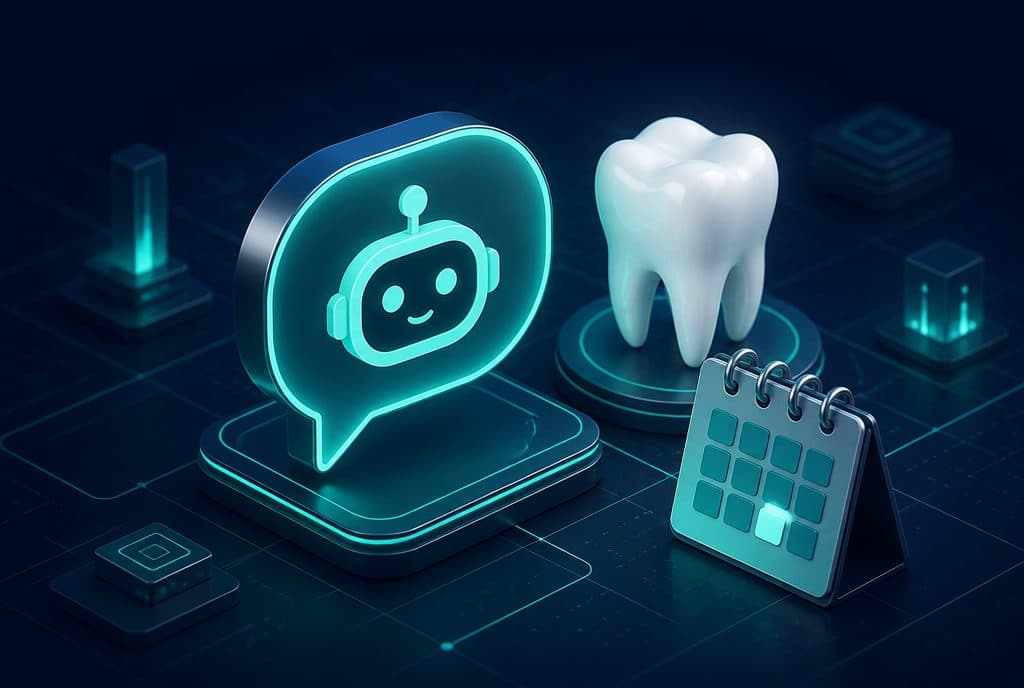
A dental clinic WhatsApp bot is an AI agent that schedules appointments, sends pre-treatment reminders, follows up on open treatment plans, and answers patients' frequently asked questions—all via WhatsApp, 24/7, without overloading the receptionist. The bot operates in natural Hebrew, connects to the clinic's calendar, and respects Israeli privacy protection laws.
A dental clinic with two doctors and one secretary faces a familiar reality: the phone rang again during a consultation call, a patient sent a WhatsApp message at 22:00 to check if their check-up appointment is still on, and three other patients with open treatment plans haven't returned to complete their crown treatments—and there is no time to follow up with them. Automation does not replace the staff; it handles repetitive tasks so the team can focus on caring for people.
How Does Automation Help a Dental Clinic?
Automation for a dental clinic means a WhatsApp bot that receives appointment requests and confirms them against the doctor's calendar, sends an automatic reminder 24 hours before the visit, follows up with patients who have an open treatment plan but haven't scheduled a continuation, and answers FAQs—what health funds cover, how much whitening costs, whether there is parking. Everything happens without human intervention in the initial stage, and inquiries requiring human judgment are forwarded to the staff with a full summary.
What a WhatsApp Bot Can Actually Do — Capabilities Table
| Scenario | What the Bot Does | What is Left for a Human |
|---|---|---|
| New appointment request | Checks availability in the calendar, offers slots, confirms, and sends confirmation | Complex treatments requiring prior doctor evaluation |
| Pre-visit reminder | Sends a message 24-48 hours prior, allows confirmation/cancellation/rescheduling | Last-minute cancellations requiring waiting list management |
| Treatment plan follow-up | Reminds the patient of an open treatment (crown, implant, alignment) and invites them to schedule | Medical decision on the continuation of treatment |
| Frequently Asked Questions | General pricing, hours, health funds, post-surgery instructions | Specific medical questions regarding the patient's condition |
| New patient | Collects name and contact details, sends a questionnaire, schedules a consultation | Initial clinical evaluation |
| Waiting list | When a slot opens up, offers it to the waiting list in order | Urgent cases requiring judgment |
Five Scenarios That Work
1. Patient requests an appointment at 21:30
A patient sends "I want an appointment for a dental cleaning." The bot checks the doctor's calendar, offers three available slots next week, receives confirmation, books the appointment, and sends a confirmation with the clinic's address. The receptionist sees the appointment the next morning and doesn't need to do a thing. Without a bot—the 21:30 inquiry would only be opened in the morning, and in the meantime, the patient might have reached out to another clinic.
2. Reminders that reduce no-shows
48 hours before any appointment, the bot sends a message: "Hello [Name], a reminder for your appointment on Thursday at 10:00 with Dr. Cohen. Confirm / Change / Cancel?" Anyone who cancels—opens up a slot that is automatically offered to the waiting list. Anyone who doesn't respond up to two hours before—the staff receives an alert and can call. No-shows are one of the most painful costs in a clinic; an active reminder (requiring a response) is much more effective than a passive message.
3. Treatment plan follow-up
A patient underwent an oral assessment, received a treatment plan including two crowns, said "I'll think about it"—and disappeared. Three weeks later, the bot sends: "Hello [Name], a few weeks ago you received a treatment plan. I'd be happy to help schedule a continuation whenever it's convenient for you." One click—and they are back in the conversation. Without a bot, this kind of follow-up depends on the receptionist's time—and usually doesn't happen.
4. Frequently asked questions via automated FAQ
"How much does teeth whitening cost?" / "Does Maccabi cover veneers?" / "Is there parking near the clinic?"—these are questions the staff answers dozens of times a week. The bot knows the answers in advance, replies within seconds, and frees up the staff for conversations that truly require a human. Inquiries with a specific clinical question ("Do I need an implant based on the X-ray?") are forwarded to the doctor with an explicit note that it is a medical question.
5. Interested new patient
"I saw you on Google, are you accepting new patients?"—the bot confirms, sends a link to a short questionnaire (age, dental insurance status, reason for inquiry), and schedules a consultation. The receptionist meets a new patient with the basic information already in hand—not starting from scratch.
Privacy and Medical Data — What You Need to Know
Medical information is classified under the Israeli Privacy Protection Law as sensitive information, which is subject to a stricter protection regime. When building a bot for a clinic, several principles guide the development:
What the bot does NOT do:
- Does not store medical content on an external server
- Does not analyze clinical findings or provide medical recommendations
- Does not store X-rays, test findings, or clinical records
What the bot DOES do:
- Schedules appointments (name, date, time, general treatment type)
- Sends reminders and scheduling follow-ups—not clinical content
- Receives general questions and forwards medical questions to the staff
Development rules:
- The data the bot collects is minimal—only what is required for scheduling
- Medical data remains strictly within the clinic management system
- A patient can request the deletion of their details at any time
Every clinic is responsible for defining its privacy policy. It is recommended to seek legal counsel regarding specific requirements for the medical field.
How to Get Started — Three Steps
Step 1: Map out repetitive inquiries
Before building—write it down. What questions does the staff answer more than five times a day? What inquiries arrive after hours? What is the current no-show rate? The answers define what the bot will handle first.
Step 2: Basic bot first, integration later
Start with a bot that answers FAQs and sends calendar reminders—even without full integration into the calendar. This provides immediate value and allows the staff to get used to the workflow. Later, connect it to the calendar and add automated appointment scheduling.
Step 3: Measure and adjust
After two weeks—check: how many inquiries did the bot handle without forwarding to the staff? How many appointments were confirmed automatically? What was the no-show rate before and after reminders? The data will guide what needs improvement.
A dental clinic that wants to reduce phone load, handle after-hours inquiries, and bring back patients with open treatment plans—talk to us and we will build a solution tailored to your size and style.
Additional FAQs
Does the bot work in Arabic and Russian? Yes. The language models we use conduct natural conversations in Hebrew, Arabic, and Russian—highly relevant for clinics serving a diverse population.
Do we need to replace our clinic management system? No. The bot works on top of the existing system. Integration depends on the interface the system allows—some provide an API, others require an external bridge. We check this specifically before implementation.
Do patients realize they are talking to a bot? The solutions we build are transparent: the bot introduces itself as the "clinic's digital assistant," not as a doctor or a human representative. Clinical questions or requests to speak with a human are forwarded immediately.
How much does it cost?
| Component | Price (one-time setup, ex-VAT) |
|---|---|
| AI booking agent — simple | ILS 8,000 |
| Calendar link and meeting booking | ILS 2,000 |
| Appointment reminders and confirmations | ILS 1,750 |
| Automatic follow-up sequence | ILS 2,500 |
| WhatsApp Business API setup | ILS 700 |
A complete starting point — a WhatsApp AI agent including the business number, server and agent control room — is from ILS 10,200; an agent with a management system (CRM) from ILS 18,200, a multi-agent system from ILS 25,350. There is no monthly fee; third-party costs (server, messages, AI) of about ILS 100–500 a month are paid directly to the providers. The full component price list: pricing page.
Summary
A dental clinic with a WhatsApp bot allows the staff to stop handling repetitive inquiries—reminders, appointment confirmations, pricing questions, scheduling requests—and focus on what only humans can do: caring for patients. The bot does not replace clinical judgment; it handles what is routine and straightforward.
The starting point is simple: a bot that answers FAQs and sends reminders, built within a week, proves itself—and then you expand. Full details on automated scheduling and WhatsApp bots for business are available on our service pages. And for those looking for a broader guide to clinic automation—see also our article on AI automation for clinics.