
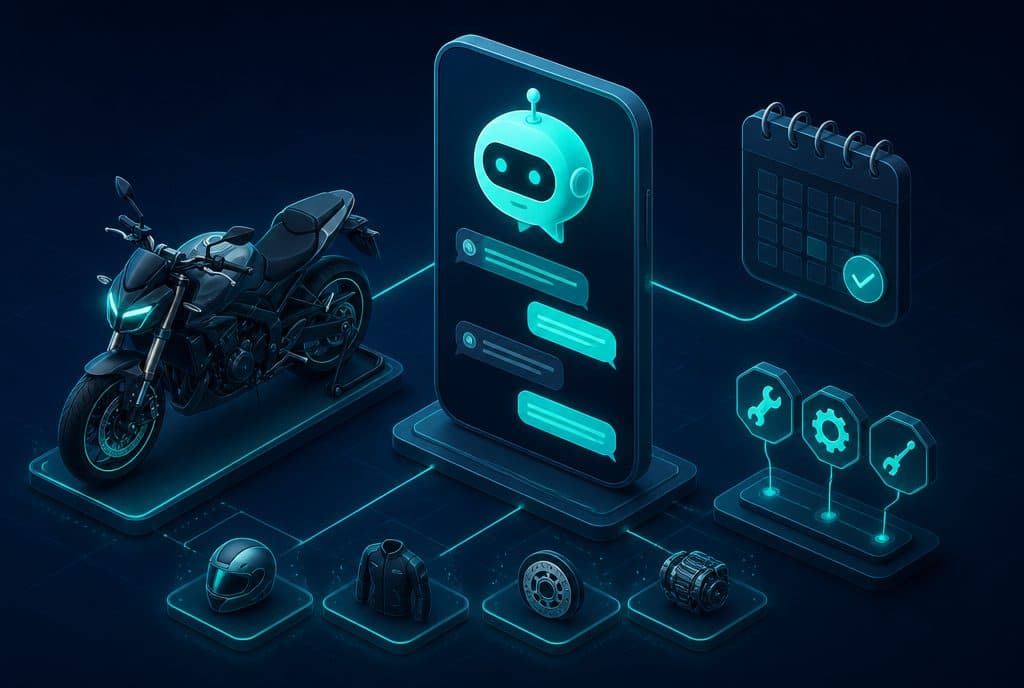
A WhatsApp bot for a motorcycle dealership is an AI agent that receives a customer inquiry, understands what they are looking for—model, budget, intended use—and guides them to the next step: a test ride, a price quote, or scheduling a service appointment. Everything happens on WhatsApp, 24/7, without overwhelming sales representatives with leads that aren't yet ready to close. In the Israeli market, where a significant portion of purchases begins with informational research before the buyer is ready to speak with a salesperson, the difference between an immediate response and a reply the next day is often the difference between a deal closed with you and one closed with your competitor.
How Automation Helps a Motorcycle Dealership
A WhatsApp bot for a motorcycle dealership answers questions about models and prices at any hour, filters leads based on purchase intent—license, budget, intended use—schedules test rides and service appointments directly in the calendar, and sends automatic service reminders. The team only sees leads that have been filtered and are ready for a conversation, rather than every initial inquiry.
The Problem Motorcycle Dealerships Know All Too Well
A motorcycle dealership receives vastly different types of inquiries: someone wanting to know "how much a commuter electric scooter costs," someone who just got their A1 license and is looking for their first bike, and someone who needs a 10,000 km service and wants to book an appointment. They all arrive on WhatsApp, at unpredictable hours, expecting a quick response.
The problem: when a sales rep is busy with a test ride or another call, inquiries pile up and go cold. A customer who doesn't get a response within an hour or two moves on to the next dealership on Google. This is just as true for motorcycles as it is for cars—as explained in depth in WhatsApp Bot for Car Dealerships.
What a WhatsApp Bot Handles in a Motorcycle Dealership
Information on Models, Prices, and Inventory
The customer asks, "Do you have the Honda CB500F? How much is it?" — the bot checks the current inventory, returns precise information about the model, and adds relevant details: engine displacement, horsepower, license compatibility, and available color options. If the model is out of stock, the bot suggests close alternatives and offers to put the customer on a waiting list.
Lead Qualification: Serious Buyer vs. Casual Browser
The most important qualification question in a motorcycle dealership isn't "what is your budget?"—it's "do you have a license?" A customer looking for a 650cc bike who doesn't have a license yet gets a different path (explanation of training programs, timelines, costs) compared to a customer with an active A license looking for their second bike. The bot collects: license type, budget, primary use (commuting, touring, racing), and purchase timeline. Based on this data, the lead receives a priority score—and only qualified leads are passed to a sales representative.
Scheduling Test Rides
"I want to try the Yamaha MT-07" — the bot checks availability, syncs with the calendar, and sends an automatic confirmation with the address and what to bring (license, helmet). 24 hours prior, the customer receives a reminder. After the ride, the bot sends a follow-up message: "How was the ride? Do you have any questions? Would you like to discuss financing?"
Booking Service Appointments and Reminders
An existing customer asks, "When is my next service?" — if the data exists in the system, the bot returns it. If not, it asks for the current mileage and schedules an appointment. A few days before the service, the bot sends a reminder with options to confirm, reschedule, or cancel. This significantly reduces no-shows and allows the workshop to plan its workload.
Automated Follow-up
A lead who visited the dealership a week ago and hasn't responded yet—the bot sends a message with a focused question: "Hi [Name], we wanted to check if you had any further questions about the MT-07 you rode. We are here to help." No pressure, no aggressive sales pitch, just a natural continuation of the conversation.
Capabilities Table
| Scenario | What the Bot Does | What's Left for the Rep |
|---|---|---|
| Price/Model Inquiry | Answers, attaches specs, suggests alternatives | — |
| Inventory Check | Checks in real-time, offers waitlist | — |
| License & Purchase Timeline Check | Asks, filters, assigns priority | Closing call with a qualified lead |
| Test Ride Scheduling | Schedules, sends confirmation, sends reminder | Managing the actual ride |
| Service Appointment Booking | Schedules, confirms, sends reminders | Performing the service |
| Post-Visit Follow-up | Sends targeted follow-up | Closing call when the customer responds |
| General Financing Inquiry | Explains general options | Specific financing details |
| Lead Without a License Yet | Explains training paths, stays in touch | — Until the customer is ready |
Three Scenarios Showing How It Works
Scenario A: The Urban Commuter Friday at 10:00 PM. Someone writes: "I'm looking for an electric scooter for my commute to work, about 30 km round trip. Budget up to 20,000 ILS." Within seconds, the bot replies with three models that fit the range and budget, including a comparison of battery range and charging costs. It asks if they have parking with an electrical outlet. At the end of the conversation, the lead details are in the CRM with the tag "fits electric scooter, budget 20K, schedule test ride for Sunday." Sunday morning, the sales rep opens the CRM and sees a hot lead who already knows exactly what they want.
Scenario B: The Returning Rider A man in his 40s asks about a touring motorcycle up to 150,000 ILS. He has an A license from 2003 but hasn't ridden in years. The bot asks about his experience, style, and type of trips. It suggests three adventure/touring models and adds a question about seat height (an important consideration when returning to riding after a break). It invites him to schedule a test ride back-to-back for two models on the same day.
Scenario C: The Service Customer An existing customer writes: "Hey, I'm due for a service." The bot checks the name and license plate, confirms that the CBR650R has reached 10,000 km, schedules an appointment for Tuesday at 09:00, asks if there are any other issues besides routine maintenance, and sends a confirmation with the details. The team gets an organized booking without a single phone call.
The Privacy Protection Law Question
When connecting a bot to WhatsApp and storing customer data—name, phone number, purchase preferences—the Israeli Privacy Protection Law applies. In practice, this means: transparency with the customer regarding data storage, not sharing data with third parties without consent, and reasonable security measures. The bot can include a privacy policy consent at the beginning of the conversation. A lawyer is the right professional for specific legal advice tailored to your dealership.
How to Get Started
Step 1 — Scenario Mapping: Write down the types of inquiries you receive in a typical week. Usually, 80% of them fall into 5-7 recurring categories.
Step 2 — Defining Boundaries: Decide what the bot answers and what gets passed to a representative. A rule of thumb: anything a salesperson explains twice a day can be automated.
Step 3 — System Integration: Excel sheet? CRM? Google Calendar? It is during the mapping stage that you define the automated lead management—so that every detail the customer provides to the bot immediately appears in their record.
Step 4 — Training on Your Catalog: The bot learns your models, prices, and test ride policies. This is not a generic bot—it speaks about your dealership, in your style.
Step 5 — Pilot and Optimization: Start with one clear scenario, measure, and expand. Don't try to launch everything on day one.
How much does it cost?
| Component | Price (one-time setup, ex-VAT) |
|---|---|
| WhatsApp AI sales agent | ILS 9,000 |
| Lead intake from Facebook / Instagram / website | ILS 2,000 |
| Connection to an existing system (CRM / Sheets / Monday) | ILS 2,500 |
| Automatic follow-up sequence | ILS 2,500 |
| WhatsApp Business API setup | ILS 700 |
A complete starting point — a WhatsApp AI agent including the business number, server and agent control room — is from ILS 10,200; an agent with a management system (CRM) from ILS 18,200, a multi-agent system from ILS 25,350. There is no monthly fee; third-party costs (server, messages, AI) of about ILS 100–500 a month are paid directly to the providers. The full component price list: pricing page.
Summary
A motorcycle dealership that implements a WhatsApp agent doesn't replace its salespeople—it allows them to focus on conversations that are ready to close, instead of answering the same informational questions over and over. Leads arriving at night or over the weekend don't go cold; service customers receive reminders and show up; and follow-ups that used to be forgotten manually now happen automatically. The Israeli market is fast and competitive—a customer who isn't answered within an hour is already on their way to another dealership.
Want to build a WhatsApp bot for your motorcycle dealership? Contact us and let's define which scenario to start with.