
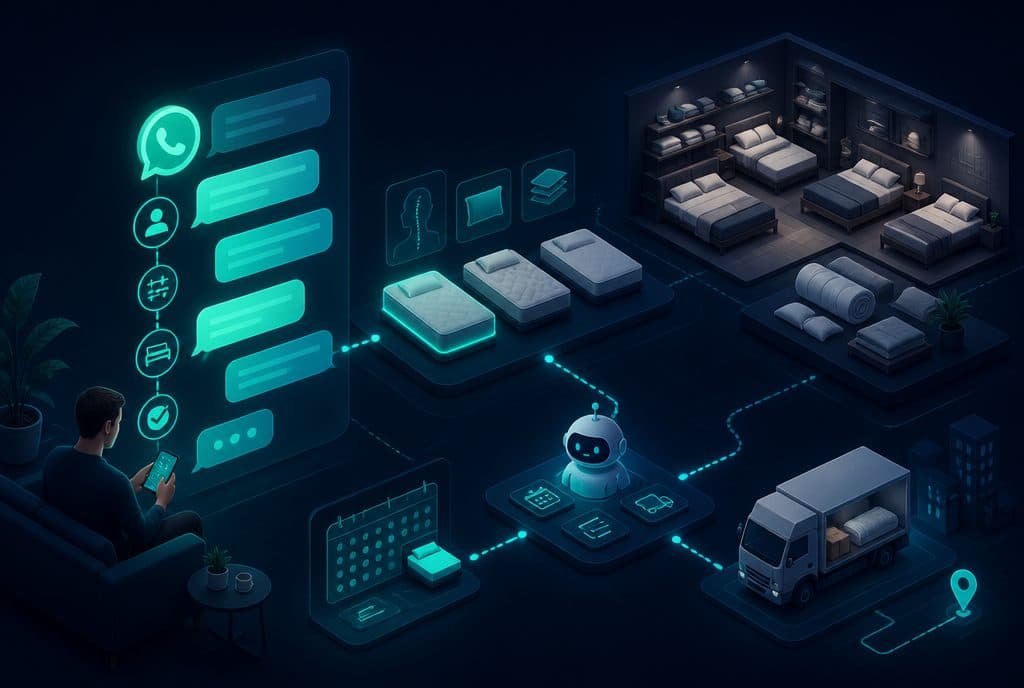
A WhatsApp bot for a mattress store is an AI agent that manages all stages of the purchasing process via chat — from a recommendation questionnaire covering size and firmness, through inventory checks and delivery coordination, to handling warranty claims and post-sale questions. It answers 24/7 on WhatsApp, writes data to the CRM, and routes to a human representative only when real intervention is needed. For mattress and bedding stores in Israel that receive dozens of repetitive inquiries a day, this saves hours of manual work and prevents lead loss during hours when the store is closed.
Purchasing a mattress is not impulsive. The customer asks questions: What is the difference between springs and memory foam? What firmness is recommended for side sleepers? Is there stock in 160x200? When can I get delivery? — and then waits for an answer. If the answer doesn't arrive quickly, they open another tab and look for a competitor. A WhatsApp bot connected to the catalog and inventory closes this phase without a representative needing to be available.
How Automation Helps a Mattress Store
Automation for a mattress store is connected to WhatsApp, the product catalog, and the inventory system — allowing an AI agent to answer recommendation questions (size, firmness, material), check real-time availability, coordinate delivery dates, and send reminders before delivery. Warranty claims and usage questions that arrive weeks after the purchase are handled automatically — without waiting in line and without overloading the team.
What the Bot Actually Handles: Capabilities Table
| Scenario | What the Bot Does | What is Left for a Human |
|---|---|---|
| Mattress Recommendation | Short questionnaire → Recommendation from catalog | Complex consultation / In-store testing |
| Inventory Check | Question about size/model → Real-time answer | Handling shortages or special orders |
| Delivery Coordination | Date selection from calendar → Automatic confirmation | Exceptional changes, floor without elevator |
| Pre-delivery Reminder | Message the day before + attendance confirmation | Handling cancellations or postponements |
| Warranty Claim | Receiving complaint → Form + opening a ticket | Physical inspection, replacement approval |
| Post-sale Questions | Answering usage and maintenance questions | Exceptional inquiry / Uncovered damage |
| Customer Follow-up | Sending satisfaction question after a week | Handling dissatisfaction |
Example Use Cases
Scenario 1: An Interested Customer on Friday Night
A customer writes on WhatsApp at 23:30: "I'm looking for a 160x200 mattress, I sleep on my side and have back pain. What do you recommend?"
The bot conducts a short questionnaire: body weight, whether they sleep alone, estimated budget. After three questions — two targeted recommendations, links to product pages, and a question: "Would you like to check availability and schedule a store visit?" — the customer is entered into the CRM with all the data, and a representative gets back to them on Sunday for a prepared conversation.
Scenario 2: Delivery Coordination After Purchase
An online purchase is completed. The bot automatically sends a WhatsApp message: "Your order is confirmed! When is it convenient for you to receive the mattress?" — and displays a weekly calendar with available delivery windows. The customer chooses, receives confirmation, and the day before delivery — an automatic reminder with the driver's name and time range. All without a single phone call.
Scenario 3: Warranty Claim
A customer who purchased a mattress four months ago writes: "The mattress sagged on the left side, do I have a warranty?" — The bot checks the customer's profile in the CRM for the purchase date and warranty details, sends instructions for taking photos, opens a ticket in the system, and forwards it to a service representative with all the data ready. The customer feels answered — not forgotten.
Scenario 4: Bedding and Accessories Questions
A customer who purchased a 160×200 mattress asks "Which bedding fits?" — The bot knows the mattress dimensions from the previous purchase, sends targeted recommendations from the bedding department, and offers to complete another order on WhatsApp. A cross-sell that works without a salesperson needing to remember that the customer exists.
How to Get Started: Four Practical Steps
Step 1 — Characterizing Repetitive Inquiries. Write down the ten questions your team receives the most: product questions, availability questions, delivery requests, warranty claims. These are the first scenarios for automation.
Step 2 — Mapping Existing Systems. Which system manages inventory? Is there a CRM? A delivery calendar? Every integration built connects the bot to real data — rather than a manual answer that someone needs to update.
Step 3 — Modular Building. Start with one scenario: usually, product questions and inventory checks. After that is working and stable — add delivery coordination, then warranty. Gradual building helps see value quickly and prevents mistakes that are hard to fix later.
Step 4 — Defining "When to Transfer to a Human". Not every inquiry is suitable for automation. An inquiry from an angry customer about unusual damage, an order with a special request, a situation the bot doesn't recognize — all of these transfer to a representative with a summary of the conversation, so the human continues from where the bot left off.
Useful Links
For those who manage a sleep furniture store and want to understand the broader picture, here are three directly relevant links:
- E-commerce Automation — Everything related to managing orders, inventory, customer communication, and automations in e-commerce, including solutions for stores that sell both online and physically.
- Smart Agent for WhatsApp — The platform on which all the bots described here run: WhatsApp Business API, n8n for automations, and a connected CRM.
- WhatsApp Bot for Furniture Stores — A complementary article on automation in furniture stores in Israel, with a lot of overlap with the mattress and bedding field.
Before We Wrap Up: What to Pay Attention To
Privacy Protection Law. Any information the bot collects from customers — name, phone, purchase details — must be stored and handled in accordance with the Israeli Privacy Protection Law. A customer can request to delete their details, and it must be clearly explained what information is saved and why.
A Bot Does Not Replace In-Store Consultation. A mattress is a product people want to try before they buy. The bot is excellent for filtering, warming up, and initial consultation — but does not replace the in-store experience. The goal is to bring the customer closer to a visit, not to close every deal in the chat.
Content Maintenance. Product catalogs and prices change. It is important to pre-define an update process: from where the bot pulls the information, and who is responsible for updating it. A bot selling a product that is out of stock creates greater dissatisfaction than no response at all.
How much does it cost?
| Component | Price (one-time setup, ex-VAT) |
|---|---|
| WhatsApp AI sales agent | ILS 9,000 |
| Lead intake from Facebook / Instagram / website | ILS 2,000 |
| Connection to an existing system (CRM / Sheets / Monday) | ILS 2,500 |
| Automatic follow-up sequence | ILS 2,500 |
| WhatsApp Business API setup | ILS 700 |
A complete starting point — a WhatsApp AI agent including the business number, server and agent control room — is from ILS 10,200; an agent with a management system (CRM) from ILS 18,200, a multi-agent system from ILS 25,350. There is no monthly fee; third-party costs (server, messages, AI) of about ILS 100–500 a month are paid directly to the providers. The full component price list: pricing page.
Summary
A mattress and bedding store that connects a WhatsApp bot to its purchasing processes — recommendations, inventory, delivery, warranty — creates a seamless customer experience without increasing headcount. The customer gets an answer at a time convenient for them, the team is freed up to handle conversations that truly require a human, and not questions that the bot can solve in seconds. The right approach is to start narrow — one or two scenarios — make sure it works, and expand.
Want to understand what such automation would look like for your store? Talk to us on WhatsApp and let's map out together which scenarios are best to start with.