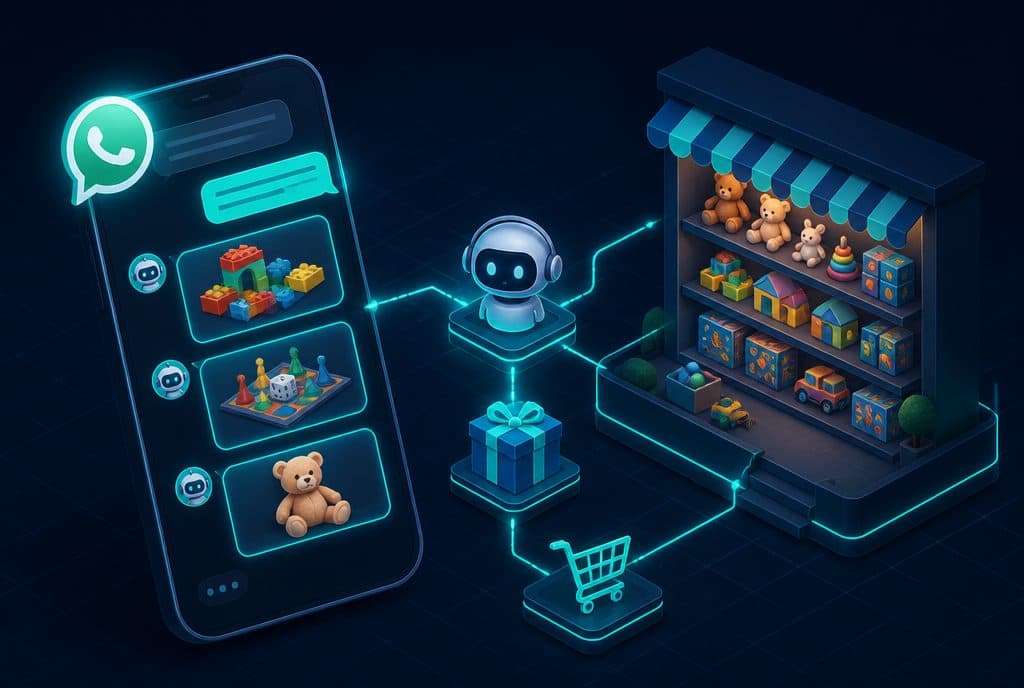

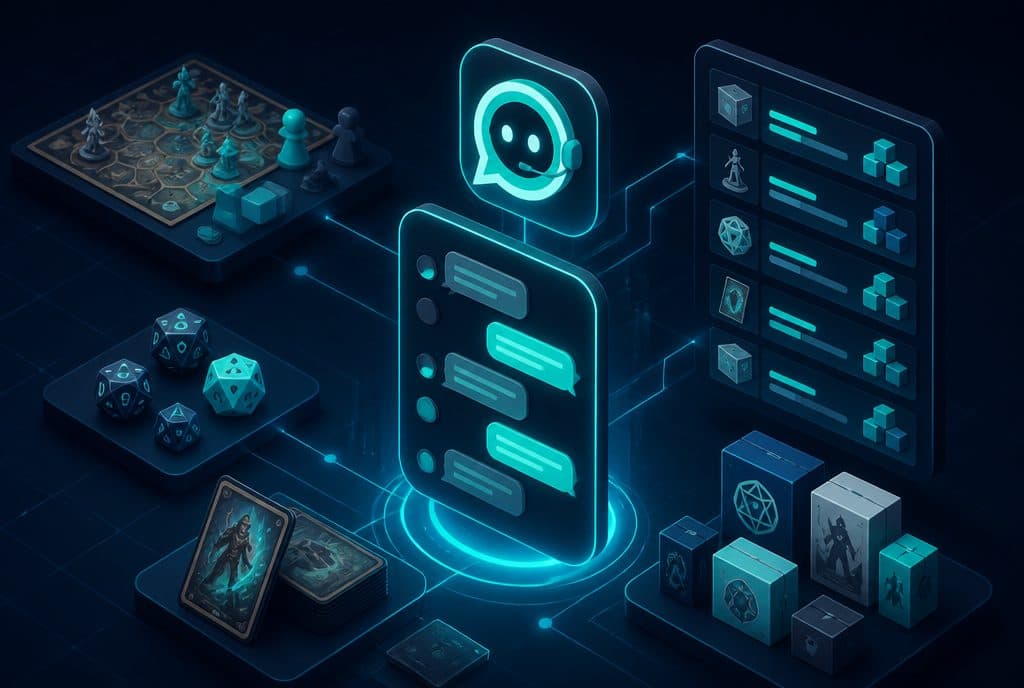
A WhatsApp bot for a hobby, board game, or comic book store is a tool that allows the store to automatically answer inventory and price questions, accept pre-orders, register customers for events and tournaments, and send updates on product releases — 24/7, right through the WhatsApp that customers are already using anyway. This is a direct solution to one of the central problems of specialized stores: a high volume of direct, repetitive questions that land exactly when the staff is busy with in-person service.
How does automation help a hobby store?
A WhatsApp bot saves a hobby store the time spent on dozens of daily repetitive questions — "Do you have X in stock?", "When is the next event?", "Can I make a preorder?" — and allows the staff to focus on service that requires a human: in-depth consultation, running events, and building a community. The bot answers immediately, day and night, and transfers to a representative only when necessary.
Why WhatsApp — and not an app, email, or form?
Hobby and board game stores attract a highly connected audience. Customers write directly to the store on WhatsApp because that's what they do with friends — not because it's a store "policy." They won't open a dedicated app, fill out a form, or send an email.
The problem: when the store is small, WhatsApp questions arrive exactly at peak times — Friday afternoon, the eve of an event, or when someone has left and the inventory hasn't been updated yet. The bot does not replace the staff; it takes away the messages that don't require human judgment and leaves them with the conversations that do.
What can a WhatsApp bot do in a hobby store?
| Scenario | What the bot does | What is left for a human |
|---|---|---|
| Inventory and price inquiry | Answers based on an updated catalog, sends a purchase link | Periodic catalog updates |
| Pre-order | Collects name, phone, and item, confirms and registers | Payment and delivery confirmation |
| Event / Tournament registration | Registers participants, sends confirmation and reminder | Running the actual event |
| Waitlist | Adds to the list, notifies when stock arrives | Final confirmation and sale |
| Product recommendation | Asks 3-4 questions and presents targeted recommendations | Complex consultation requiring experience |
| Opening hours and location | Answers immediately, 24/7 | — |
| Club member updates | Sends bulk updates on releases / promotions | Determining message content |
Example Scenarios: A Day in the Store with a Bot
Friday, 16:00 — Peak Rush Hour
A customer sends: "Hi, do you have Gloomhaven Frosthaven?" The bot checks the catalog and answers: "Yes, Frosthaven is available — 1 copy left. The price is ₪649. Would you like to reserve it? Send 'reserve' and I will collect your details." The customer sends "reserve" — the bot collects their name and phone number, sends a confirmation, and registers the item as "waiting for pickup." The store staff saw the registration on the management dashboard — and set it aside.
Sunday Night, 23:30
A new customer sends: "When is the next Magic tournament?" The bot: "The next tournament is Thursday, June 28, at 19:00. Spots: 12. 4 left. Would you like to register?" Customer: "Yes." The bot collects their name and number, sends a confirmation, and an automatic reminder 24 hours before. The staff discovered at 9:00 AM that there are 4 more registrants and only one spot left.
Waitlists: A Tool Most Hobby Stores Don't Use
Rare products, limited editions, and out-of-stock games — these are exactly the cases where a customer writes "when will it be back?" and doesn't get an answer because it's impossible to know.
A bot can manage a simple waitlist: "You are registered. When stock arrives, we will send you a direct message." When the inventory is updated (manually or through a management system), the bot sends a message to everyone on the list — with a direct link to purchase. This retains customers who would otherwise turn to a competitor.
Events and Tournaments: The Registration Usually Managed in Google Sheets
Hobby stores host events — game nights, tournaments, introduction days for new games. Registration is often managed in a WhatsApp group, Google Forms, or direct messages to the owner. This is cumbersome and leads to no-shows.
A bot connected to n8n can send every registrant a reminder the day before the event, collect attendance confirmation, and export an organized list for the staff. Fewer no-shows — more spots utilized — less manual work.
Customer Club: Loyalty Through WhatsApp
A hobby store builds repeat customers. A bot can support this in a few simple ways:
- Club Registration: The customer sends "club", the bot registers them and sends a confirmation.
- Release Updates: Proactive messages to subscribers when a new item arrives from a category they indicated interest in.
- Member Promotions: Periodic messages with an exclusive discount code for club members.
All of these can be executed via n8n — without managing complex tools. It is important to ensure that any proactive outreach to a customer is based on explicit consent in accordance with the Israeli Privacy Protection Law.
Connecting to Existing Systems: What is Relevant for a Hobby Store?
Unlike a large e-commerce chain, a hobby store often manages inventory in Google Sheets, POS software, or an internal table. This is not a problem — a WhatsApp bot connected to n8n can read from a variety of sources and update them.
Common integrations for hobby stores:
- Google Sheets — Basic inventory catalog, event registration
- POS System — Real-time availability checks (depending on API)
- Google Calendar — Coordinating pickup times, event reminders
- Simple CRM — Customer records, waitlists, preferences
You don't have to connect everything on day one — the right approach is to start with one scenario and expand. See also E-commerce and Store Automation.
How to Get Started?
- Map Scenarios — Write down the 5 questions you receive most often on WhatsApp. These are your starting point.
- Choose a Channel — WhatsApp Business API for a full bot, or start with a simple bot and grow from there.
- Build and Integrate — We configure the bot, connect it to your inventory and calendar, and train it on your store's specific questions.
- Controlled Launch — Activate it for 20% of the traffic, test, fine-tune — and then expand.
Want to understand if a WhatsApp bot is right for your store? Talk to us — we will map out together which scenarios are best to start with and what is expected to save you the most time.
How much does it cost?
| Component | Price (one-time setup, ex-VAT) |
|---|---|
| AI order-taking agent | ILS 7,500 |
| Payment link and checkout inside the chat | ILS 2,800 |
| Business knowledge base | ILS 3,000 |
| Automatic follow-up sequence | ILS 2,500 |
| WhatsApp Business API setup | ILS 700 |
A complete starting point — a WhatsApp AI agent including the business number, server and agent control room — is from ILS 10,200; an agent with a management system (CRM) from ILS 18,200, a multi-agent system from ILS 25,350. There is no monthly fee; third-party costs (server, messages, AI) of about ILS 100–500 a month are paid directly to the providers. The full component price list: pricing page.
Summary
An Israeli hobby, board game, or comic book store faces the same challenge as any specialized store: connected customers who want immediate information, changing inventory, and events that require coordination — and usually a small staff that has to handle it all. A WhatsApp bot doesn't solve every challenge, but it saves the time spent on repetitive questions and allows the staff to focus on what people actually come to the store for: the expertise, the community, and the recommendation that only a human can give.
Read more: WhatsApp Bot for Retail Stores | WhatsApp Agent Service | Online Store Automation