

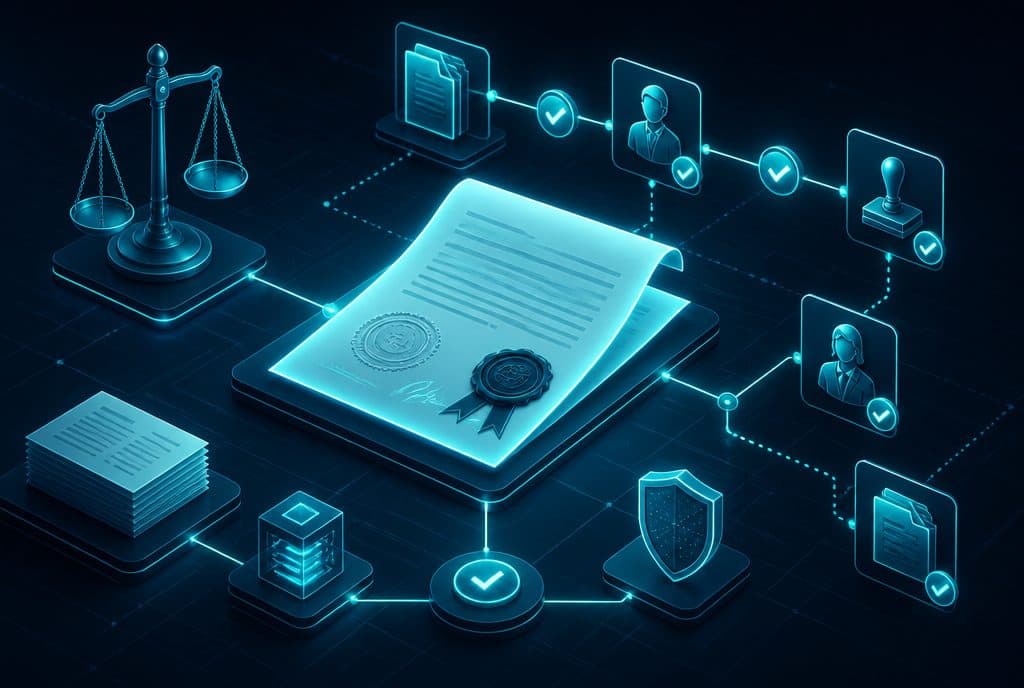
A notary receives dozens of inquiries a day—WhatsApp, phone, email—most of which ask the exact same thing: "What documents do I need to bring for an apostille?", "How much does a signature verification cost?", "When do you have an opening?". Each such call takes two to five minutes, generates no direct income, and repeats dozens of times a week. An AI bot and business automation can handle this screening phase—classifying the request, sending the exact document list, collecting initial details, and scheduling a meeting—allowing the notary to focus on the actual notarial work.
How Automation Helps a Notary?
An AI agent classifies every incoming inquiry by service type (signature verification, apostille, notary translation, etc.), automatically sends the list of required documents, collects initial details from the client, and offers an available time slot on the calendar—24/7, in natural Hebrew, without the notary having to touch the phone during the initial screening phase.
What Automation Can Do—and What It Cannot
Before starting to build, it is important to define clear boundaries. Automation in legal-notarial services is suitable for the stage before meeting with the notary, and the scheduling and follow-up stage after it—not for the substantive part of the work itself.
What Automation Does
| Stage | What the Agent Performs |
|---|---|
| Receiving an inquiry | Responds to inquiries on WhatsApp / form / email within seconds |
| Classifying the request | Identifies the service type: signature verification, apostille, notary translation, power of attorney, prenuptial agreement, affidavit verification |
| Document list | Sends an exact list based on the confirmed service type |
| Collecting details | Collects name, phone number, and what else the client knows about their need |
| Scheduling a meeting | Displays available time slots, confirms, and books in the calendar |
| Reminders | Sends a reminder the day before the meeting with the document list again |
| Status update | Updates the client when a document is ready for pickup (after a manual update from the notary) |
What Automation Does Not Do
- Does not provide legal advice—any question requiring interpretation, legal assessment, or personal recommendation is routed directly to the notary.
- Does not verify documents—checking validity, identifying forgeries, and verification is solely the notary's role.
- Is not committed to every inquiry—when a client describes a complex situation, the agent transfers it to the notary with a full summary of the conversation.
Privacy Protection: Any information collected from the client (name, documents, inquiry content) is handled in accordance with the Israeli Privacy Protection Law. The system is configured so that sensitive details are not saved in the log unless specifically defined—and we map the storage points as part of the characterization process.
Common Scenarios in Notarial Practice
Scenario 1—Apostille for Aliyah Purposes
A client writes on WhatsApp: "I need an apostille on a birth certificate for a visa." The agent responds within seconds: identifies that it is an apostille, sends a detailed list (original birth certificate, two hours before the meeting), and asks "Which country is the document intended for?"—since some countries require an accompanying translation. Based on the answer, the list is updated and available meeting times are displayed.
Scenario 2—Notary Translation for a Contract
A company sends an email: "We need a notary translation for a lease agreement from English to Hebrew." The agent asks how many pages, what the timeline is, and if there is a target date. The notary receives all the details in one place, sets an exact price and time estimate, and only then is a meeting scheduled—while the agent updates the client that there is manual approval from the notary before the final booking.
Scenario 3—General Power of Attorney
Someone writes: "I want to make a power of attorney for my mother." The agent classifies the request and replies: "With pleasure. For a general power of attorney, IDs of both of you and the presence of both of you at the meeting are required. Are we talking about a regular or an ongoing power of attorney?"—a question aimed at the correct type. At this stage, if the client is unsure, the agent transfers them to the notary for a brief call.
Lead Management: Don't Lose an Inquiry Due to Response Time
A high percentage of inquiries to a notary arrive during hours when the office is unavailable—evening, night, Friday. A client who doesn't receive a response by morning has usually already turned to another notary.
An automated lead management system ensures that every inquiry receives an immediate response with useful information—even at midnight. The notary starts the workday with an organized list of inquiries that have already undergone initial screening, complete with client details and request type.
Appointment Scheduling: A Calendar That Manages Itself
Automated scheduling is one of the areas where the savings are most tangible in notarial practice:
- The client chooses a time from a list of available slots—without a coordinating phone call
- Confirmation is sent automatically with the details and the document list
- A reminder the day before significantly reduces the no-show rate
- Automatic cancellation—when a client cancels, the slot reopens
The agent can be configured so that meetings for certain services (complex affidavit, prenuptial agreement) require manual approval by the notary before booking—maintaining control over the schedule.
Automation and Professional Confidentiality
Lawyers and notaries are required to maintain professional confidentiality. When building the system, we adhere to several principles:
- The agent does not save document content—it manages logistics (lists, meetings, reminders), not legal content processing.
- Restricted access—only the notary and their authorized assistants access client data.
- Client details are saved in a protected environment in accordance with the Israeli Privacy Protection Law.
- The agent states at the beginning of the conversation that it is an automated system—there is no deception.
We map all storage and access points as part of the characterization process, before setting anything up.
Connections with Similar Services
If you are a lawyer or legal advisor (not just a notary), the article automation for lawyers and accountants details additional scenarios—lead management from ads, pre-meetings, and follow-up with existing clients.
How to Get Started
Step 1—Characterization: A working call of about 45 minutes to map out: how many inquiries arrive per day, through which channels, what questions repeat, and what currently takes up the most time. No obligation.
Step 2—Detailed Proposal: After the characterization, we present a plan detailing what will be built, how long it will take, and the cost.
Step 3—Building: We start with a narrow agent—usually classification + document lists—ready within two weeks, and expand after it proves itself.
Step 4—Training and Support: The notary and their assistants receive brief training. Following that—ongoing support for content updates and procedure changes.
Want to build such a system? Leave your details—we will get back to you to schedule a no-obligation introductory call and build a customized proposal for your practice together.
How much does it cost?
| Component | Price (one-time setup, ex-VAT) |
|---|---|
| AI customer-service agent | ILS 9,400 |
| Document collection on WhatsApp | ILS 4,000 |
| Data extraction from documents (OCR) | ILS 3,500 (per document type) |
| ERP / accounting integration | ILS 4,500 |
| Automatic document generation | ILS 4,500 |
A complete starting point — a WhatsApp AI agent including the business number, server and agent control room — is from ILS 10,200; an agent with a management system (CRM) from ILS 18,200, a multi-agent system from ILS 25,350. There is no monthly fee; third-party costs (server, messages, AI) of about ILS 100–500 a month are paid directly to the providers. The full component price list: pricing page.
Summary
Notarial practice is a service with high demand for repetitive logistical questions—document types, availability, cost—which is highly suitable for automation at the screening stage. An AI agent that receives inquiries 24/7, classifies the request, sends a document list, and schedules a meeting—without touching the legal work or providing advice—frees the notary from the bulk of administrative communication. The right approach: start with one clear scenario, build it right, and expand gradually.