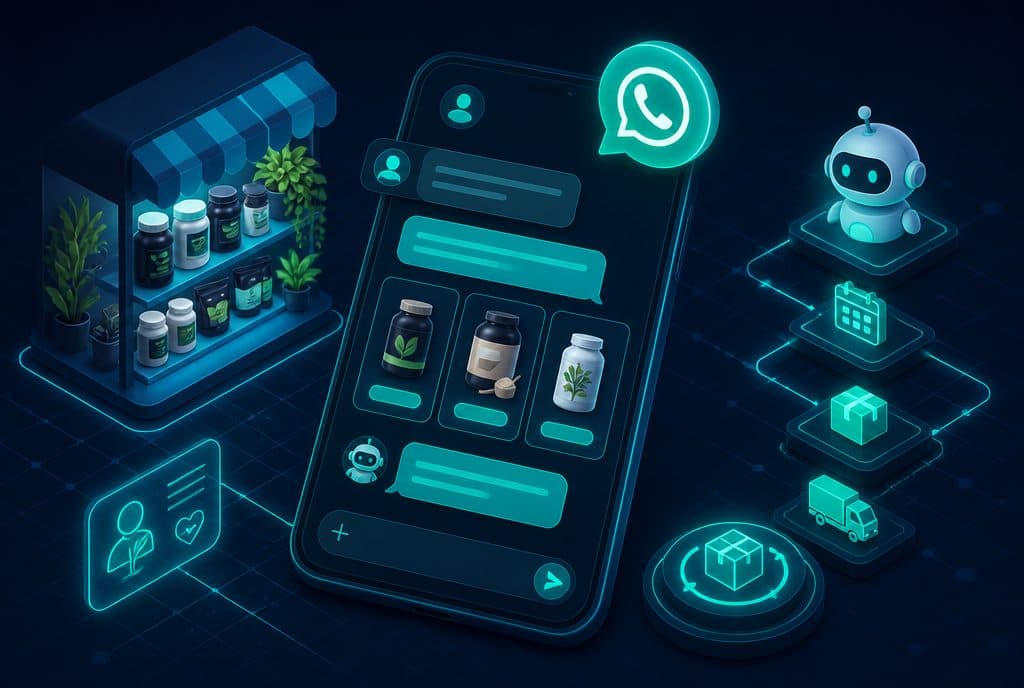


A medical and rehabilitation equipment supplier in Israel receives various types of inquiries daily: questions about product availability, requests for photos and specification adjustments, insurance coverage or nursing fund eligibility checks, repeat orders, and delivery status inquiries. Most of these inquiries do not require professional judgment—they are a matter of information, coordination, and paperwork. An AI WhatsApp bot connected to the ordering system can handle them automatically, 24/7, leaving representatives free for inquiries that truly require a human touch—complex pricing, customization advice, and troubleshooting.
How Automation Helps Medical Equipment Suppliers
An AI bot for a medical equipment supplier answers availability questions, sends catalogs and specifications, collects insurance and fund details, and creates draft quotes—while simultaneously confirming orders and updating delivery status, all on WhatsApp 24/7, without a live agent. Any inquiry requiring professional judgment is transferred to a human with a full summary. The bot does not provide medical advice—this is an absolute red line.
Which Inquiries Can Be Streamlined—and Which Cannot
Before setting up a bot, it is crucial to clearly separate two types of inquiries:
| Inquiries that can be streamlined | Inquiries that remain for a human agent |
|---|---|
| "Do you have X in stock?" | "What is the right device for my mother?" |
| "Send me a catalog / technical spec" | Questions about clinical suitability |
| "How much does it cost? What is the insurance coverage?" | Custom pricing or framework agreements |
| "I am with fund X—what am I entitled to?" | Complaints about medical equipment malfunctions |
| "When is it arriving?" / "Order confirmation" | Post-use advice / complex maintenance |
| "How do I place a repeat order?" | Any question with a medical-clinical nature |
This separation is not just good governance—it is a fundamental prerequisite for responsible deployment in the health-adjacent sector.
Common Scenarios in the Israeli Market
1. Availability Check and Product Presentation
A customer writes on WhatsApp: "Do you have a folding bathtub safety rail? What are the dimensions?" The bot pulls the product details from the catalog, sends photos and a size chart, and if the product is out of stock—suggests a similar alternative and asks if they would like to be notified when it's back in stock. All of this happens in seconds, without an agent needing to be awake.
2. Insurance and Fund Eligibility Check
Rehabilitation equipment is often purchased through supplementary insurance, health funds (Kupat Holim), National Insurance (Bituach Leumi), or long-term care funds. The eligibility check process involves standard questions—full name, ID number, fund name, license/power of attorney number. The bot collects all these details in a structured conversation, sends the list of required documents, and forwards everything to an agent who can review and approve the quote—without any details getting lost in someone's personal WhatsApp.
3. Automated Price Quote
Once eligibility details are approved, the bot can generate a draft price quote based on an updated price list, send it as a PDF on WhatsApp, and explain what is covered and what must be paid directly. The agent approves it before the final document is sent to the customer.
4. Order Confirmation and Delivery Status Updates
After order approval, the bot automatically sends a confirmation with the order number and estimated delivery date. When the shipment leaves the warehouse, an automatic update is sent to the customer—again, without an agent needing to remember to call.
5. Repeat Orders
Customers ordering consumables (gloves, binders, disinfectants, masks) need to reorder every few weeks. The bot can identify a returning customer, display their last order, and ask, "Would you like to order the same thing again?"—enabling a one-click conversion.
Required Tools and Integrations
A complete solution for a medical equipment supplier typically consists of several layers:
- Communication Channel: WhatsApp Business API (the dominant channel in the Israeli market)
- Automation Engine: n8n to manage logic, flows, and integrations
- Knowledge Base: Product catalog, price list, insurance/fund lists—updated and fed to the bot
- CRM / Ordering System: So the bot writes leads and orders directly into the existing system
- Agent Interface: Any conversation requiring a human is transferred with a full summary—so they don't have to search through the history
A Note on Privacy and Data Sensitivity
Medical and rehabilitation equipment lies in a gray area between commercial and medical. A clear rule of thumb: if the collected information could imply a medical condition—for example, someone ordering a wheelchair after hospitalization—it must be handled in accordance with the Israeli Privacy Protection Law. In practice, this means:
- Do not store health-adjacent information without explicit consent
- Do not transfer customer data to third parties without authorization
- Allow customers to request data deletion
- Ensure that any health-adjacent information is transferred to a human agent and not processed automatically
If the supplier works with insurance providers or nursing funds, it is advisable to consult with a legal advisor to determine if a dedicated privacy policy is required for the digital channel.
How to Get Started?
The right approach is to start narrow and controlled:
- Characterization: Identify the 3-5 most common types of inquiries that do not require professional judgment.
- Knowledge Base: Organize the catalog, price list, and FAQs into a format that can be fed to the bot.
- Clear Boundaries: Define exactly what the bot answers and what goes to an agent—and consult with a lawyer if regulatory questions arise.
- Limited Pilot: Launch the bot on a single channel (WhatsApp) and measure performance for two weeks before expanding.
- Continuous Improvement: Analyze conversations, identify unanswered or poorly answered questions, and update the knowledge base.
Want to map out what fits your processes? Talk to us and let's define a practical starting point together.
Related Links
- Business Automation — Everything You Need to Know
- WhatsApp Bot for Business
- Automation for B2B Suppliers and Manufacturers
How much does it cost?
| Component | Price (one-time setup, ex-VAT) |
|---|---|
| WhatsApp AI sales agent | ILS 9,000 |
| Lead intake from Facebook / Instagram / website | ILS 2,000 |
| Connection to an existing system (CRM / Sheets / Monday) | ILS 2,500 |
| Automatic follow-up sequence | ILS 2,500 |
| WhatsApp Business API setup | ILS 700 |
A complete starting point — a WhatsApp AI agent including the business number, server and agent control room — is from ILS 10,200; an agent with a management system (CRM) from ILS 18,200, a multi-agent system from ILS 25,350. There is no monthly fee; third-party costs (server, messages, AI) of about ILS 100–500 a month are paid directly to the providers. The full component price list: pricing page.
Summary
A medical and rehabilitation equipment supplier that connects an AI bot to WhatsApp and their ordering system is not replacing representatives—it is freeing them from routine inquiries so they can handle the ones that truly require a human. The bot handles logistics and commerce: availability, pricing, insurance, ordering, and delivery. It does not touch clinical considerations or offer medical advice—a red line that must be explicitly defined right at the characterization stage. The right starting point: gather the most common inquiries, mark what is routine and what is clinical, and build a narrow pilot that proves value before expanding.