
Dropshipping business automation connects the supplier, the order management system, and the customer service channel into a single flow that operates without manual intervention: automatic shipping status updates, answering "where is my order?" within seconds, and structured returns management — all through n8n and a WhatsApp AI agent. This allows you to manage hundreds of orders a month without increasing your team, while maintaining consistent customer service even during peak times.
How Does Automation Help a Dropshipping Business?
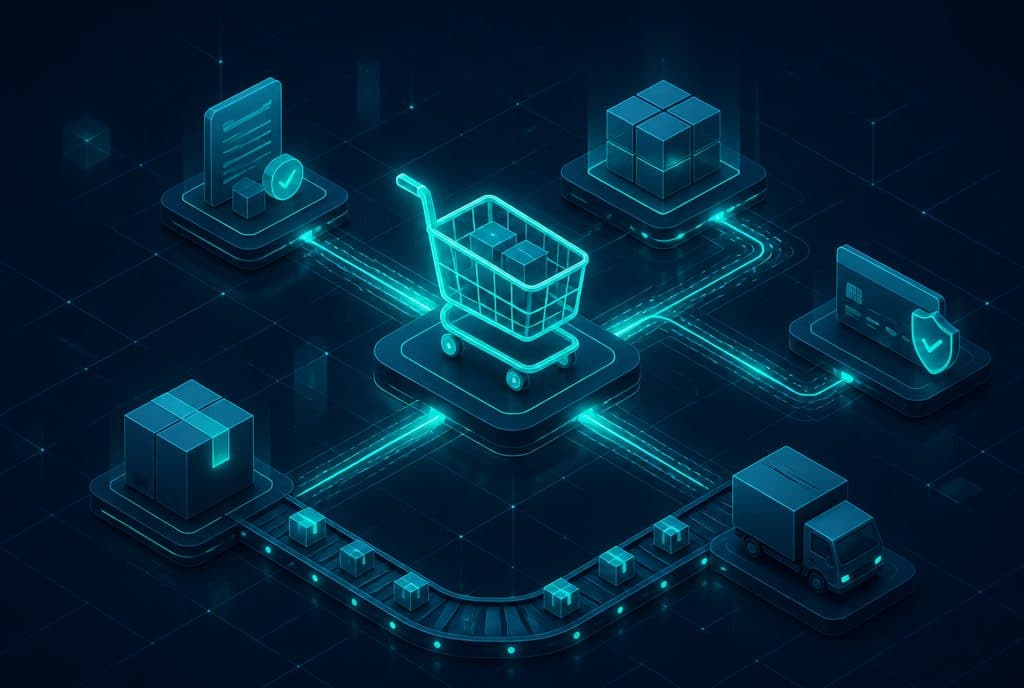
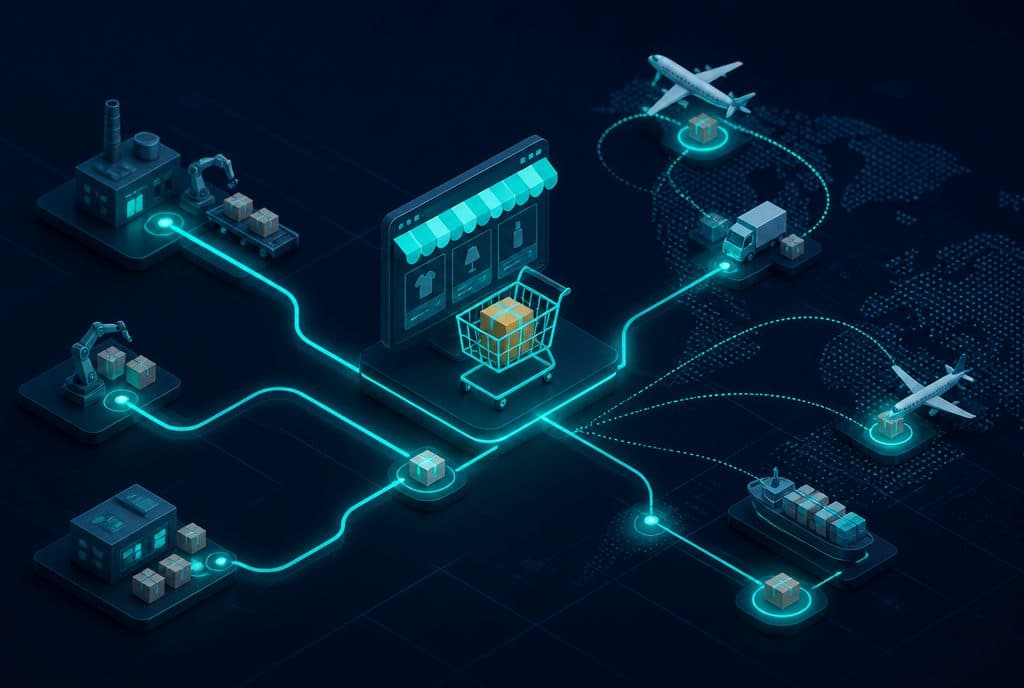
Dropshipping automation creates a "pipeline" that flows information between the supplier, the online store, and the end customer — without manual touch: a new order is automatically sent to the supplier, a tracking number is immediately returned to the customer via WhatsApp, an AI bot answers status questions in real time, and a return request opens a structured process that goes to the supplier and ends with a refund — without anyone on the team typing manually.
Why Dropshipping Requires Automation More Than a Regular Store
In a regular store, you have control over inventory and shipping. In dropshipping, you don't: the goods are shipped directly from the supplier to the customer, and the store owner has no direct access to the process. This creates three specific problems:
- Information Gaps — The customer asks "when is it arriving?" and you have to ask the supplier, who then has to ask the shipping provider. Every question takes hours.
- Repetitive Question Volume — "Where is my order?" accounts for 40% to 60% of all customer service inquiries in dropshipping stores. A single question that touches almost every customer.
- Supplier Return Management — Every return requires coordination: customer → store → supplier → refund. Manually, this is a burden; automatically, it flows.
Automation Capabilities for a Dropshipping Store
| Process | What Happens Manually | What Happens with Automation |
|---|---|---|
| Receiving an Order | Manual transfer to the supplier via email | The supplier receives the order immediately via API |
| Updating Tracking Number | The customer asks, you search | The customer receives an automatic SMS/WhatsApp |
| "Where is my order?" | Manual response to each inquiry | An AI bot answers in seconds with real-time data |
| Inventory Update | Manual check with the supplier | Inventory is synchronized in real time in the store |
| Return Management | Long email chain | Customer request automatically opens a structured case |
| Post-Purchase Follow-up | Usually doesn't happen | Automatic thank you message + review request |
Four Scenarios Every Dropshipping Store Knows
Scenario 1: "Where is my order?" — The Most Common Inquiry
A customer writes on WhatsApp: "I ordered a week ago and still haven't received it." Without automation, someone on the team has to look up the order, check with the supplier, and reply — a process that takes anywhere from an hour to several hours.
With an AI agent: The bot identifies the phone number, pulls the order data and tracking number from the system in real time, and answers within seconds: "Your order was shipped on 12.6, tracking number: IL123456789, expected to arrive between 14-16.6 via DHL."
Scenario 2: Supplier Synchronization — Automated Order Dispatch
A customer placed an order on Shopify. n8n captures the event, formats the order exactly as the supplier requires, and sends it automatically — to the supplier's email, their API interface, or a shared Google Sheets spreadsheet, as appropriate. The supplier receives a clean order; the store owner did nothing.
Scenario 3: Real-Time Inventory Update
A supplier updates that an item is out of stock. n8n receives the supplier's notification, automatically updates the store ("Out of stock"), and sends an alert to the store owner. This prevents a situation where a customer orders a product that does not exist.
Scenario 4: End-to-End Return Management
A customer writes "I want to return this." The bot asks one question — "What is the reason?" — and opens a return case: updates the supplier, sends shipping instructions to the customer, and tracks the status until the refund is approved. All parties receive automatic updates at every stage.
What is Required to Build This?
The automation is built on three components:
- n8n as the Workflow Engine — Connects Shopify/WooCommerce, the supplier's system (API or email), and the WhatsApp bot. See the E-commerce and Automation Guide.
- WhatsApp AI Agent — Manages the conversation with the customer, pulls real-time data based on order number, and hands over to a human agent only when necessary.
- Supplier Interface — Exporting data in the format the supplier expects: structured email, Google Sheets, automatic CSV file, or direct API.
How to Start — A Modular Approach
The right approach is not to "optimize everything in one day" but to start with the point that yields the highest return the fastest:
Step 1 — Service Inquiries (First Week): Build a bot that answers order status questions. This immediately removes the heaviest burden from the team.
Step 2 — Supplier Synchronization (Second-Third Week): Automatically connect new orders to the supplier's interface. Prevents manual entry errors and processing delays.
Step 3 — Returns and Follow-up (Third Stage): Structured return management and sending post-purchase follow-up messages. Adds a layer of customer experience that increases positive reviews.
Each step has a clear metric: how many inquiries were handled automatically, how many entry errors were prevented, how many hours we saved.
Questions to Ask Before You Start
- How many "where is my order" inquiries do you receive per week? — This is the figure that defines the ROI of the first step.
- What format does the supplier require? — Email, CSV, API? This determines how complex the supplier connection is.
- Which platform does the store run on? — Shopify and WooCommerce are the most common and have ready-made integrations.
- Which channels are active for customer service? — WhatsApp, email, Instagram, chat? Automation can cover them all from the same place.
Privacy Protection Law and Online Commerce
Building automation that processes customer data — names, addresses, order details — requires attention to the Israeli Privacy Protection Law. The key points: storing customer data on a secure server, clearly defining who can access the data, and deleting data when there is no longer a business need to keep it. In building the solution, we ensure that the automation complies with legal requirements.
How much does it cost?
| Component | Price (one-time setup, ex-VAT) |
|---|---|
| AI order-taking agent | ILS 7,500 |
| Payment link and checkout inside the chat | ILS 2,800 |
| Business knowledge base | ILS 3,000 |
| Automatic follow-up sequence | ILS 2,500 |
| WhatsApp Business API setup | ILS 700 |
A complete starting point — a WhatsApp AI agent including the business number, server and agent control room — is from ILS 10,200; an agent with a management system (CRM) from ILS 18,200, a multi-agent system from ILS 25,350. There is no monthly fee; third-party costs (server, messages, AI) of about ILS 100–500 a month are paid directly to the providers. The full component price list: pricing page.
Summary
A dropshipping business that manages orders manually gets stuck in a "playing field" where any growth in volume means growth in the service team. Automation breaks this equation: updating orders to the supplier, answering status questions, managing returns — all of these can run without manual touch, so the store owner can focus on growing sales, not managing processes.
The right place to start: identify the most common inquiry you receive today — almost always the status question — and build that first.
Want to understand the right solution for your store? Contact us for an initial characterization — we will analyze your processes and suggest what to optimize first. See also WhatsApp AI Agent for details on the customer service layer.