
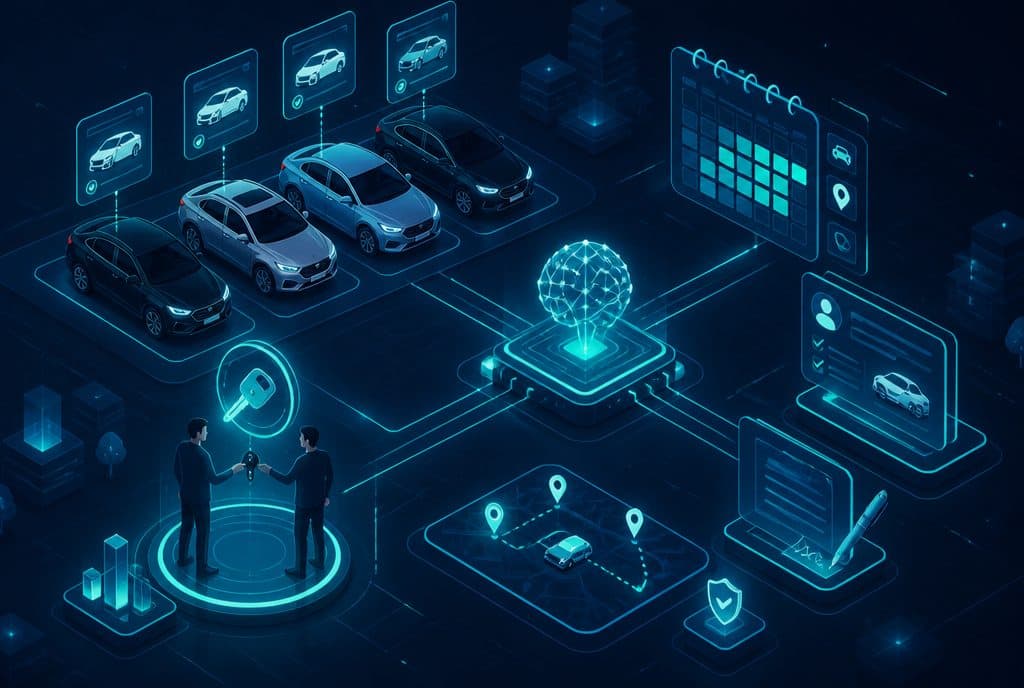
A WhatsApp bot for a car rental company is an automation system that answers customer inquiries about availability and pricing, collects booking details, sends confirmations and pickup information, reminds customers about return times, and allows rental extensions—all through a standard WhatsApp conversation, without requiring an agent to be available for every routine inquiry.
Car rental companies in Israel face a recurring volume of repetitive inquiries: "Do you have a car for X dates?", "How much is Group B for a week?", "What time can I pick it up?", "Can I extend for another day?". Every single one of these questions can be answered accurately without a human agent—provided there is a bot properly connected to the vehicle fleet database and the booking system.
How Automation Helps a Car Rental Company
A WhatsApp bot connected to the vehicle database answers availability and pricing inquiries within seconds, collects booking details and sends confirmation, delivers pickup information the evening before the rental, and sends return reminders—freeing up branch staff to handle walk-in customers, damages, and cases that truly require human attention.
Repetitive Inquiries Received Daily
Before deciding what to streamline, it is highly recommended to map out the types of inquiries that actually come in. In most Israeli rental companies, the picture is very similar:
- Availability and pricing checks — "Do you have an SUV from July 20th for a week?"
- Rate inquiries — Differences between groups, full vs. basic insurance, additional driver fees.
- Confirmation and pre-pickup info — Address, hours, what to bring, what is included.
- Rental extensions — "I need another two days, how much does it cost?"
- Return reminders — When to return, to which branch, what happens if late.
- On-the-road issues — Parking, accidents, flat tires (these are routed to a human agent).
The first four can be fully automated. The fifth (reminders) is proactive—the bot sends it without waiting for the customer to ask. The sixth is transferred to an agent with full context.
What the Bot Actually Does — Capability Table
| Scenario | What the Bot Does | What is Left for the Agent |
|---|---|---|
| Availability Check | Asks for dates, checks against the database, returns options + pricing | — |
| Booking | Collects name, ID, driver's license, credit card, sends confirmation | ID verification if required |
| Pre-pickup Info | Sends a message the night before: address, hours, what to bring | — |
| Rental Extension | Checks availability, approves/declines, updates booking, charges difference | — |
| Return Reminder | Sends 24 hours prior: return time, branch, fuel status | — |
| Damage / Accident | Collects initial description, transfers to agent with summary | Entire conversation |
| Complex Complaint | Receives, classifies, transfers to agent with resolution attempt | Entire conversation |
Three Representative Scenarios
Scenario A: A Customer Writing at 11:00 PM on Friday Night
A customer is looking for a car for next weekend. Without a bot—they write on Friday night, get no response until Sunday, and in the meantime, find a competitor. With a bot—they ask about availability, the bot checks the database, presents two options with pricing, collects booking details, and sends a confirmation—all within 4 minutes, while everyone is asleep.
Scenario B: Rental Extension via WhatsApp
A customer on vacation realizes on the fifth day that they need the car for two more days. They write on WhatsApp. The bot checks if the car is available for those dates, provides the daily rate, gets approval, updates the booking in the system, and charges the difference to the saved card. The customer receives confirmation within 3 minutes without having to call anyone.
Scenario C: Return Reminder that Prevents Disputes
The day before the return date, the bot sends the customer a message with the return time, branch address, required fuel status, and a link to report any damages in advance. This reduces disputes over "non-existent" damages and shortens the vehicle check-in time at the branch.
Advanced Capabilities to Consider
Returning Customer Recognition — The bot recognizes a customer by their phone number, pulls their license and card details from the CRM, and offers to "keep the same car group as last time?"—shortening the booking process for returning clients.
Post-Rental Follow-up — A message sent the day after return: "We received the vehicle back, thank you! Thinking about next time?" with a link for quick booking. Not spam—just a single, highly relevant message.
Multi-lingual Support — In Israel, there is significant demand from Russian and English-speaking customers. The bot can detect the language of the inquiry and continue the conversation in that language.
Seamless Agent Handoff — When a customer writes "I have a scratch and I'm not sure if it's my fault," the bot doesn't try to solve it—it collects a description and photo, summarizes, and transfers it to an agent with the full history. The agent doesn't need to ask "what happened?"—everything is already documented.
Privacy Protection Law and Driver Data
Car rental companies collect sensitive information: ID numbers, driver's license details, and credit cards. Israeli privacy protection laws require managing databases lawfully, obtaining consent for data usage, and allowing customers to know how their information is managed. When building the bot, it is crucial to ensure that data flows directly into the company's secure systems and is not stored in intermediate pipelines, and that the customer receives clear confirmation regarding the use of their data for the rental.
How to Get Started — Practical Steps
Inquiry Characterization — Collect a week or two of WhatsApp messages and classify them: how many availability checks, how many extensions, how many rate questions. This determines your priorities.
System Mapping — Is there a booking management system with an API? Is the database accessible in real-time? These define the integration complexity.
Flow Building — Design all conversation paths: what the bot answers, when it asks follow-up questions, and when it transfers to an agent. Most importantly: define clear handoff rules.
Controlled Pilot — Run for a week or two with monitoring: which questions can't the bot answer? Which agent transfers are unnecessary? Adjust accordingly.
Expansion — Once the core is stable, add return reminders, follow-ups, extensions—one module at a time.
For details on the development process, see What is an AI Agent for Business—the same principles apply to car rental companies.
Want to See How It Works?
If you manage a car rental company in Israel and receive repetitive inquiries about availability, extensions, and reminders—these are exactly the scenarios we build. Our WhatsApp Bot Service is the right starting point, and a basic bot can typically be deployed within a week.
For Automated Scheduling—such as booking a car for a future date with two-way confirmation—there is an additional layer that connects the bot to your calendar and real-time availability database.
Contact us and let's map out together which scenarios generate the bulk of your workload—and what makes the most sense to automate first.
How much does it cost?
| Component | Price (one-time setup, ex-VAT) |
|---|---|
| AI booking agent — simple | ILS 8,000 |
| Calendar link and meeting booking | ILS 2,000 |
| Appointment reminders and confirmations | ILS 1,750 |
| Automatic follow-up sequence | ILS 2,500 |
| WhatsApp Business API setup | ILS 700 |
A complete starting point — a WhatsApp AI agent including the business number, server and agent control room — is from ILS 10,200; an agent with a management system (CRM) from ILS 18,200, a multi-agent system from ILS 25,350. There is no monthly fee; third-party costs (server, messages, AI) of about ILS 100–500 a month are paid directly to the providers. The full component price list: pricing page.
Summary
A car rental company that connects a WhatsApp bot to its routine processes—availability checks, booking, pickup info, extensions, and return reminders—answers every routine inquiry within seconds, even at 11:00 PM or on Friday afternoon. The team is freed up to handle cases that truly require a human touch: damages, complaints, and unexpected situations. The right way to start is not to automate everything at once—but to identify the three most common types of inquiries and start there.