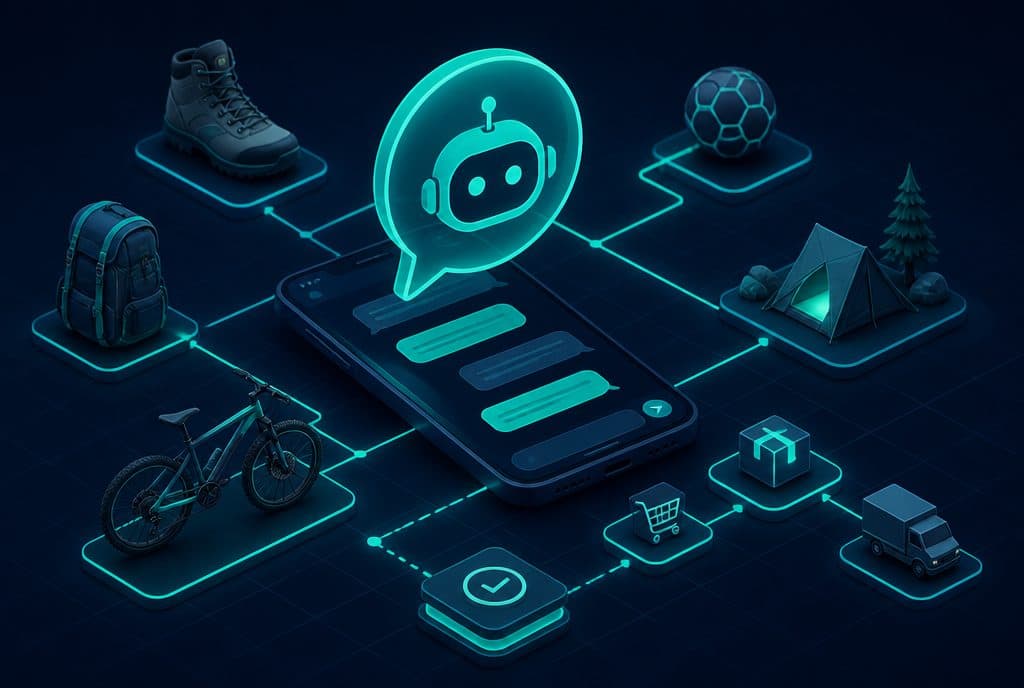
A WhatsApp bot for a sports store answers questions about sizes, stock availability, and prices 24/7, sends gear recommendations based on the type of activity (running, climbing, outdoor, beach, cycling), and manages orders and self-pickup — without overloading the staff. In an Israeli sports store, where there are busy seasons (winter sports, summer camps, pre-holiday demand) and customers ask complex technical questions, such automation allows the team to free themselves up for consultative selling and in-store customer service. At Automaziot AI, we implement these bots for Israeli retail stores — physical, online, and hybrid.
How Does Automation Help a Sports Store?
A WhatsApp bot for a sports store connects the customer to the store's knowledge — catalog, inventory, and policies — in real-time and in natural language. It answers questions like "Do you have a running shoe in size 43?", "Which sleeping bag is suitable for a trip to Mount Hermon in November?", "What is the status of my order?" — and transfers to an agent only when the question requires professional judgment. The result: fewer callback phone calls, fewer unanswered messages during peak hours, and customers getting answers even on Friday night.
What Types of Inquiries Reach a Sports Store on WhatsApp?
A sports store receives three main types of inquiries that repeat dozens of times a day:
- Product and Inventory Questions — "Do you have the blue version? In size 42? How much does it cost?"
- Recommendation Questions — "I'm looking for a two-person tent for a trip to Sinai, what do you recommend?"
- Order and Logistics Questions — "I ordered on Monday, when will it arrive? Can I pick it up from the store?"
Each of these can be fully or partially automated — depending on how deeply the store has connected the bot to its internal systems.
What Can the Bot Handle, and What is Left for Humans?
| Topic | Bot | Human Agent |
|---|---|---|
| Checking product and size availability | Yes — in real-time | — |
| Prices, promotions, coupons | Yes | — |
| Gear recommendation by activity | Yes — guiding questions + suggestion | Yes — when professional depth is required |
| Order and shipping management | Yes — status, confirmation, changes | Yes — complex issues |
| Sizing advice for technical apparel | Partial — size chart + guidance | Yes — personal customization |
| Complaints and service issues | Collects and summarizes, transfers | Yes |
| Loyalty program and points | Yes — balance, redemption | — |
| Booking gear for rental / loan | Yes — availability and scheduling | Yes — contract and terms |
Practical Scenarios in a Sports Store
Scenario 1: Inventory and Size Inquiry
A customer writes on WhatsApp at eight in the evening: "Do you have Columbia hiking shoes in gray, size 38?"
The bot checks the inventory database and answers within seconds: "Yes, size 38 in slate gray — we have 2 pairs left. Price: ₪549. You can pick them up tomorrow from the store or get delivery within two days. Would you like to order?"
The customer clicks "Yes" — the bot opens an order, sends a payment link, and saves the details in the CRM. The staff sees an order ready for packing in the morning.
Scenario 2: Outdoor Gear Recommendation
A customer writes: "I'm going on a 5-day trip to the Negev in February with a 12-year-old, what do we need?"
The bot asks two guiding questions: camping experience and budget. Based on the answers, it sends a tailored list — a sleeping bag rated for average night temperatures in the Negev, backpack size based on the route, basic cooking gear — with links to product pages. If the customer prefers, the bot schedules a short consultation call with an agent.
Scenario 3: Rental Management and Loyalty Program
A club member writes: "How many points do I have and when do they expire?"
The bot verifies the phone number against the loyalty database and replies: "You have 340 points (worth ₪34). They are valid until 31.12.2026. Would you like to use them on your next order?"
Scenario 4: Shipping Update
48 hours after an online purchase, the bot proactively sends a message: "Your order — Black Diamond trekking poles — has shipped. Tracking number: ####. Estimated arrival: tomorrow by 18:00."
Where Does the Bot Generate the Highest Value for a Sports Store?
Peak Hours: Weekends, the "big" days before seasons (Hanukkah, Sukkot, summer) — the bot absorbs repetitive questions without a queue. The staff is freed up to serve customers who are physically in the store.
After Hours: Israelis buy sports gear at night too. A customer planning a weekend trip writes on Thursday night. Without a bot, the message waits until Sunday — by which time they might have already ordered from a competitor.
Deep Catalog: A sports store can hold thousands of SKUs — shoes by size/color/model, pressure valves by size and type. Specific inventory questions take an agent minutes; for a bot, it takes seconds.
Returning Customers: A customer running a half-marathon looking for a specific shoe is not a "cold lead" — they are buying. A fast and accurate answer to their question closes the deal.
How to Start: 4 Steps
Step 1 — Characterizing Inquiry Types. Collect 50–100 of your last WhatsApp messages and categorize them: inventory/price, recommendation, order/shipping, other. This shows where the bot will create immediate value.
Step 2 — Connecting Inventory. For the bot to answer inventory questions in real-time, it needs access to data. This can be an API of the ERP / POS system, a scheduled CSV export, or a Google Sheets spreadsheet that updates automatically. This connection is the "brain" of the bot — without it, it only works with static information.
Step 3 — Defining Boundaries. What does the bot answer on its own? What does it present and then forward to an agent? What does it not do at all (returns, complex complaints)? Clear rules drive a consistent and safe experience.
Step 4 — Going Live and Learning. Start with one scenario (usually inventory and price questions), measure for 2–4 weeks, and expand to the next scenarios. n8n is the tool we use for integrations — connecting WhatsApp, the inventory database, and the CRM without custom code.
Frequently Asked Questions about Sports Store Automation
Does the bot handle technical questions about gear? Yes, within pre-defined boundaries. The bot can send specifications, size charts, and basic comparisons. Questions that require professional judgment (for example, "Which surfboard is right for me based on the wave in the workshop?") — it forwards to an agent with a description of what the customer asked.
Does the WhatsApp Business API require Meta approval? Yes. Opening a WhatsApp Business API account through an authorized provider usually takes 3–5 business days. We guide you through the entire process.
What happens if the customer sends a photo of the product they have and wants to know if there are spare parts? The bot can ask for the model number from the photo and search by it, or transfer the photo to an agent with the request. Automatic image recognition is a possible capability but is defined separately for each project.
Privacy Protection Law: Saving customer data and order information must comply with the Israeli Privacy Protection Law. We pre-define what data is saved, for how long, and how the right to erasure is implemented — as part of the project scope.
Useful Links
- WhatsApp Bot for Business — Full Service
- E-commerce Automation — Online Stores
- WhatsApp Bot for Retail Stores — General Guide
How much does it cost?
| Component | Price (one-time setup, ex-VAT) |
|---|---|
| AI order-taking agent | ILS 7,500 |
| Payment link and checkout inside the chat | ILS 2,800 |
| Business knowledge base | ILS 3,000 |
| Automatic follow-up sequence | ILS 2,500 |
| WhatsApp Business API setup | ILS 700 |
A complete starting point — a WhatsApp AI agent including the business number, server and agent control room — is from ILS 10,200; an agent with a management system (CRM) from ILS 18,200, a multi-agent system from ILS 25,350. There is no monthly fee; third-party costs (server, messages, AI) of about ILS 100–500 a month are paid directly to the providers. The full component price list: pricing page.
Summary
An Israeli sports and outdoor gear store deals with demand that comes in waves — before seasons, before holidays, before trips — and with customers who want a fast and accurate answer about specific gear. A WhatsApp bot connected to inventory and the ordering system is not a "gimmick" — it is operational: it shortens response time, prevents lost orders because the customer didn't get an answer in time, and frees up the team for consultative service that sells more. The right approach is to start with one clear scenario, measure, and gradually expand.
Want to understand what a WhatsApp bot can do specifically for your store? Talk to us and we will build a practical characterization together at no cost.