
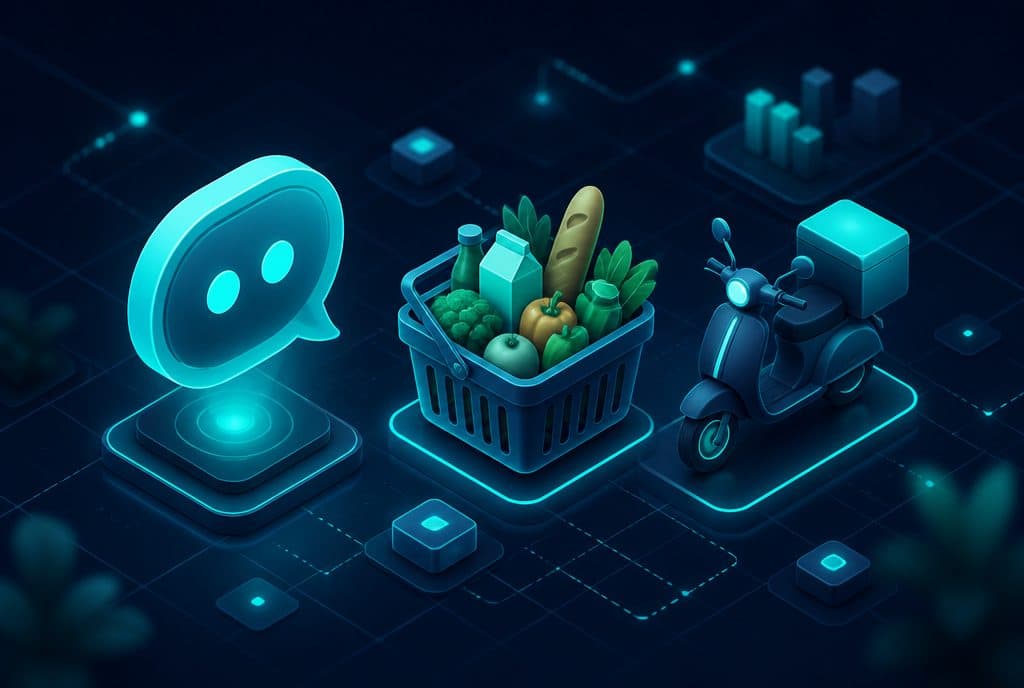
A WhatsApp bot for minimarkets is a system that receives orders directly on WhatsApp, checks inventory, offers available delivery slots, sends confirmation, and transfers the details to delivery management—without a single phone call. The customer writes "I want to order," the bot manages the entire conversation in natural language, and ultimately delivers a neat lead with address, items, delivery window, and payment. At Automaziot AI, we build such systems for Israeli food businesses using tools like WhatsApp Business API and n8n to connect the systems.
Minimarkets and food delivery services face a specific pressure point: demand often peaks in short bursts—Friday afternoon, pre-holiday, lunchtime—when the staff is busy and the phone won't stop ringing. Every missed call is an order lost to a competitor. Automation doesn't replace the staff—it allows them to focus on preparation and delivery while the bot handles taking the orders.
How Automation Helps Minimarkets
A WhatsApp bot connected to inventory allows minimarkets to receive orders 24/7 without phone overload: the customer orders in a natural conversation, the bot checks real-time availability, allocates an available delivery slot, confirms payment, and adds the order to the delivery queue—all automatically, without any staff member needing to be available at that moment.
What Can a WhatsApp Bot for Minimarkets Do?
| Capability | What it means in practice |
|---|---|
| Order Taking | A structured conversation that allows selecting items, quantities, and updating before confirmation |
| Real-Time Inventory Management | Checking availability before confirmation; alternatives for out-of-stock items |
| Delivery Windows | Displaying only available slots; division by delivery zones |
| Repeat Orders | Weekly reminder; confirmation in a single message |
| Payment | Link to approved payment gateway; payment confirmation sent back to WhatsApp |
| Change Management | Canceling or updating an order up to an hour before delivery |
| Status Updates | Notification when the delivery has left, arrived, and confirmation of receipt |
| Inventory Alerts | Notification to the store owner when a product reaches a critical threshold |
Common Scenarios
New Customer — First Order
A customer saw a local advertisement, saved the WhatsApp number, and writes: "Do you deliver to neighborhood X?". The bot replies instantly with service areas, operating hours, and an order link. Within three messages, the customer selects items, confirms a delivery window, and pays—without anyone needing to answer the phone.
Existing Customer — Repeat Order
Every Friday morning, the bot sends regular customers a reminder: "Hi, would you like to repeat your usual order?". A customer who confirms with "yes" receives a confirmation with an itemized summary and a payment link. A complete order in less than 30 seconds for the customer, zero load on the staff.
Managing Peak Demand — Holiday Eve
Demand surges before a holiday: dozens of orders per hour. The bot manages a digital queue—when all delivery windows for that day are full, it automatically offers the next day. Customers receive an immediate response and don't face a busy line; the staff receives an organized delivery list.
Out-of-Stock Item Before Delivery
A peach runs out of stock before the delivery goes out: the bot sends a message to the customer with options to replace it with a nectarine, remove the item, or cancel the order. The customer decides and confirms. The staff doesn't need to try to reach the customer by phone while they are busy.
Why WhatsApp and Not an App?
Israel is a market where WhatsApp is the dominant communication channel. Customers don't need to download a new app, don't need to create an account, and don't have to switch from what they are already doing all day. The bot operates in an interface the customer already knows and is comfortable with, significantly reducing friction for the first order.
Additionally, history is saved—a customer returning after two months can scroll up and see what they ordered last time. The bot can use this information to offer a smart repeat order.
What Automation Doesn't Do
Let's be clear: the bot doesn't decide on its own whether to approve exceptional credit, doesn't handle complex complaints, and doesn't decide on price flexibility for a VIP customer. These remain with humans. The bot presents a full summary—name, order, history—to the human representative when needed, and doesn't just drop the conversation midway.
Additionally, all automation is built in accordance with the Israeli Privacy Protection Law: customer information is stored securely, customers can request deletion, and there is no sharing of information with third parties without consent.
How to Get Started?
The setup process for a minimarket ordering bot typically goes through the following stages:
1. Process Mapping — We map out all common types of inquiries: new orders, changes, cancellations, questions about items. We decide what the bot answers on its own and when it transfers to a representative.
2. Digital Catalog — We prepare the list of items, categories, prices, and inventory thresholds. This can be connected to an existing inventory management system (such as Lightspeed, Revel, or a Google Sheets file) so that prices are always up-to-date.
3. WhatsApp Business API Connection — This requires approval from Meta. The process typically takes two weeks and is handled by us.
4. Building in a Test Environment — The bot is built in n8n with all flows: order receipt, inventory check, time slot management, confirmations, and payment.
5. Controlled Pilot — We run a two-week pilot with a small group of customers, fine-tune based on feedback, and then expand.
Relevant Links
- WhatsApp Bot for Business — Full Service
- E-commerce and Retail Automation
- WhatsApp Bot for Taking Orders — Detailed Guide
How much does it cost?
| Component | Price (one-time setup, ex-VAT) |
|---|---|
| AI order-taking agent | ILS 7,500 |
| Payment link and checkout inside the chat | ILS 2,800 |
| Business knowledge base | ILS 3,000 |
| Automatic follow-up sequence | ILS 2,500 |
| WhatsApp Business API setup | ILS 700 |
A complete starting point — a WhatsApp AI agent including the business number, server and agent control room — is from ILS 10,200; an agent with a management system (CRM) from ILS 18,200, a multi-agent system from ILS 25,350. There is no monthly fee; third-party costs (server, messages, AI) of about ILS 100–500 a month are paid directly to the providers. The full component price list: pricing page.
Summary
A minimarket or food delivery service that wants to grow cannot rely on phone calls and manual typing into Excel. A WhatsApp bot connected to inventory and delivery management solves the key pressure point—receiving orders during peak demand—without increasing staff. The customer receives an immediate response, the order is entered in an organized manner, and the delivery team works from a clear list instead of trying to assemble a puzzle from 40 phone calls.
Want to understand what such a bot could look like for your store? Talk to us on WhatsApp and we will do an initial mapping together at no cost.