
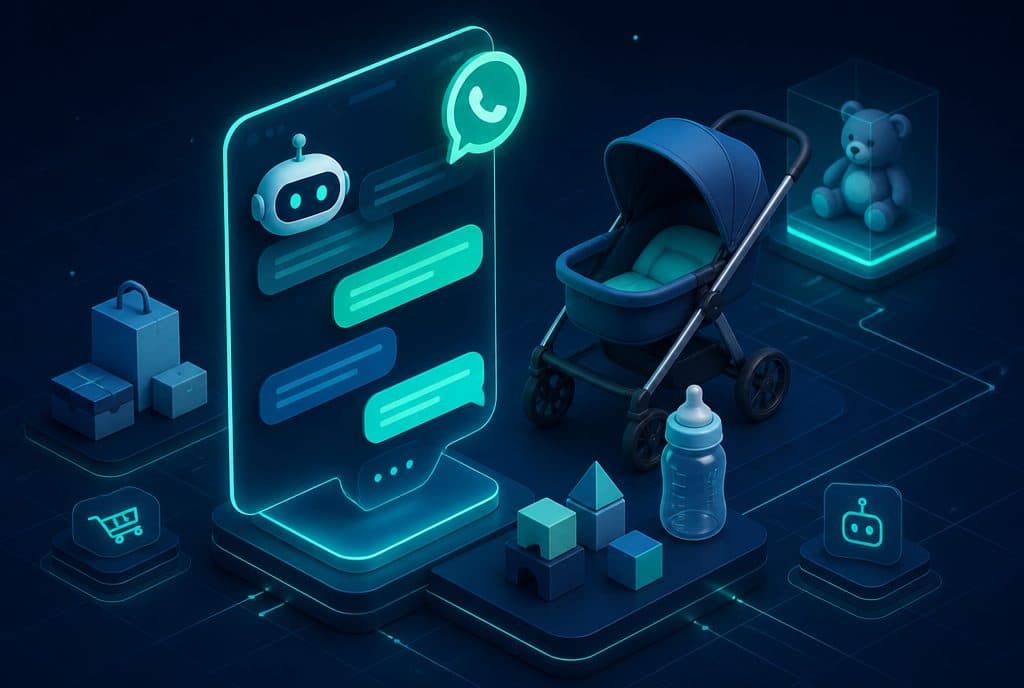
A WhatsApp bot for a baby store is an automation system that answers inventory and sizing questions in real-time, manages baby shower registries, sends shipping updates, and brings customers back to complete purchases—all without the staff having to stop and answer every phone call. In Israel of 2026, where parents shop primarily from their mobile devices and during late-night hours, an immediate response on WhatsApp is not an advantage—it is an expectation. At Automaziot AI, we have built such solutions for retail stores, and in this article, we will explain exactly what works in the world of babies and children.
In a market where every birth generates a wave of purchases—stroller, car seat, crib, clothing, room furniture—and where young parents check product availability at two in the morning between feedings, a store that does not answer immediately simply loses the sale to a competitor that runs a bot.
How Automation Helps a Baby Store
Automation for a baby store connects WhatsApp to inventory, orders, and the customer database—so that any question about size, availability, shipping, or a gift registry receives an immediate and accurate answer, 24/7, without employing a representative who refuses to lose sleep. The team only receives a query for handling when human judgment is required—not to search through the inventory catalog.
Queries That Recur Daily in a Baby Store
Before setting up automation, it is helpful to understand exactly what the team answers over and over again:
| Query Type | Frequency | Average Human Response Time |
|---|---|---|
| "Do you have this in size X in color Y?" | Very High | 5–15 minutes |
| "When is my delivery arriving?" | Very High | 3–10 minutes |
| "Can I add this to the gift registry?" | High | 5–20 minutes |
| "Are you back in stock with the model that was sold out?" | Medium | Query not always answered |
| "Is there a discount for a double purchase?" | Medium | 5–10 minutes |
| "How many loyalty points do I have?" | Low–Medium | Requires manual check |
When you connect a bot, every row in this table becomes an automated response within seconds—and the entire team frees up time for work that requires a human presence.
Five Key Automation Scenarios for a Baby Store
1. Real-Time Inventory and Sizing Questions
A parent writes: "Do you have the Bugaboo Fox 5 stroller in Forest Green?" — the bot immediately sends: availability, price, delivery time, and a link to purchase. If it is out of stock, it suggests an alternative model and allows them to sign up for an alert when it arrives. Everything is done through a connection to the Shopify, WooCommerce, or Priority API—without a representative opening an Excel sheet.
2. Managing Baby Shower Registries
This is one of the gems of the baby world: young parents send a link to their registry, and guests write to the store "What is left on Michal and Yaniv's registry?"—a scenario that requires tedious manual checking. With a bot, every guest immediately receives the updated list, can mark what they are taking, and complete the purchase—without a representative touching the process.
3. Order and Shipping Updates
After a purchase, the bot automatically sends: order confirmation with details, an update when the product is shipped (including a tracking number), and a reminder on the day of delivery. If there is a delay, the parent receives a proactive update—no need to call to find out. This significantly reduces the volume of "where is my order" calls.
4. Bringing Back Customers When a Product Was Out of Stock
A customer asked for a baby crib that was out of stock and left—without a bot, she probably won't return. With a bot, she signs up for an alert, and the moment the product is back in stock—she receives a WhatsApp message. This is one of the most effective conversion mechanisms in children's retail, and in many cases, it closes sales that seemed lost.
5. Loyalty Program and Coupons
"How many points do I have?"—a question that comes up a lot, and requires a manual check. With a bot, the customer sends their number and immediately receives: points balance, value in Shekels, and how to redeem. Coupons can also be sent automatically—on the child's birthday, after a large purchase, or after a period of inactivity.
Capabilities Table: What the Bot Does vs. What is Left for a Human
| Task | Bot | Human Representative |
|---|---|---|
| Checking inventory and sizes | Yes — in real-time | — |
| Updating order status | Yes — automatic | — |
| Managing gift registry | Yes | — |
| Back-in-stock alert | Yes | — |
| Loyalty points balance | Yes | — |
| Receiving a complaint about a defective product | — | Yes |
| Stroller selection advice based on parameters | Partial (guiding questions) | Yes — to finalize |
| Setting up a complex deal | — | Yes |
| Handling an exceptional return | — | Yes |
The simple rule: what is repetitive and has a definitive answer—the bot. What requires judgment, empathy, or negotiation—a human.
How to Get Started: Four Steps
Step 1 — Query Characterization. Collect 50–100 recent WhatsApp messages and classify them into categories. This reveals what the bot needs to cover on day one.
Step 2 — Connecting Systems. The bot needs to talk to your inventory. Whether it is Shopify, WooCommerce, Priority Israel, or a synchronized Google Sheets spreadsheet—define the connection before writing the first line of code in n8n.
Step 3 — Defining Scenarios. Start with 3–5 scenarios that cover the highest volume of queries (usually: inventory, orders, shipping). Do not try to optimize everything at once.
Step 4 — Testing and Refining. Deploy to 20% of queries first, check where the bot struggles, improve—and then expand.
Want to see how this works for a children's store just like yours? Talk to us on WhatsApp and we will build a short characterization together at no cost.
Frequently Asked Questions by Store Owners
"Will the bot sound robotic?" — Today's language models write completely natural Hebrew. You can define a style (warm, professional, family-oriented) that matches the store's persona. Most customers do not notice it is an automation—until they ask directly.
"What happens when the bot doesn't know how to answer?" — We define a "fallback path": the bot recognizes it does not have an answer, informs the customer that a representative will return shortly, and sends an alert to the team. No customer falls between the cracks.
"Is it legal to send marketing messages?" — According to Israeli privacy protection laws, as long as the customer agreed to receive messages and there is a clear opt-out option in every message—it is completely legal. We build this mechanism as a standard part of every system.
How much does it cost?
| Component | Price (one-time setup, ex-VAT) |
|---|---|
| AI order-taking agent | ILS 7,500 |
| Payment link and checkout inside the chat | ILS 2,800 |
| Business knowledge base | ILS 3,000 |
| Automatic follow-up sequence | ILS 2,500 |
| WhatsApp Business API setup | ILS 700 |
A complete starting point — a WhatsApp AI agent including the business number, server and agent control room — is from ILS 10,200; an agent with a management system (CRM) from ILS 18,200, a multi-agent system from ILS 25,350. There is no monthly fee; third-party costs (server, messages, AI) of about ILS 100–500 a month are paid directly to the providers. The full component price list: pricing page.
Summary
A baby and children's store is a business that lives on customer relationships—parents who return again and again over the years, from infancy products to children's clothing and room furniture. A WhatsApp bot does not replace this relationship—it ensures it is not worn down by inventory questions and shipping updates that bore the staff and exhaust the customer. When automation works, the team can invest time in customers who come for real advice—and those are the customers who return.
For more details on store automation: E-commerce Automation and Smart Agent for WhatsApp. See also: WhatsApp Bot for Retail Stores — The Complete Guide.