
RAG (which stands for Retrieval-Augmented Generation) is the technology that allows an AI agent to answer questions specific to your business — products, prices, terms, procedures — without making up answers. Without RAG, an AI agent works from the general knowledge learned during its training and might guess when asked about the specific details of your business. With RAG, the agent retrieves the real information from the business's knowledge base before formulating any answer — just like an employee who knows how to look things up in the company files before responding to a client.
What is RAG? Definition
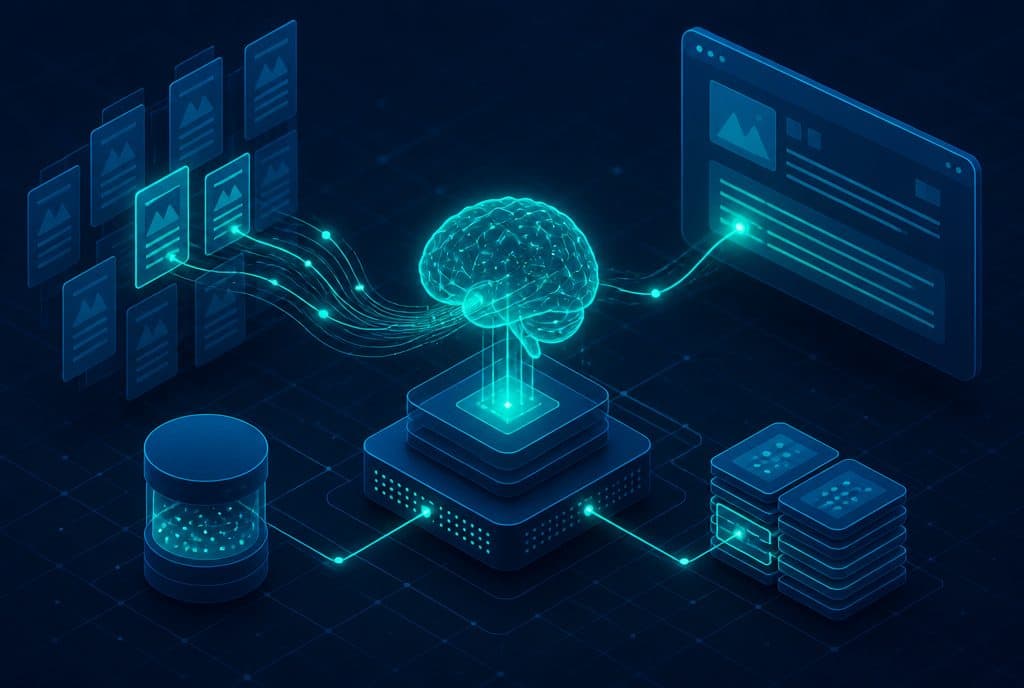
RAG (Retrieval-Augmented Generation) is an AI architecture where the model does not rely solely on what it learned during training, but retrieves relevant information in real-time from an external knowledge base — product catalog, FAQs, procedures, documents — and uses it as context before formulating an answer. The result: an AI agent that answers questions specific to your business accurately and reliably, without guessing or making things up.
RAG vs. a Knowledge-less Bot
This is the difference most business owners haven't heard of — but it is critical:
| Bot without a Knowledge Base | AI Agent with RAG | |
|---|---|---|
| "What is the price of product X?" | Guesses or says "I don't know" | Retrieves the price from the catalog and answers accurately |
| "What is your cancellation policy?" | Might make up a policy | Reads from the official document and quotes it |
| "Do you have stock of Y?" | Cannot know | Accesses the connected inventory data |
| "How long does delivery to Haifa take?" | General answer only | Answers according to internal shipping terms |
| Price update | Requires retraining | Updates in the knowledge base with a single click |
A bot without knowledge is an automated sign. An AI agent with RAG is a representative who truly knows the business.
How Does It Work?
Behind the scenes, RAG consists of four steps that happen within seconds during every conversation:
1. Preparing the Knowledge (One-time) The business documents — FAQs, catalog, procedures, terms — are processed and stored in a way that allows for rapid searching. This is the agent's "knowledge library."
2. A Question Arrives A customer sends a message: "Do you do plumbing for old apartments?" or "What is included in the basic package?"
3. Retrieval The agent searches the knowledge base for the most relevant snippets to the question — not all documents, just what is needed for this specific answer.
4. Generation The language model receives the customer's question along with the retrieved snippets and formulates a natural, accurate, and brand-aligned response — in Hebrew, in the tone you defined.
Why This is Important for Your Business's AI Agent
The most sophisticated AI agent in the world will be problematic if it gives an incorrect price, invents a non-existent warranty term, or says "yes, we offer service X" when you don't. In the Israeli business world, an incorrect answer doesn't just disappoint a customer — it can cause real damage: transaction cancellation, complaints, and damage to credibility.
RAG is what turns an AI agent from "impressive in a demo" to "reliable in practice." When a customer asks a question specific to your business, the agent needs to know the real answer — not guess.
This has another implication: knowledge updates are instant. Changed a price? Updated a policy? Added a product? You update it in the knowledge base — and the agent already knows. There is no need to retrain a model, no "rebuilding" period. Knowledge is a living library, not hardcoded into the AI.
Automated lead management also benefits from RAG: when the agent qualifies a lead, it needs to know exactly what questions to ask, what products to offer, and what to promise — all of this is learned from the business's knowledge base, not from guessing.
What Goes Into the Knowledge Base?
When we build an AI agent with RAG for a business, we typically collect and organize several types of documents:
- FAQs — The list of common questions the business receives along with the official answers
- Product/Service Catalog — Names, descriptions, prices, options, limitations
- Terms of Service and Policies — Cancellations, warranties, payments, shipping
- Work Procedures — What the agent should do in different scenarios ("If a customer asks X, ask Y")
- Team and Availability Info — Who is available, what hours, what can be scheduled
Not every document needs to go in — we carefully choose what is helpful for answers and what adds "noise." Part of the art is knowing how to write documents that an AI agent can use effectively.
How to Get Started
The first step is not technical — it is documentation. Before connecting anything to an AI agent, you need to collect and organize the existing knowledge in the business. This often reveals that a lot of critical information exists only "in the head" of the owner or in old WhatsApp chats — and is not written down anywhere.
The practical approach we recommend:
- Collect the 20–30 most common questions you receive — from customers, WhatsApp, phone calls
- Write an official answer for each — what you want the agent to say, in your style
- Document your service/product catalog with up-to-date prices and clear terms
- Define "boundaries" — what the agent answers on its own and what it hands over to a human
With these basic documents, you can build an initial RAG that already pays off the investment. You can expand it gradually as needed.
Want to know if your agent (or one you are considering building) would benefit from RAG? Talk to us and we will examine your business's existing knowledge and how to connect it correctly.
Connection to CRM and Lead Management
RAG does not work in isolation from the rest of the business systems. When an AI agent is connected to both a CRM and a RAG knowledge base, a new capability is unlocked: the agent can combine what it "knows" about the business (from RAG) with what it "knows" about the specific customer (from the CRM). "Hello Rachel, I saw you were interested in the basic package last month — we have launched an upgraded version, would you like to hear about it?"
This is the next level — an AI agent that is both an expert on your business and knows the history of every customer.
What Happens Without RAG?
The real danger of an AI agent without a knowledge base is not that it says "I don't know" — the danger is that it answers questions it doesn't know with confidence. Large language models are designed to be helpful, and sometimes "helpful" means filling in knowledge gaps with guesses that sound plausible. A customer asking "How much does service X cost?" might get a price the agent made up — and then reach the closing stage only to discover the real price is different.
With RAG, the agent does not invent — it retrieves. If the information is not in the knowledge base, it says "I couldn't find information on that, let me connect you to a representative" — rather than guessing.
Summary
RAG is not a nice-to-have add-on for an AI agent — it is the foundation that makes an AI agent reliable in a real business environment. Without RAG, an AI agent is a nice piece of furniture that might cause damage; with RAG, it is a digital employee that truly knows your business and answers accurately.
For Israeli businesses finding themselves building an AI agent for the first time — our recommendation is clear: do not start building the agent before you understand what its knowledge base will be. The agent is only as good as the knowledge it can access.
You've read about what an AI agent is and now you understand RAG — the next step is to understand what knowledge is worth documenting in your business and how to connect it all to a clear business scenario.