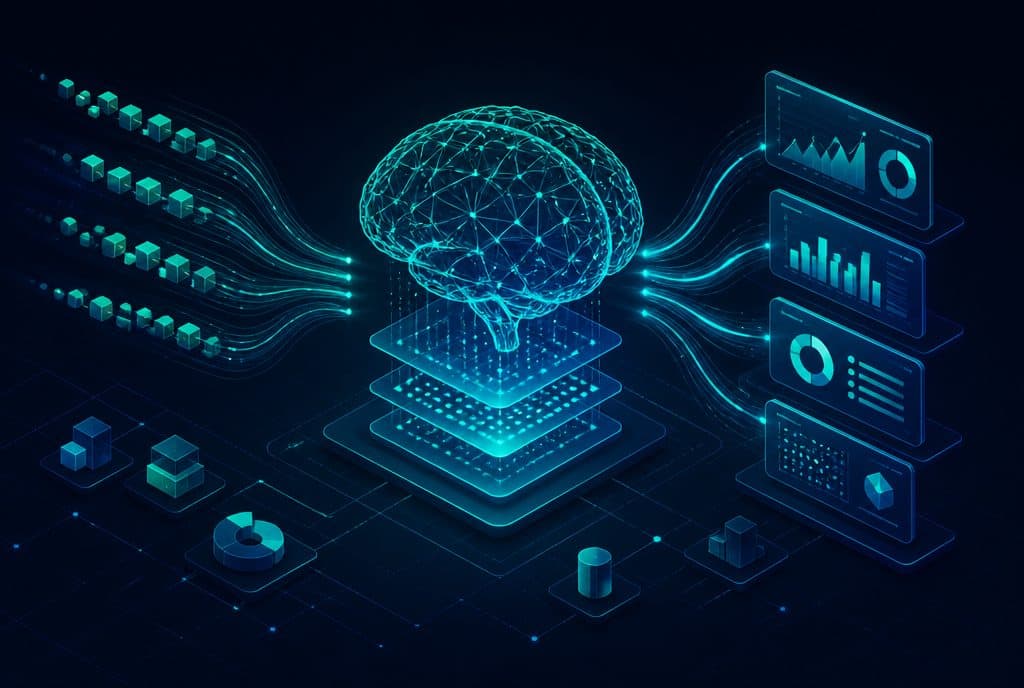


Generative AI is a branch of artificial intelligence that creates new content—text, images, audio, and code—based on instructions in plain language. Unlike traditional AI systems that classify existing data, Generative AI generates original output every single time, based on learning from vast amounts of examples. In a small to medium-sized Israeli business, it can save hours of weekly work—if you understand where it is right to use it and where you need to be careful.
OpenAI's ChatGPT, Google's Gemini, and Anthropic's Claude are all examples of Generative AI. Between 2023 and 2026, they evolved from niche technological tools into a business infrastructure used by businesses of all sizes. At Automaziot AI, we integrate it into AI agents and business automation workflows for Israeli businesses.
What is Generative AI?
Generative AI is a technology that creates new content based on natural language instructions. The model is trained on vast amounts of text, images, and audio, learning to identify patterns and produce new outputs that did not exist before. It doesn't "search" for a saved answer—it composes a new answer for every request.
The difference from "old" AI is fundamental: an older model would classify an image as a "dog" or a "cat"; a Generative model will create a new image of a dog based on the description you provide. A search engine returns pages that already exist; ChatGPT drafts a brand-new answer for you.
Types of Generative AI — Quick Reference Table
| Type | What It Generates | Common Examples | Business Use |
|---|---|---|---|
| Text (LLM) | Articles, emails, code, summaries | ChatGPT, Claude, Gemini | Content writing, customer replies, meeting summaries |
| Image | Images, infographics, designs | DALL-E, Midjourney | Social media posts, marketing materials |
| Audio / Voice | Synthetic speech, music | ElevenLabs, Suno | Voice AI agents, podcasts, marketing messages |
| Code | Scripts, API requests, test coverage | GitHub Copilot, Claude | Automation, faster development |
| Video | Clips from text or images | Sora, Runway | Marketing content, product demonstrations |
In the Israeli business environment, the most common use today is text: writing price quotes, drafting customer emails, composing social media posts, and transcribing and documenting calls.
Realistic Business Use Cases
1. Content and Marketing Communication
Writing LinkedIn and Instagram posts, drafting newsletters, writing initial drafts for blog posts and service pages—Generative AI can provide a first draft within seconds. Our experience: the output requires human editing, but it removes the barrier of the blank page and shortens content production time.
2. Customer Support and Responses
Language models trained on business knowledge—product lists, return policies, FAQs—can answer repetitive customer questions via chat, WhatsApp, or email. This is the foundation of a WhatsApp AI Agent that responds 24/7.
3. Meeting Summaries and Documentation
Recording a meeting → automatic transcription → summarizing key points and action items: this chain, composed of several Generative AI tools, saves businesses an hour per meeting. In n8n, you can build this sequence as an automated workflow that distributes the summary to all participants.
4. Price Quotes and Repetitive Documents
Drafting a customized price quote based on parameters (customer name, service, terms)—instead of copying, pasting, and manually changing details every time. Note: the output still requires human approval before sending.
5. Natural Language Data Analysis
"What is the trend in CRM inquiries from the past month?"—instead of pulling a manual report, Generative AI can analyze a file or database and generate insights in a single paragraph. Great for weekly reports and operational decisions.
What to Watch Out For
Hallucinations
This is the primary limitation: a language model can generate information that sounds completely credible but is simply incorrect—a wrong date, a non-existent price, or a fabricated quote. It doesn't "know" it is wrong. Therefore:
- Never send unverified output to a customer that contains specific factual data.
- Any legal, medical, or financial information generated by the model requires verification against a reliable source.
- The Israeli Privacy Protection Law imposes specific obligations—do not rely on what the model "knows" about them.
Lack of Up-to-Date Information
Most models were trained up to a specific cutoff date and are unaware of events that occurred afterward. For news, current prices, or market data, you must integrate live search (RAG—Retrieval-Augmented Generation) rather than relying on the model's base knowledge.
Data Security
Inputting sensitive information—customer data, financial records, intellectual property—into public AI services (like ChatGPT or Gemini) can pose a risk. In a serious business environment, you must verify whether the provider allows privacy settings that prevent data from being used for model training, or opt for a private deployment.
Over-reliance
Generative AI streamlines many processes, but it does not replace human judgment. Businesses that adopt it blindly—without output control or clear boundaries—often find themselves correcting errors that have already been sent to customers.
The Connection to Automation and AI Agents
Generative AI is the engine—the component that understands language and generates content. Business automation is the pipeline—the sequence that connects systems (CRM, calendar, WhatsApp, email) and moves data between them. And an AI agent is the combination of both: a language model that understands the request, decides what to do, and executes it through integrations.
A practical example: A customer writes on WhatsApp, "When do you have availability?". Generative AI understands the intent. The automation requests the relevant data from the calendar. The agent proposes three timeslots, gets confirmation, and books it—all without manual intervention. This sequence is built using tools like n8n, which connects all the components.
Where to Start?
The right approach for businesses starting out: choose one high-volume, low-complexity process—drafting emails, summarizing calls, answering FAQs—and test the tool there. The takeaway: if the output saves you time after a quick edit, it works. If you spend more time fixing it than writing from scratch, the tool, the prompt, or the process needs improvement.
The next step is to connect Generative AI to your existing processes: CRM, WhatsApp, calendar—so that information doesn't need to be manually moved between systems. This is where automation truly comes into play.
Want to understand which process in your business can benefit the most from Generative AI? Contact us and let's build a practical direction together—without tech jargon or overhyped promises.
Summary
Generative AI is not a buzzword—it is an infrastructure that changes how businesses create content, respond to customers, and manage workflows. For a small to medium-sized Israeli business, the right entry point is a small, controlled step: one process, output control, drawing conclusions—and then expanding. AI does not replace business judgment, but when integrated correctly with business automation and AI agents, it frees up hours that would otherwise be spent on repetitive manual work.