

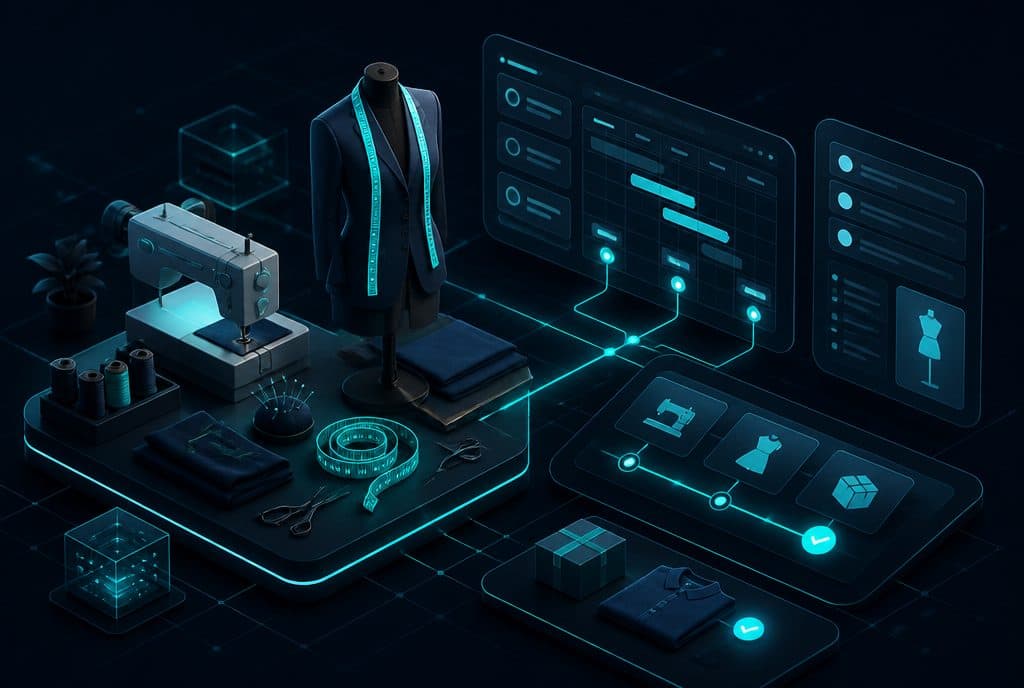
A tailor working alone — or a small clothing alteration business with two or three people — faces one recurring problem: the phone rings exactly when the needle is in the fabric. A customer asks, "Can you take in a shirt?", "How much does it cost to shorten pants?", "When can I pick it up?". If you didn't answer — they moved on. A simple WhatsApp bot handles all these inquiries automatically: it gathers details, sends a quote, schedules a fitting appointment, and sends an update when the garment is ready. All in Hebrew, without you ever picking up the phone.
How Does Automation Help a Tailor?
A WhatsApp bot for tailors responds to inquiries instantly, collects job details (type of alteration, size, and a photo if needed), sends a price quote based on your predefined price list, and schedules a fitting appointment in your calendar — all automatically. When the garment is ready, the system sends the customer an automatic notification. This way, you keep working without interruptions and don't lose customers who didn't get an immediate response.
Which Processes Can Be Automated?
A tailoring and clothing alteration business consists of several small processes that repeat dozens of times a week. Each of these can be streamlined:
| Process | What Happens Today | What Automation Does |
|---|---|---|
| Receiving a new inquiry | The phone rings, you are unavailable, the customer leaves | The bot answers immediately on WhatsApp, asking what is needed |
| Price quote | You have to stop working, call back, and ask for details | The bot collects details and sends a price based on your price list |
| Scheduling a fitting | Back-and-forth over the phone to find a free slot | The bot displays available time slots and confirms in the calendar |
| Appointment reminder | Customers forget, no-shows occur | A WhatsApp message is sent a day before and an hour before |
| "Garment is ready" update | Calling each customer one by one | The bot sends an automatic message with pickup hours |
| Follow-up on uncollected items | Forgotten garments pile up on the rack | An automatic reminder is sent after two days |
Three Real-World Scenarios
Scenario 1: A WhatsApp Inquiry on Friday Afternoon
A customer sends a message: "I have a wedding dress that needs shortening, is it possible?" On Friday at 15:00, you are already closed. The bot replies instantly: "Hello! Yes, we do dress shortening. Could you send a photo of the dress and mention approximately how many cm to shorten?" The customer sends a photo, the bot asks about the fabric and embellishments, and sends a price range quote. On Sunday morning, you have a warm lead with all the details — not a forgotten weekend call.
Scenario 2: Scheduling a Suit Fitting
A new customer wants a suit for an event in three weeks. The bot collects contact details, explains that an initial fitting is required, and displays available slots for the coming week based on your calendar settings. The customer chooses a time — and the event is automatically created. A reminder is sent to them the day before. You start your morning and see a scheduled fitting in your calendar — without a single phone call.
Scenario 3: Clearing the "Bottleneck" of Ready Garments
At the end of a busy work week, six garments are ready to be returned to customers. Instead of calling everyone, you send a simple internal message to the bot or mark them in the system management sheet. The bot sends each customer a WhatsApp message in the format you defined: "Hello [Name], your garment is ready for pickup. We are open Sun-Thu 9:00-18:00, Friday 9:00-13:00. Looking forward to seeing you!" Anyone who doesn't show up within two days receives a reminder. This saves an hour of phone calls and forgotten items.
What is Needed to Make It Work?
The tools behind the system are completely standard:
- WhatsApp Business API — The channel through which the bot communicates with customers
- n8n — The platform that connects the bot, the calendar, and the list of ready garments
- Google Calendar or Outlook — For managing appointments
- A simple Google Sheets spreadsheet (or CRM) — For the list of ready garments, customer details, and price list
There is no need for specialized software for a tailoring business. The bot is built on top of the tools most small businesses already use.
Privacy and Security
When managing customer conversations through a digital channel, it is important to be familiar with the Israeli Privacy Protection Law. In practice, this means: you cannot save customers' personal information (name, phone, clothing details) without consent, and you must give the customer the option to request deletion. When building the automation system, we define in advance what is saved, where, and for how long — so everything is compliant and secure.
How to Get Started?
The right approach is not to start with the entire system all at once. The process that succeeds in practice:
- Map out one initial scenario — Usually: "Receiving an inquiry + sending a price quote". This is the scenario that yields the fastest results and proves its value.
- Connect to the calendar — Once the bot filters and warms up the lead, it offers available hours. This eliminates more manual work.
- Ready updates — Once the basic automation is running and stable, add the "garment is ready" notifications and no-show reminders.
The first stage usually takes about a week. Start narrow, verify that it works in practice, and then expand.
Want to see how this looks in practice for a service business like tailoring? Talk to us on WhatsApp and let's build your first scenario together — with no mapping fee.
How much does it cost?
| Component | Price (one-time setup, ex-VAT) |
|---|---|
| AI booking agent — simple | ILS 8,000 |
| Calendar link and meeting booking | ILS 2,000 |
| Appointment reminders and confirmations | ILS 1,750 |
| Automatic follow-up sequence | ILS 2,500 |
| WhatsApp Business API setup | ILS 700 |
A complete starting point — a WhatsApp AI agent including the business number, server and agent control room — is from ILS 10,200; an agent with a management system (CRM) from ILS 18,200, a multi-agent system from ILS 25,350. There is no monthly fee; third-party costs (server, messages, AI) of about ILS 100–500 a month are paid directly to the providers. The full component price list: pricing page.
Summary
An independent tailor or a small clothing alteration business doesn't need a marketing department. They need a customer who wrote on Friday night to get an answer, a customer who scheduled a fitting not to forget to come, and all customers whose garments are ready to know about it without having to call everyone. A simple WhatsApp bot solves exactly these three things — and without requiring technical knowledge from the business owner. The right platforms (n8n, WhatsApp Business API, standard calendar) already exist; all that is needed is the right connection.
Read more about WhatsApp bots for businesses, automated appointment scheduling, and how automation helps service businesses.