
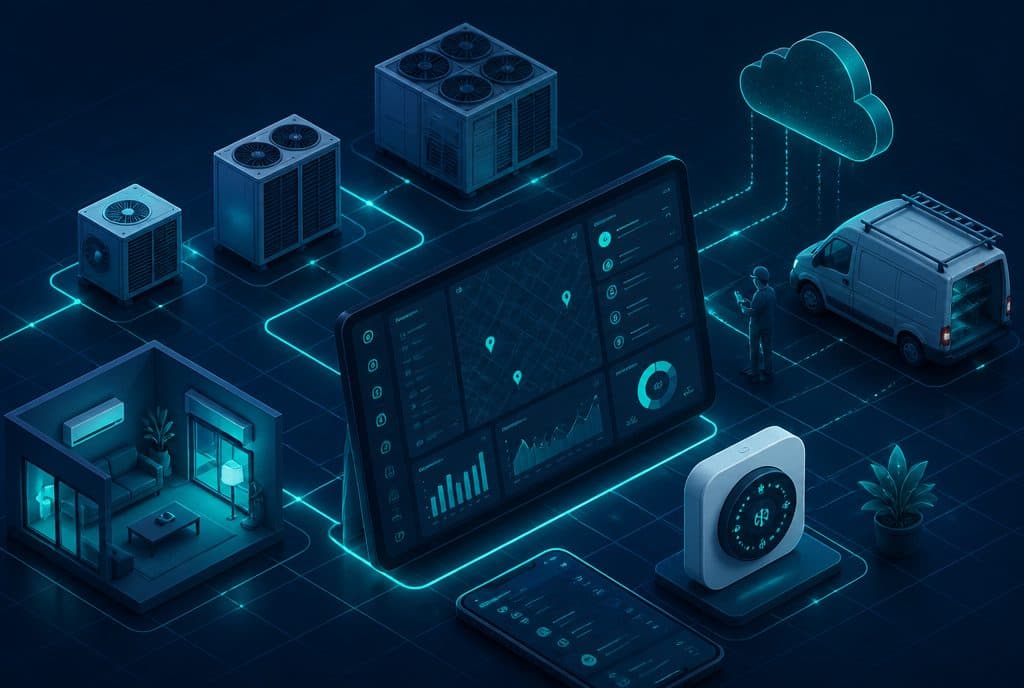
A WhatsApp bot for HVAC technicians filters the type of issue with the customer, sends an initial quote, schedules a technician appointment based on actual availability, and sends seasonal maintenance reminders — all automatically, even when you are on a roof with screws in hand. In this article, we will explain how this automation is built and what it actually does for an Israeli AC service business. You can see more about the general approach to building this in the article on automation for service businesses.
How Automation Helps HVAC Technicians
A WhatsApp bot for HVAC technicians handles the entire loop: a customer sends a message → the bot identifies the inquiry type (malfunction, quote, maintenance) → asks targeted screening questions → displays an initial quote → schedules an appointment directly in the technician's calendar → sends a confirmation, a reminder, and after the visit — a follow-up and a reminder for the next maintenance. The technician arrives in the field; the automation manages the customers.
Why AC Businesses Benefit So Much From This
An AC service business operates in two extremes: relative quiet in the winter and heavy load in the summer, when everyone calls at once at 9 AM on the first hot day of June. Without automation, the business owner receives 30 WhatsApp messages a day while on a ladder at a customer's site, and probably loses 10 of them by the time they get back to the phone.
The problem is not solved by hiring an extra person just to answer WhatsApp — financially, it doesn't make sense for a small-to-medium business. Automation provides a solution: the inquiry is closed automatically 24/7, independent of human availability.
What the Bot Does at Each Stage
Stage 1: Intake and Malfunction Screening
The customer sends "The AC is not cooling" on Friday at 8 PM. The bot responds immediately, asking targeted questions:
- What is the AC model?
- When did it stop cooling?
- Is there an unusual noise or smell?
- How old is the AC?
The answers make it possible to filter between a malfunction that requires an urgent technician, a regular repair, or sometimes — a simple operating instruction that solves the problem without a visit at all.
Stage 2: Initial Quote
Based on the filtered inquiry type, the bot sends an initial price range: "Diagnostic visit + basic cost for treating a cooling issue — X-Y ₪, final price after on-site inspection." Not a promise, but a range that prepares the customer and reduces surprises. It also filters out customers looking for an unrealistic price — before the technician arrives and wastes time.
Stage 3: Appointment Scheduling
The bot displays available time slots based on the technician's calendar (according to the neighborhood, the estimated scope of the visit, and what is already booked). The customer chooses a time, receives an immediate confirmation, and an automatic reminder two hours before the visit — to reduce "no-shows".
Stage 4: Seasonal Maintenance Reminders
This is one of the easiest things to miss manually, and it holds the most value: after every visit, the bot adds the customer to a reminder list. Before summer (April-May) and before winter (September-October), an automatic message goes out — "It's time for seasonal service, filter cleaning, and gas check." A customer who receives a reminder at the right time is much more likely to stay in touch than a customer you try to reach six months later.
Stage 5: Post-Visit Follow-Up
A day after the visit, a short message goes out: "Hi, is the AC working properly? If you have any questions, we'd be happy to help." This is not aggressive marketing — it's service. And a customer who feels you are keeping in touch after the visit will return next time and refer friends.
Capabilities Table — What the Automation Covers
| Scenario | Manual | With Automation |
|---|---|---|
| Night / weekend inquiry | Unanswered | Responds immediately, books appointment |
| 20 inquiries a day | Waiting queue, some get lost | Handled simultaneously |
| Sending a quote | Manually every time | Automatic based on service type |
| Reminder before visit | Sometimes forgotten | Sends automatically |
| Seasonal maintenance reminder | Usually not done | Automatic for the entire customer database |
| Post-service follow-up | Rare | Automatic the next day |
Three Real-Life Scenarios
Scenario A — Solo technician with 2 teams: Every day, 8-15 inquiries come in. The technician himself is in the field and returns calls during breaks between visits. With a WhatsApp bot, inquiries are closed automatically based on availability — he ends the day with a full calendar that he didn't have to build by hand.
Scenario B — Business with a small call center (2 agents): In the peak of summer, the two agents cannot answer everyone. The bot absorbs the overflow, filters, and forwards to an agent only cases that require a human conversation (complex malfunction, VIP customer, emergency). The rest of the inquiries are closed automatically.
Scenario C — Service company with annual contracts: After every installation or visit, the customer enters an annual maintenance track. Seasonal reminders go out automatically and offer contract renewal — without an agent having to remember who was treated and when.
The Integrations That Make It Possible
The automation is built from several components working together:
- WhatsApp Agent — manages the conversation with the customer in natural language
- Automated Scheduling — connects the bot to the technician's calendar and displays only open slots
- n8n — the automation engine that connects WhatsApp to all other systems
- Customer Database — saves visit history and schedules seasonal reminders
All components work together: the customer writes on WhatsApp, n8n routes, the calendar updates, and reminders go out on time.
What the Automation Does Not Do
It is important to be clear: the bot does not diagnose complex technical malfunctions and does not replace the technician's judgment. It manages the pipeline — from intake to scheduling — and frees up the technician to do what they do best: fix air conditioners. Complex conversations, price arguments, an angry customer — these are passed to a human.
How to Get Started
- Characterization — detailing the types of inquiries that come in (common malfunctions, quote requests, maintenance requests) and the rules for scheduling appointments by area and availability
- Building and Testing — the bot is built and undergoes testing with real scenarios before going live
- Gradual Launch — starting with one scenario (usually malfunction screening + scheduling), adding layers gradually
The approach is not to set up everything in one day, but to start with what solves the biggest headache — usually the 24/7 availability and peak summer load — and build from there.
Want to see what this looks like for your business? chat with us on WhatsApp and we will build the characterization together — free of charge.
How much does it cost?
| Component | Price (one-time setup, ex-VAT) |
|---|---|
| WhatsApp AI sales agent | ILS 9,000 |
| Automatic quoting engine | ILS 6,500 |
| Calendar link and meeting booking | ILS 2,000 |
| Automatic follow-up sequence | ILS 2,500 |
| WhatsApp Business API setup | ILS 700 |
A complete starting point — a WhatsApp AI agent including the business number, server and agent control room — is from ILS 10,200; an agent with a management system (CRM) from ILS 18,200, a multi-agent system from ILS 25,350. There is no monthly fee; third-party costs (server, messages, AI) of about ILS 100–500 a month are paid directly to the providers. The full component price list: pricing page.
Summary
HVAC technicians and AC service businesses lose leads due to one simple thing: they cannot answer everyone on time, especially not in the peak of summer. A WhatsApp bot connected to a scheduling calendar solves this problem directly: every inquiry is answered, every appointment is booked, and every customer who had a visit receives a reminder — without the technician having to touch the phone between visits. You can read about a similar approach and other service businesses in the article on automation for service businesses.