
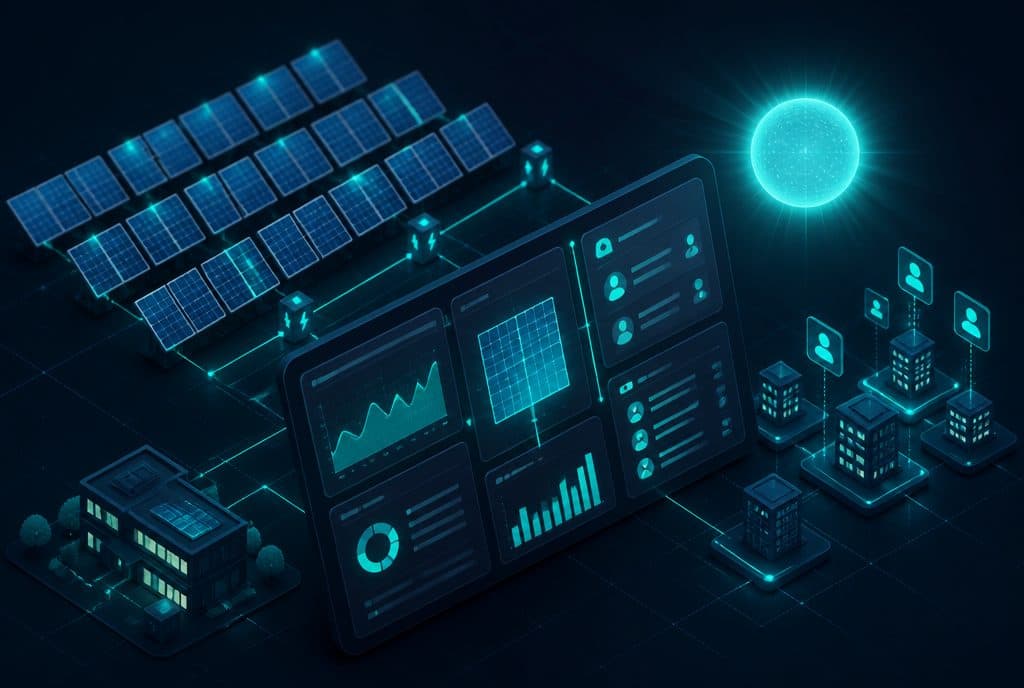
A solar energy company that receives leads from Google and Facebook faces a well-known problem: the lead asks "How much will a solar system cost me?", waits for an answer, and by the time a representative is available — they have already spoken with three competitors. AI automation for solar companies solves exactly this: screening the lead by roof type, electricity usage, and region, sending an initial estimate, scheduling a site survey in the technician's calendar, and ongoing follow-up — all automated, 24/7, without a representative having to handle each inquiry individually.
How does automation help a solar energy company?
An AI agent for a solar company screens every incoming lead according to pre-defined criteria (roof type, monthly electricity usage, geographical area), sends an initial feasibility estimate, schedules a site survey directly in the relevant technician's calendar, sends automated reminders before the visit, and manages follow-up after the proposal — all computerized, without a representative handling each stage manually. The result: the sales team receives only qualified leads, ready for a business conversation.
The challenges of an Israeli solar company with leads coming from multiple channels
The solar energy market in Israel has grown significantly in recent years. Homeowners, business owners, and apartment buildings reach out to solar companies from Google, Facebook, WhatsApp, and recommendations — often during hours when no representative is available.
The main problem is not the volume of leads, but what happens to them after they arrive:
- Unscreened leads — a sales representative makes contact, asks the same basic questions every time, and discovers that the roof is rented, the electricity consumption is too low to justify the investment, or the area is not covered.
- Delayed response — a lead that arrives on Friday afternoon waits until Sunday. In a competitive market, they have already closed with a competitor.
- Irregular follow-up — a price quote is sent, but follow-up depends on the representative's memory. "Hot" leads go cold.
- Scheduling site surveys — when reaching qualified leads, scheduling the visit involves phone calls and emails. Not infrequently, the visit is canceled at the last minute.
What can be streamlined in a solar energy company
| Process Stage | What the Agent Does | What is Left for a Human |
|---|---|---|
| Lead Capture | Receives inquiries from any channel (WhatsApp, form, Facebook/Google leads), opens a record in the CRM | — |
| Initial Screening | Automatically asks: roof type, year of construction, monthly electricity consumption, region | Complex questions or non-standard roofs |
| Feasibility Estimate | Sends an indicative calculation based on the collected information | Leads with unusual characteristics |
| Scheduling Site Survey | Offers available time slots in the relevant technician's calendar, sends confirmation + address | — |
| Reminders | Sends reminders 24 hours and 2 hours before the visit | — |
| Post-Proposal Follow-up | Sends the price quote, schedules follow-up after two days, and after a week | Negotiating terms |
| Maintenance & Service | Sends a reminder for an annual inspection, allows opening a service call via WhatsApp | Diagnosing complex faults |
Practical Scenarios
Scenario 1: A Facebook lead on Friday afternoon
A homeowner fills out a lead form on Facebook after seeing an ad. The agent detects the inquiry within minutes, sends her a WhatsApp with basic screening questions. She answers. The agent calculates an initial estimate, sends it, and offers three time slots for a roof survey next week. She chooses one. A basic check is completed — before any representative even knew the inquiry arrived. On Sunday morning, the representative receives a qualified lead with all the details in their calendar.
Scenario 2: Follow-up after a price quote
A price quote was sent on Monday. The agent schedules an automated follow-up for the weekend: "Hello David, we sent you a price quote a few days ago — do you have any questions we can help with?" If David doesn't answer, another follow-up is sent after a week. All interactions are recorded in the CRM. The representative sees the full picture and steps in only when there is a question requiring a human response.
Scenario 3: Annual maintenance reminder
A customer who installed a system a year ago receives a WhatsApp: "Your system has been active for a year — an inspection is recommended. Would you like us to schedule a technician visit?" He confirms, the agent schedules it in the calendar and sends a reminder. This increases revenue from the existing customer base — without a representative needing to remember to reach out.
How to start: A modular approach
The common mistake is trying to streamline everything at once. The approach we recommend:
Stage 1 — Screening and Scheduling (Weeks 1-2): An agent that receives inquiries, asks screening questions, and schedules a site survey. This usually yields the fastest ROI.
Stage 2 — Follow-up (Weeks 3-4): Adding a follow-up sequence after a price quote. The agent sends messages at defined times and updates the CRM after each interaction.
Stage 3 — Maintenance and Retention (Months 2-3): Annual reminder sequences for existing customers, option to open a service call via WhatsApp.
Each stage is independent and adds immediate value. You don't need to wait for the next stage to see results.
Frequently Asked Questions from Solar Companies
Can the agent handle technical questions about the system? The agent can answer frequently asked questions that you define in advance — advantages of type X panels, average ROI time, generator support. Complex questions requiring engineering are transferred to a human representative along with a summary of the conversation.
What happens when the agent doesn't know how to answer? It politely admits it doesn't know and transfers the conversation to a representative with all the context — not "I didn't understand, try again." This is the difference between a rule-based bot and an AI agent. See What is an AI agent for business to understand the difference in depth.
Is this suitable for a small company with two or three representatives? Precisely there. A small company cannot afford a representative wasting 40% of their time on unqualified leads and manual scheduling. The agent operates 24/7 and passes to the representative only what justifies human time.
Integration with Existing Systems
Integration is possible with most common tools used by Israeli solar companies:
- CRM (any system with an API) — lead records, status updates, conversation history
- Google Calendar / Outlook — direct scheduling of site surveys
- WhatsApp Business API — incoming and outgoing conversations
- Facebook and Google Lead Forms — immediate capture of the lead after form submission
- n8n — the central automation platform that connects all components
See also: Automated Lead Management and Automated Scheduling.
Compliance and Privacy Issues
Every system we build complies with the requirements of the Israeli Privacy Protection Law: explicit consent of the customer before saving their details, storing information on secure servers, and the option to request information deletion. If your solar company is also subject to additional regulatory guidelines (such as licensing from the Ministry of Energy), these are taken into account during the characterization stage.
How much does it cost?
| Component | Price (one-time setup, ex-VAT) |
|---|---|
| WhatsApp AI sales agent | ILS 9,000 |
| Automatic quoting engine | ILS 6,500 |
| Calendar link and meeting booking | ILS 2,000 |
| Automatic follow-up sequence | ILS 2,500 |
| WhatsApp Business API setup | ILS 700 |
A complete starting point — a WhatsApp AI agent including the business number, server and agent control room — is from ILS 10,200; an agent with a management system (CRM) from ILS 18,200, a multi-agent system from ILS 25,350. There is no monthly fee; third-party costs (server, messages, AI) of about ILS 100–500 a month are paid directly to the providers. The full component price list: pricing page.
Summary
A solar energy company that receives inquiries from multiple channels and faces a multi-stage sales process — lead, estimate, survey, proposal, follow-up, maintenance — is an excellent candidate for automation. The agent does not replace the representative; it ensures that the representative focuses only on conversations that justify human time: negotiating, complex engineering questions, and closing deals.
Want to build an AI agent for your solar company? Contact us for a free consultation call — we will map your inquiry process and show how automation fits into it.