
A locksmith who receives an urgent inquiry on WhatsApp at 02:00 AM cannot afford to wait. A smart bot responds immediately, confirms that the technician is on the way, requests an exact location, and sends an initial price estimate — all before the customer has even had time to open Google and search for a competitor. Locksmith services are one of those industries where response speed is the difference between closing the job and losing it.
How does automation help a locksmith?
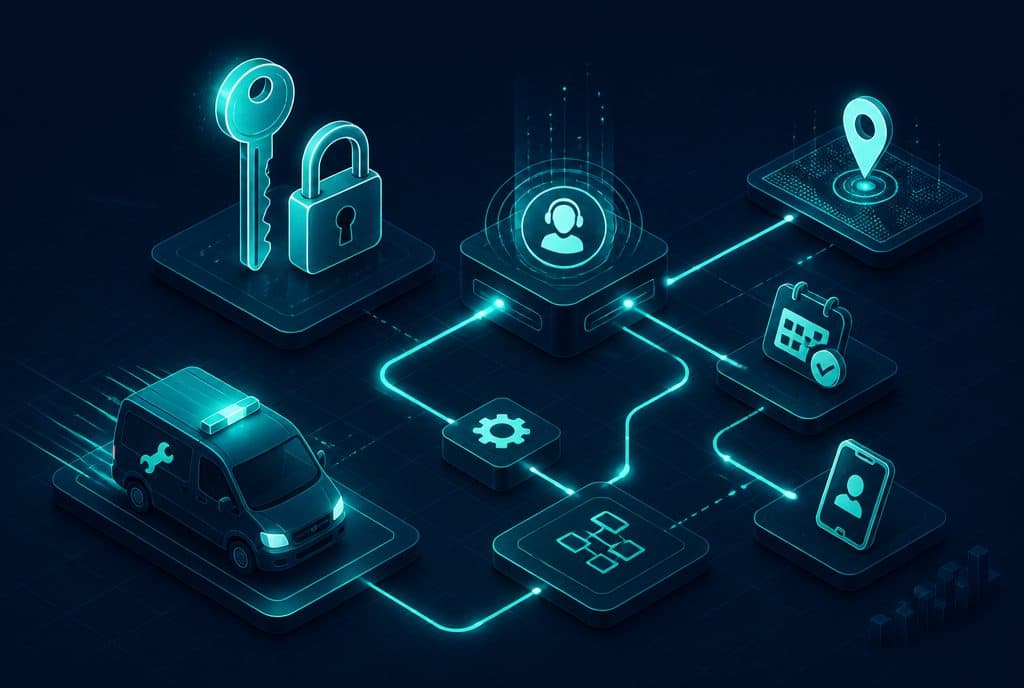
Automation for locksmiths helps in three critical areas: immediate response to urgent inquiries (24/7, including nights and weekends), rapid dispatching to the available technician, and sending an initial price quote — without the business owner having to touch their phone. After the job is completed, the automation system sends a follow-up, requests a review, and retains the customer for future inquiries. Returning commercial clients (offices, buildings) receive automated periodic maintenance reminders that generate stable, recurring revenue.
Why do locksmiths specifically need an immediate response?
Locksmith services are a "here and now" business. When someone is locked out in the rain, or a lock breaks at a storefront entrance in the morning, they don't conduct market research — they reach out to the first one who answers. Whoever answers first — closes the job.
The problem: many locksmiths still work alone or with one or two technicians. It is impossible to answer every call at any hour while simultaneously driving to a job site. Any inquiry that doesn't receive a response within a minute or two — goes to a competitor.
Automation solves this: a WhatsApp bot operates 24/7, responds in seconds, and manages the initial conversation while the technician is on the way.
Key Capabilities: What does the automation actually do?
| Capability | What happens in practice | Why it matters |
|---|---|---|
| Immediate WhatsApp response | A bot answers within seconds, 24/7 | The customer doesn't wait and doesn't move on to a competitor |
| Location and job details collection | The bot requests the address, lock type, and issue type | The technician arrives prepared, saving an extra trip |
| Initial price estimate | Automated response with a price range | The customer knows what to expect, resulting in fewer cancellations |
| Dispatching to a technician | The bot sends a message to the available technician with the customer's details | No need for manual coordination calls |
| Post-service follow-up | Automated message to check satisfaction + request a review | Google reviews without having to beg |
| Returning commercial clients | Annual/periodic reminders to check locks | Stable revenue from service contracts |
| Lead management in CRM | Every inquiry is automatically entered into a record | Customer history is never lost |
Scenario: An urgent inquiry at 23:45 PM
To understand how this works in practice, here is a day-to-day scenario:
23:45 — A customer sends a WhatsApp message: "I'm locked out, Tel Aviv, need an urgent locksmith."
23:45 — Within seconds — The bot responds: "Hello! We are available right now. Please send your exact address and I will give you an estimated arrival time."
23:46 — The customer sends the address. The bot confirms receipt, sends an initial price range for night service, and forwards a message to the available technician with the customer's details and address.
23:47 — The technician confirms they are on the way. The bot updates the customer: "The technician is on the way, estimated arrival time: 20 minutes."
00:10 — The technician arrives and performs the work.
00:30 — The bot sends the customer a follow-up message: "Thank you for choosing us. We hope everything is sorted out — if you have any questions, we are here. We would appreciate a quick review on Google."
Without the system: The business owner would have had to answer from bed, coordinate back-and-forth by phone with the technician, and ensure the customer didn't abandon while waiting for an answer. With the system: everything happened automatically.
Commercial Clients: Stable revenue from contracts
Urgent inquiries are important, but returning commercial clients are the backbone of an established locksmith business. A building manager, a property management company, an office with dozens of doors — these are clients who need periodic maintenance, lock replacements after employees leave, and annual inspections.
Business automation (lead management) enables:
- Automated periodic reminders — "Hello, it has been a year since your last inspection. Would you like to schedule one?" — sent via WhatsApp completely hands-free.
- Service contract tracking — Reminders to renew before expiration.
- Job reporting to WhatsApp — After each visit, the client receives a summary of what was done (highly useful for public entities that require documentation).
- Separate routing from urgent inquiries — Commercial clients are recognized and routed through a different process than an emergency broken lock.
Managing commercial clients manually — via personal WhatsApp, Excel files, or sticky notes — is what leads to losing a client who didn't receive a reminder and switched to a competitor. A system that manages this automatically allows you to grow without adding staff.
How to get started?
The recommended approach is modular — you don't roll out a massive system in one day, but rather start where you will get the most value quickly:
Step 1 — Initial Response (1 week) A WhatsApp bot that answers urgent inquiries, collects the address, and forwards it to the technician. This alone solves the "I didn't answer at night" problem.
Step 2 — Follow-up and CRM (1-2 weeks) Every inquiry is logged into a CRM record. After the job is done — a thank-you message and a review request are sent.
Step 3 — Commercial Clients (1-2 weeks) Periodic reminders, contract management, and distinct routing based on client type.
Each step builds on the previous one, and you can test results before moving forward. Our approach at Automaziot AI is always to perform an initial assessment — to understand the incoming inquiries, the workflow, and what is already working — before writing a single line of automation.
What automation does NOT do
To keep expectations clear:
- It does not make decisions instead of the technician — The bot collects information; it does not perform a professional assessment. The final price is determined by the technician on-site.
- It does not replace complex human conversation — Insurance issues, price disputes, or angry customers will be transferred to a human with a full summary.
- It does not work without proper definition — A bot built without understanding the business's workflow will cause more harm than good. The initial assessment is the foundation.
How much does it cost?
| Component | Price (one-time setup, ex-VAT) |
|---|---|
| WhatsApp AI sales agent | ILS 9,000 |
| Automatic quoting engine | ILS 6,500 |
| Calendar link and meeting booking | ILS 2,000 |
| Automatic follow-up sequence | ILS 2,500 |
| WhatsApp Business API setup | ILS 700 |
A complete starting point — a WhatsApp AI agent including the business number, server and agent control room — is from ILS 10,200; an agent with a management system (CRM) from ILS 18,200, a multi-agent system from ILS 25,350. There is no monthly fee; third-party costs (server, messages, AI) of about ILS 100–500 a month are paid directly to the providers. The full component price list: pricing page.
Summary
A locksmith who loses night jobs and commercial follow-ups doesn't lose them because of price — they lose them because of response speed and forgetfulness. A WhatsApp bot that answers in seconds, lead management that documents everything, and automated reminders for commercial clients — these are not luxury tools. They are the way a solo locksmith operates like an organized business without hiring an office manager.
Read more about automation for service businesses in our Automation Guide for Service Businesses.
Want to understand how this looks in your business and where it's best to start? Chat with us on WhatsApp — initial assessment at no cost.