

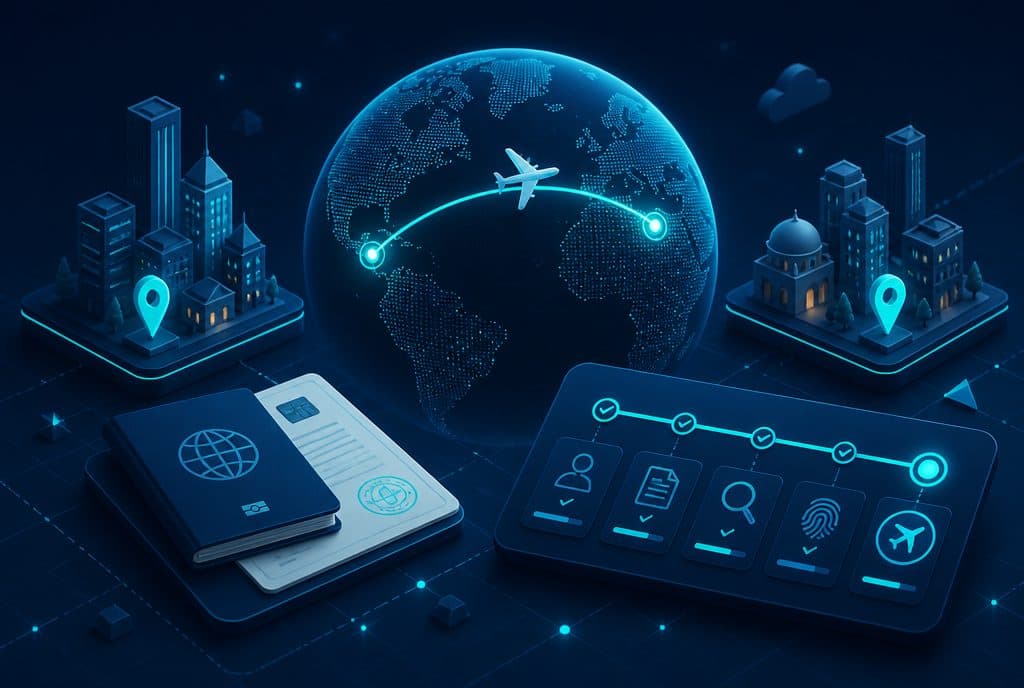
Immigration and relocation consultants in Israel face a unique challenge: inquiries arrive from every direction — WhatsApp, website forms, email — each with a different destination country, visa type, and required documents. For an independent consultant or a small firm, the initial screening alone can consume hours. An AI agent for an immigration consultant screens by country and visa type, collects basic documents, schedules a meeting in the calendar, and updates status throughout the process — without providing legal advice at any stage. It does not replace the consultant; it ensures that every consultation meeting begins with an organized file rather than basic questions that could have been gathered in advance.
How Does Automation Help an Immigration Consultant?
An AI agent in the immigration field receives an inquiry, asks three to four screening questions (destination country, visa type, current status, urgency), collects initial documents, schedules a consultation meeting in the calendar, and sends an automatic reminder — all before the consultant has even seen the inquiry. It does not interpret laws or assess chances; any question requiring professional judgment is routed directly to a human, along with a full summary of what has been collected.
What Exactly Can Automation Handle?
Not every task in an immigration office is suitable for automation. It is important to distinguish between what can be delegated to an AI agent and what must remain in the hands of the consultant:
| Action | Suitable for Automation? | Note |
|---|---|---|
| Screening inquiries by country and visa type | Yes | Standard questions, structured answers |
| Collecting personal details and basic documents | Yes | Checklist based on category |
| Scheduling consultation meetings in the calendar | Yes | Integration with Google Calendar / Calendly |
| Sending reminders and status updates | Yes | Via WhatsApp or email |
| Answering general FAQs | Partially | Public general information only, no legal assessment |
| Assessing visa approval chances | No | Must be a human consultant |
| Interpreting immigration law | No | Must be a human consultant |
| Recommending a specific pathway | No | Must be a human consultant |
Three Practical Scenarios
1. Screening Incoming Inquiries on WhatsApp
An inquirer writes "Hello, I am interested in moving to Canada" — the agent responds immediately, asking about marital status, occupation, whether they have prior PR, and the desired timeframe. At the end of the brief conversation, the inquiry is categorized (Express Entry, Provincial Nominee, Family Sponsorship), logged in the CRM, and sent to the consultant's priority queue. Inquiries where the pathway is unclear after the screening questions are transferred to the consultant at the very first stage.
2. Document Collection Before a Meeting
After a meeting is scheduled, the agent sends the client a document checklist tailored to their category (for example: for a German work visa application — passport, translated educational certificates, job offer). The client uploads the files through a secure interface; the agent verifies that the list is complete and marks the meeting as "File Ready" or "Missing X Documents". The consultant arrives at the meeting with the material already prepared.
3. Status Updates for Existing Clients
A client who has submitted an application and is waiting for approval sends questions on WhatsApp. Without automation, every "What is the status?" question goes directly to the consultant. With automation, the agent checks the latest processing stage in the CRM, sends an update ("Your application is currently in the document review stage — expected response time is X weeks"), and flags only urgent inquiries for human attention.
Clear Boundaries: What the Bot Should Not Do
In the immigration field, it is particularly important to define clear boundaries for the AI agent:
- No legal advice — The agent does not assess chances, recommend pathways, or interpret laws. Any question requiring professional judgment is manually transferred to the consultant.
- No promises — The agent does not state "You are eligible" or "Your application will be approved." It collects information and allows the consultant to make the assessment.
- Public information only — If the agent answers a general question, it clearly states that this is general and public information, not case-specific advice.
Confidentiality and Privacy: The Israeli Privacy Protection Law
Immigration consultants handle highly sensitive personal information — passports, employment records, marital status. Working with an AI agent must comply with the Israeli Privacy Protection Law:
- Transparency — The client knows they are interacting with an automated system and understands what data is collected and why.
- Data Minimization — The agent collects only what is necessary for the current stage; documents are transferred directly to the CRM and are not stored in intermediary tools.
- Right to Access and Deletion — The client can request to know what has been saved and ask for deletion.
- Secure Storage — Client details are saved in a protected CRM, not in external chat tools.
The automation itself is designed as a pipeline — it routes information, it does not store it unnecessarily.
How to Get Started?
Step 1 — Define Entry Scenarios: Where do inquiries come from (WhatsApp, form, email)? What are the basic questions every consultant asks in the first conversation?
Step 2 — Define the Screening Tree: Which category does each inquiry belong to (country, visa type, urgency)? What is transferred immediately to the consultant and what continues in the automated process?
Step 3 — Build the Agent and Integrations: Connect to WhatsApp, calendar, and CRM. This is typically done using n8n as the automation platform, with connections to Google Calendar and the existing CRM system.
Step 4 — Define Clear Boundaries in the Prompt: Ensure the agent knows exactly what it is forbidden to say and when to hand over to the consultant.
Step 5 — Controlled Launch and Tuning: One to two weeks of operation under close supervision, identifying inquiries that the agent did not handle correctly and tuning the instructions.
Want to design the right automation for your immigration office? Talk to us and let's build your first clear scenario together.
Questions to Ask Before Building
Before any automation project for an immigration consultant, it is worth clarifying:
- How many new inquiries arrive per week, and from which channel?
- What are the screening questions that repeat in every first call?
- What is the existing CRM — and if there is no CRM, what is the current tracking mechanism?
- What is the current response time for a new inquiry, and what is the target?
- Which documents are collected at the initial stage, and which of them often arrive missing?
The answers to these questions are the foundation for proper design — and will determine whether you start with a simple screening agent aimed at booking a meeting, or a complete system with document collection and status updates.
Relevant Links
- Automated Lead Management — How to ensure no inquiry is lost
- Automated Scheduling — Integration with calendar and reminders
- Lead Management Automation — The Complete Guide
How much does it cost?
| Component | Price (one-time setup, ex-VAT) |
|---|---|
| AI customer-service agent | ILS 9,400 |
| Document collection on WhatsApp | ILS 4,000 |
| Data extraction from documents (OCR) | ILS 3,500 (per document type) |
| ERP / accounting integration | ILS 4,500 |
| Automatic document generation | ILS 4,500 |
A complete starting point — a WhatsApp AI agent including the business number, server and agent control room — is from ILS 10,200; an agent with a management system (CRM) from ILS 18,200, a multi-agent system from ILS 25,350. There is no monthly fee; third-party costs (server, messages, AI) of about ILS 100–500 a month are paid directly to the providers. The full component price list: pricing page.
Summary
An AI agent for immigration and relocation consultants is not a solution for "automated consulting" — it is a solution for automated inquiry intake management. It screens, collects, organizes, and schedules meetings, so that every consultation call begins with a clear picture and an organized file instead of basic questions that waste valuable time. The boundaries are clear: what requires professional judgment remains solely in the hands of the human consultant. Proper implementation — while adhering to the rules of the Israeli Privacy Protection Law and defining precise boundaries — can save hours of routine work per week and significantly improve the client experience from the very first moment they reach out.