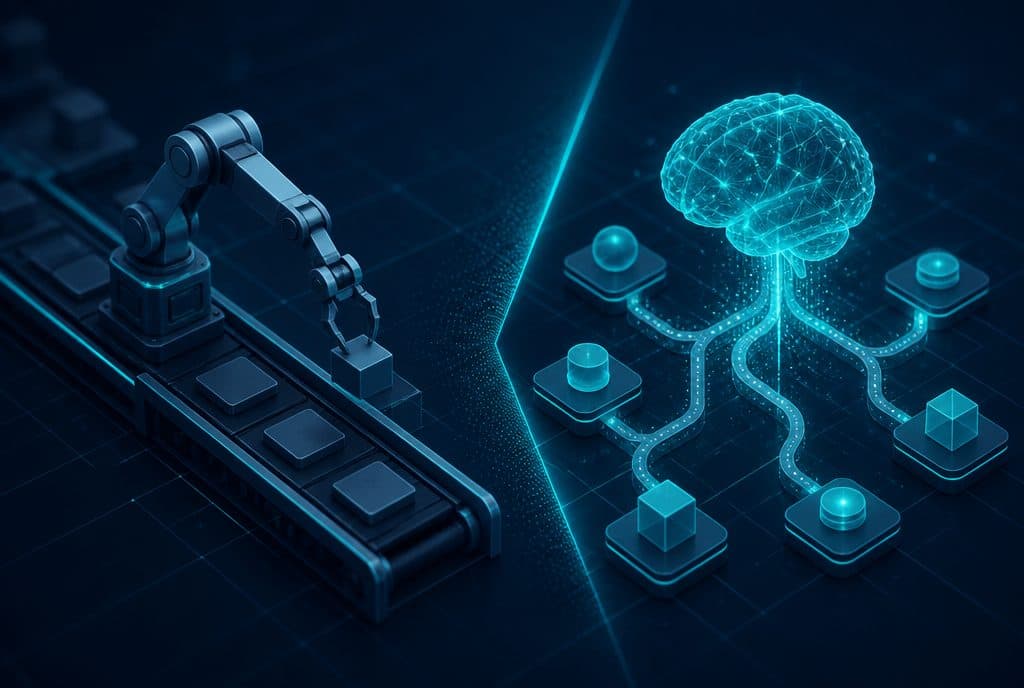


RPA (Robotic Process Automation) performs repetitive tasks based on fixed rules — such as copying data between systems. AI Agents, on the other hand, use machine learning to analyze data, make decisions, and adapt to changes. RPA is suitable for stable processes (implementation cost: $10,000-$50,000), while AI agents are suitable for dynamic environments (cost: $10-$20 per user/month). Combining them — using platforms like N8N — enables smart and flexible automation for Israeli businesses.
In today's business world, as business managers in Israel, you face a constant challenge: how to streamline processes without increasing headcount and without risking human error. Automation technologies offer solutions, but choosing between RPA (Robotic Process Automation) and AI Agents can be confusing. Both technologies enable task automation, but they operate in different ways and suit different needs. For example, if your business deals with repetitive data processing like invoice entry, RPA might be effective; whereas AI agents are capable of handling dynamic tasks like analyzing unstructured customer inquiries.
A large portion of organizations have already implemented RPA, and many more plan to do so in the coming years. At the same time, AI adoption in organizations is growing at a rapid pace. Both the RPA market and the AI agents market are growing rapidly and are valued at tens of billions of dollars, with sharp growth forecasts for the coming decade. These trends indicate that making the right choice can significantly impact your profitability.
In this article, we will review the differences between RPA and AI agents, analyze the pros and cons of each, and help you decide which is better suited for your business. We will rely on recent research and trends from 2025-2026 to provide practical insights that will help you implement automation smartly.
What is RPA and How Does It Work?
RPA, Robotic Process Automation, is a technology that mimics human actions using software. These robots operate based on predefined rules, such as copying data from one system to another or automatically filling out forms. For example, in Israeli financial businesses, RPA is used to process recurring invoices, saving hours of work per day.
Among the advantages of RPA are fast implementation and a high return on investment. The global RPA market is in continuous and rapid growth. For example, a healthcare provider that integrated RPA with Natural Language Processing (NLP) can significantly improve operational efficiency. However, RPA is mainly suitable for structured and stable tasks; when the process changes, the robot may fail, and therefore it requires frequent maintenance.
Generally speaking, RPA is an ideal tool for businesses looking for simple automation of repetitive processes. On platforms like n8n, which allow building open workflows, you can combine RPA with business automation and simple integrations, such as connecting a CRM to WhatsApp Business for sending automated messages.
What are AI Agents and Why are They Different?
AI Agents are autonomous systems that use artificial intelligence to perform more complex tasks. Unlike RPA, they are capable of analyzing unstructured data, making independent decisions, and learning from experience. For example, an AI agent can analyze customer emails, identify issues, and send a personalized response – all without human intervention.
A significant portion of organizations already use AI agents, and many plan to expand their use in the coming year. The AI agents market is growing rapidly. For example, a consumer goods company that uses AI agents to streamline supply chain processes can achieve significant cost reductions. AI agents excel in dynamic environments, where RPA would fail due to frequent changes.
Integrating AI agents into automation allows for greater flexibility. On open-source platforms like n8n, you can build agents that combine AI with workflows, such as marketing automation that tailors messages based on user behavior.
Key Differences Between RPA and AI Agents
The fundamental difference lies in the approach: RPA is based on rigid rules, while AI agents use machine learning to handle uncertainty. RPA is suitable for repetitive tasks like structured data processing, but it is fragile in the face of changes – even a slight change in the interface can break it. AI agents, on the other hand, are capable of adapting, for example, in analyzing unstructured texts or planning multi-step tasks.
AI agents tend to deliver a higher return on investment than RPA over time, with significantly lower maintenance costs in changing environments. RPA operates as a "lone robot," while AI agents can collaborate with other systems. For example:
- RPA: Effective in stable environments, such as banking.
- AI Agents: Suitable for dynamic tasks, such as customer service.
Comparison Table: RPA vs. AI Agents
| Criterion | RPA | AI Agents |
|---|---|---|
| Approach | Predefined rigid rules | Machine learning and self-adaptation |
| Task Type | Structured and repetitive | Dynamic and unstructured |
| Flexibility | Low – breaks with interface changes | High – adapts itself |
| Maintenance Cost | High when processes change | Significantly lower in changing environments |
| ROI | Fast for simple tasks | Higher return over time |
| Primary Uses | Data entry, invoice processing, reporting | Customer service, marketing, data analysis |
| Suitable for... | Businesses with stable processes | Growing businesses with changing needs |
The combination of the two, such as AI-enhanced RPA, is becoming increasingly common and enables smarter automation.
When to Choose RPA and When AI Agents?
If your business involves repetitive and structured tasks, such as data entry or routine reporting, RPA is the simple and cost-effective choice. It requires less initial investment and yields fast results. For example, in Israeli logistics businesses, RPA saves time in order processing.
Conversely, if you deal with unstructured data or require analysis-based decisions, AI agents are the right choice. They are suitable for businesses in marketing or service fields, where personalization is required. Many organizations are moving to AI agents because of these advantages.
Also consider business size: for small businesses, RPA is simpler, while for large businesses, AI agents provide better scaling capabilities.
Current Trends in the Automation Market
In 2025-2026, the trend is the integration of RPA and AI agents, known as "intelligent automation." AI agents are becoming a major trend, with an emphasis on autonomous systems. Global spending on generative AI continues to skyrocket year over year.
Organizations report moving from RPA to AI agents due to their higher adaptability. In Israel, high-tech businesses integrate tools like n8n to build AI-based workflows, enabling automation of processes like digital marketing.
Ready to move from RPA to AI agents? Discover our AI Agents service — the next step in automation.
Summary
Ultimately, the choice between RPA and AI agents depends on the specific needs of your business. RPA offers efficiency in simple and repetitive tasks, while AI agents provide flexibility and adaptation to a dynamic reality. Both technologies can improve profitability, but it is important to evaluate existing processes even before implementation.
The key to success is smart integration: start with RPA for basic tasks, and expand to AI agents as the business grows. Such a combination can significantly reduce maintenance costs. This way, you can get the most out of automation.
For example, using automation platforms like n8n, you can build a workflow that connects a smart CRM like HubSpot to a business WhatsApp agent, and automatically analyzes customer inquiries using an AI agent – thereby shortening response times and improving customer satisfaction. This allows businesses like yours to focus on growth instead of routine tasks.