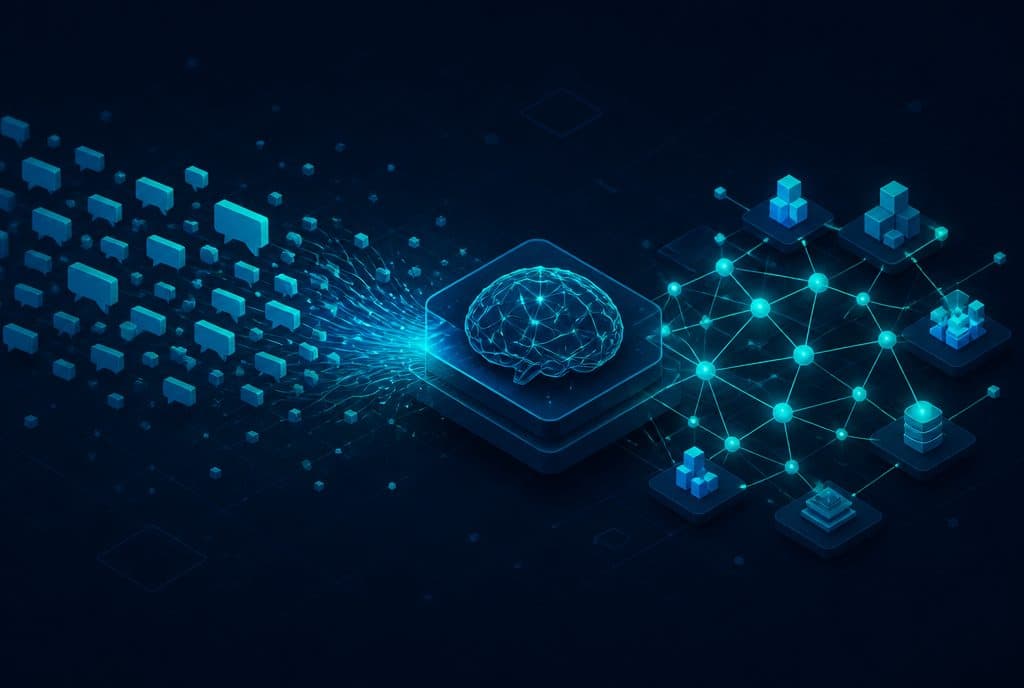
In 2026, smart chatbots are no longer simple helper tools – they have become an integral part of daily business communication. Thanks to rapid advancements in NLP (Natural Language Processing) technologies and machine learning, they are capable of understanding complex contexts, responding personally, and improving business processes. Imagine a business that handles customer inquiries 24/7, without delays, and automatically integrates these conversations with CRM systems and marketing tools. This is not a distant future – it is today's reality.
The chatbot market is growing at a rapid pace, driven by the increasing demand for automated customer service, especially in sectors like e-commerce and healthcare. As business owners, you are probably wondering how to harness these tools to streamline processes and increase profitability, without compromising on a high-quality user experience.
The key challenge today is not just answering simple questions, but managing complex conversations that feel natural. In 2026, AI-powered chatbots are capable of analyzing sentiment, understanding multiple languages, and adapting their responses to context. This opens up new opportunities for Israeli businesses, for whom multilingual service and integration with automation systems can become a distinct competitive advantage.
Advancements in NLP for Chatbots
Natural Language Processing (NLP) underwent a significant upgrade in 2024-2025, with an emphasis on generative models that enable more dynamic conversations. Models like OpenAI's GPT-4o, Google's Gemini 1.5, and xAI's Grok 3 allow chatbots to understand not just words, but also intent and context. Thus, if a customer asks about a specific product, the chatbot can offer recommendations based on their purchase history, while simultaneously analyzing the tone of the conversation to detect satisfaction or frustration.
One of the most notable improvements is multilingual support. In 2026, chatbots transition between languages seamlessly – Hebrew, English, and Arabic alike – making it easier for Israeli businesses to appeal to diverse audiences. NLP allows chatbots to handle cultural nuances, such as understanding local idioms, thereby significantly improving conversation success rates. Furthermore, integrating NLP with automation enables automated workflows, such as connecting the conversation to WhatsApp Business and a CRM system for real-time data updates.
The progress does not stop there; it also includes improvements in security and privacy. New models carry mechanisms to detect sensitive information, in compliance with the Israeli Privacy Protection Law. Thus, businesses can use chatbots to streamline processes without risking data.
Integrating Machine Learning in Chatbots
Machine Learning (ML) is the engine behind the intelligence of chatbots in 2026. Unlike old rule-based models, ML allows chatbots to learn from data in real time and improve their responses over time. A growing share of companies is already integrating conversational AI, with an emphasis on personalization that significantly improves conversion rates.
Here is a practical example: In a customer service chatbot, ML can analyze thousands of conversations to predict common questions. If a customer returns with a similar issue, the chatbot offers a personalized solution, such as a discount coupon, and integrates it into an automation that updates the marketing system. Tools like Claude 3 or LLaMA 3 do this efficiently, thanks to their ability to process billions of parameters. This saves time and increases profitability by reducing reliance on human labor.
Moreover, ML enables multimodal chatbots, which combine text with voice or images. Thus, in an e-commerce business, a customer can send a photo of a damaged product, and the chatbot will analyze it using ML to offer an automated return.
Leading Trends in Smart Chatbots in 2026
In 2026, the main trend is the transition from simple chatbots to autonomous agents. The conversational AI market is growing rapidly, and these agents perform complex tasks, such as booking tickets or managing appointments, by integrating with external APIs.
Another trend is integration with business automation. Chatbots are connected to systems like WhatsApp Business or CRM, opening up possibilities for automated workflows. Thus, a conversation with a customer can trigger an automated marketing process, such as sending a follow-up email. Many organizations are investing in bots to improve the customer experience.
Among the prominent challenges are issues of ethics and accuracy. Chatbots can spread misinformation if not trained properly, but solutions like ML-based content filtering mitigate these risks.
Business Applications of Smart Chatbots
In business, chatbots are changing the way you communicate with customers. The e-commerce sector is one of the leaders in chatbot usage, providing personalized recommendations and significantly increasing sales. For instance, an Israeli online store can run a chatbot that analyzes user behavior and suggests relevant products, while automatically connecting to the inventory system.
In healthcare, chatbots assist in scheduling appointments and answering initial medical questions, which is a growing field. They use NLP to identify symptoms and route the inquirer to professionals, while maintaining privacy.
In IT, chatbots handle technical support, shortening response times and relying on automation to resolve issues automatically.
Want a smart chatbot for sales and service? Discover our Sales & Service solution — AI that sells and serves 24/7.
Conclusion
Ultimately, smart chatbots in 2026 embody a perfect integration of NLP and machine learning, enabling natural conversations and improving business efficiency. With rapid market growth, they are becoming an essential tool for reducing costs and increasing customer satisfaction. Advancements in generative and multilingual models open the door to diverse applications, from commerce to healthcare.
However, success depends on proper integration with existing processes. Businesses that integrate chatbots into automation will see tangible results, such as savings in time and resources. It is worth starting by exploring current tools and adapting them to your specific needs.
For example, using automation platforms like N8N, you can build a workflow that connects a chatbot to WhatsApp Business and a CRM system, automatically updating data after every conversation. This saves you hours of daily work and significantly improves the customer experience.