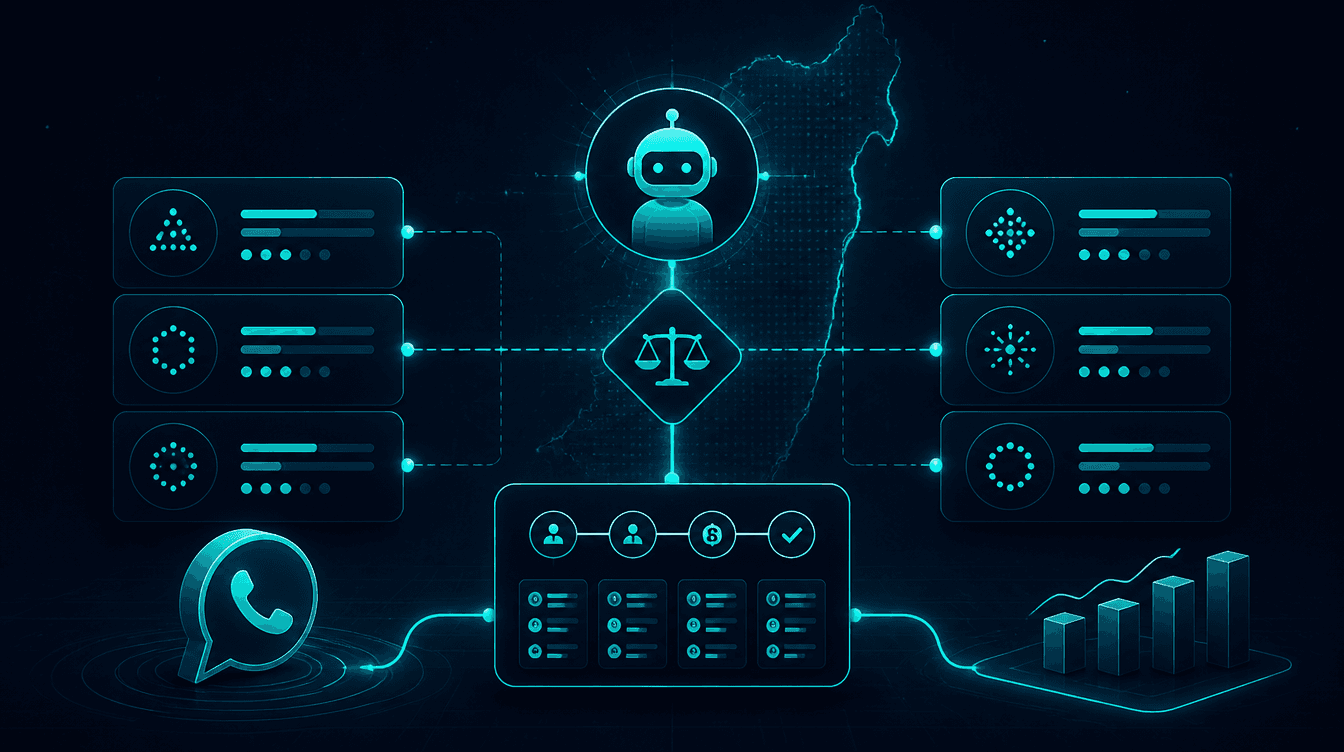


Imagine a business that runs more smoothly, where complex tasks are performed independently without the need for constant intervention. Autonomous AI agents, or Agentic AI, are not just helper tools – they are active partners that plan, make decisions, and execute actions to achieve business goals. In a world where time is the most valuable resource, such technologies can fundamentally change how you manage processes, freeing you to focus on strategy instead of the daily routine.
In 2026, with rapid advancements in AI models, these agents have become an accessible reality for businesses of all sizes. Business use of AI is on a rapid rise, and a growing share of organizations already use it in some form. But what sets autonomous AI agents apart is their ability to operate independently, integrated with existing systems like CRM or data analysis tools. This doesn't just save time – it multiplies productivity through the automation of complex processes, such as supply chain management or customer inquiry handling.
The opportunity here is immense: in IT departments, for example, AI agents can significantly increase business productivity by modernizing legacy technologies. If you run a business in Israel, where competition is high and resources are limited, getting to know this tool can be the key to efficiency and growth.
What is Agentic AI and How Does It Work?
The term Agentic AI describes AI systems capable of acting autonomously, with the ability to plan, make decisions, and adapt to a changing environment. Unlike simple chatbots that only respond to questions, these agents build workflows on their own, leverage external tools, and orchestrate multi-step actions. An AI agent can, for example, analyze sales data, identify trends, recommend price changes, and send automatic updates to the team.
The basic mechanism relies on three core components: perception of the environment, reasoning for decision-making, and action to execute them. In 2026, advancements in models like Gemini 1.5 Pro allow processing of up to 2 million tokens, enabling agents to handle more complex data. This makes them particularly suitable for business automation, where they integrate with platforms like ERP or CRM to perform tasks such as financial report analysis or inventory management.
In practice, agents leverage machine learning to improve over time. The adoption of AI agents is growing rapidly, mainly due to their ability to improve efficiency and reduce costs. If your business has repetitive processes, such as order processing, an AI agent can automate them completely and free up your time for expansion.
Impact on Productivity: Recent Data and Studies
Autonomous AI agents can multiply productivity by automating time-consuming tasks. According to a 2025 PwC report, industries most exposed to AI recorded three times higher growth in revenue per employee (27% compared to 9% in less exposed industries). This is due to the agents' ability to speed up processes, such as analyzing large volumes of data or handling inquiries.
Business use of AI has climbed sharply in recent years, and those with AI skills enjoy a significant salary premium – a figure that demonstrates the economic value of the capability. However, not all findings are clear-cut: studies indicate that without proper implementation, AI can actually slow down experienced developers, a finding that highlights the importance of correct deployment.
In Israel, small businesses can leverage this to compete with larger ones. A significant portion of organizations already use GenAI and report savings in working hours. If you manage a sales team, an AI agent can analyze customer data and significantly improve conversions when combined with automation tools.
Practical Applications in Business
AI agents for businesses are already being implemented in many fields. In the insurance industry, for example, they process claims, assess vehicle damage, and provide customer service, thereby shortening processing times from days to hours. Companies like LTIMindtree leverage these agents to automate processes, reporting improvements in efficiency.
In marketing, an AI agent can manage entire campaigns: analyze social media data, tailor content, and send personalized messages. Another example from 2025, in the cybersecurity field: agents detect threats in real-time and respond automatically, thereby protecting business data. For Israeli businesses, this is highly relevant to supply chain management, where agents predict shortages and order inventory in advance.
A short list of applications:
- Smart CRM management: automating customer updates.
- Financial analysis: forecasting cash flow.
- Customer service: handling complex inquiries through smart bots.
Integration with Automation Tools and 2026 Trends
Integrating AI agents with automation platforms increases effectiveness. Open-source platforms like n8n allow building agents that connect to more than 422 applications, including AI agents. In 2026, a prominent trend is the use of MCP (Model Context Protocol) to build customized agents.
Among the trends are vertical agents for specific industries, and a shift to multi-agent systems that coordinate actions with one another. In business, this means business automation of complex workflows, such as connecting marketing to CRM.
Among the challenges: the risk of "agent-washing" – exaggerated marketing claims – and the need for training. The recommendation: start small, with one agent for one specific task.
Want an autonomous AI agent for your business? Go to the AI Agents for Business page — we implement smart agents that work 24/7.
Summary
The bottom line is that autonomous AI agents are a powerful tool for multiplying productivity, and data from 2024-2025 points to significant growth in efficiency. They allow businesses to focus on innovation while reducing costs and time, and as technology advances, their adoption becomes a real competitive advantage.
With automation platforms like n8n, for example, you can build a workflow that connects an AI agent to CRM and WhatsApp Business, analyzes customer inquiries, and responds to them automatically – thereby saving hours of work a day and increasing satisfaction. This is how Agentic AI and automation naturally link together, allowing you to streamline processes simply.