

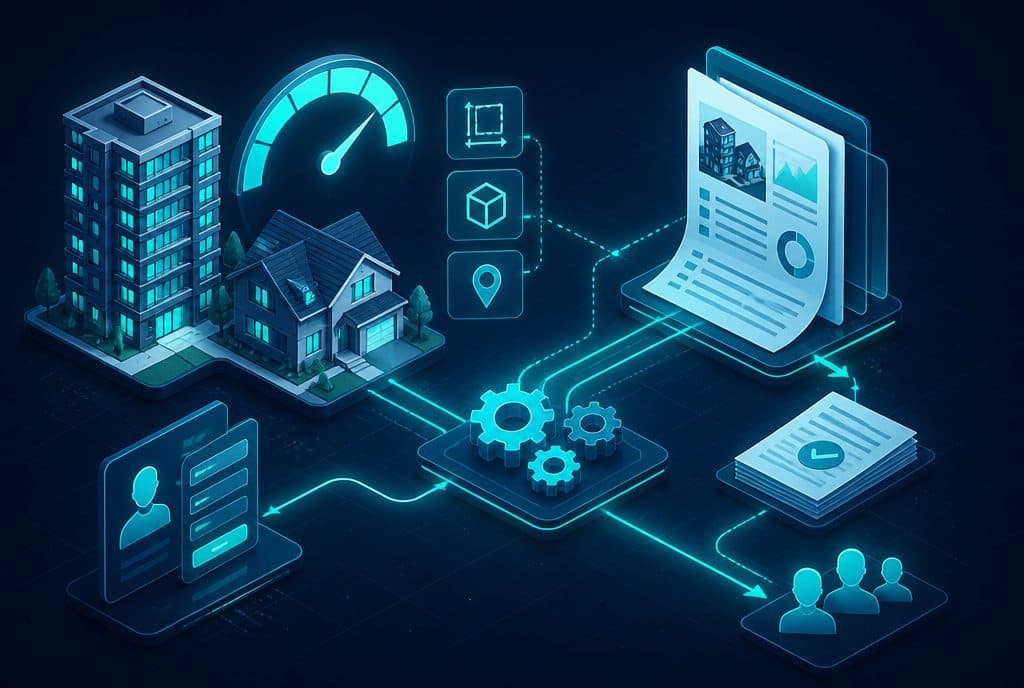
Real estate appraisers and property consultants receiving a new inquiry always go through the exact same process: clarifying the property type and the purpose of the appraisal, requesting land registry (Tabu) extracts and building permits, explaining the workflow, pricing and sending a proposal, scheduling a site visit in the calendar, and updating the client on the status. When inquiries come in through WhatsApp, phone, and email simultaneously — some on Friday afternoons — manual handling becomes a bottleneck that drains valuable time. An AI Agent handles these stages automatically, in natural Hebrew, and gives that time back to the professional work itself.
How Automation Helps Real Estate Appraisers
Automation helps real estate appraisers by having an AI agent receive every incoming inquiry 24/7, understand the property type and appraisal purpose, ask the right screening questions, request relevant documents, send an initial price quote, and schedule a site visit in the calendar — all without manual intervention at any stage. The client receives an immediate response; the appraiser receives an inquiry that has already undergone initial screening and is ready for handling.
What is the Challenge Without Automation?
The real estate appraisal process usually begins with an unscreened inquiry: "How much does an appraisal cost?" — without specifying whether it is an apartment or a plot of land, or if the purpose is a mortgage, sale, inheritance, or property tax (Arnona) appeal. Every such inquiry requires several back-and-forth messages before pricing is even possible. For an appraiser handling dozens of cases a month, the accumulation of these initial inquiries — including waiting for documents, manual reminders, and calendar coordination — creates a significant, repetitive administrative burden.
The problem worsens when inquiries arrive outside of business hours. A client who writes on WhatsApp in the evening and does not receive a response until the next day has often already found another appraiser.
Agent Capabilities: What the Automation Actually Does
| Process Stage | Without Automation | With AI Agent |
|---|---|---|
| Receiving initial inquiry | Dependent on business hours | 24/7, immediate |
| Clarifying property type & purpose | Manual call/messages | Structured questions on WhatsApp |
| Document collection (Tabu, permit) | Manual list, reminders | Automatic request + reminder |
| Sending a price quote | Manual drafting for each inquiry | Automatically customized template |
| Scheduling site visit | Back-and-forth calls | Calendar synchronization, booking link |
| Client status updates | Manual messages | Proactive automatic updates |
| Writing to CRM | Manual typing | Automatic logging at every stage |
Practical Scenarios
Scenario 1 — Mortgage Appraisal: A client writes on WhatsApp on Thursday night: "Need an appraisal for an apartment in Tel Aviv for a mortgage." The agent responds within seconds, asks about the apartment size, address, and property status (second-hand / contractor), briefly explains what a mortgage appraisal includes, and requests a copy of the contract and/or Tabu extract. On Friday morning, the appraiser receives a screened inquiry with the documents — and only responds to what requires professional judgment.
Scenario 2 — Appraisal for Inheritance/Partnership Dissolution: A common scenario coming from a lawyer or directly from the family. The agent identifies the context, adapts the questions (how many owners, is there agreement on the valuation?), and routes to an appropriate quote template — different from that of a mortgage appraisal.
Scenario 3 — Real Estate Consulting (Non-Appraisal): A real estate consultant guiding buyers and investors receives inquiries about different property types, areas, and budgets. The agent performs initial screening (budget, area, purchase goal), sends relevant content (neighborhood guide, expected costs), and schedules an initial consultation call in the calendar — so the consultant arrives at every call with full context.
Scenario 4 — Proactive Status Updates: Clients whose appraisal is already in progress tend to call to ask "where does it stand?". Simple automation that updates "We received the documents, the visit is scheduled for X" and "The report is being prepared, expected on Y" reduces follow-up inquiries and improves the client experience — without the appraiser having to remember to send the message.
Privacy Protection Law and Document Collection
In real estate appraisal, personal information and sensitive documents (contracts, Tabu extracts, property information) are collected. Any automated process for collecting documents must operate in accordance with the Israeli Privacy Protection Law — including explicit consent to store the information, clarifying the purpose of use, and providing a deletion option. The solutions we build are designed with a clear consent layer at the beginning of the conversation, and document storage with approved cloud providers.
Connection to Existing Systems
The agent works on top of the tools you already have:
- WhatsApp Business — The primary channel for inquiries (see WhatsApp Bot for Real Estate)
- Google Calendar / Outlook — Scheduling site visits directly in the calendar
- CRM — Automatic creation of a lead record with all property details and appraisal type
- n8n — The platform that connects all components and manages the routing logic
- Email — Sending price quotes and documents in an organized manner
Full lead management is documented in Automated Lead Management; visit scheduling in Automated Scheduling.
How to Get Started?
- Scenario Characterization — What are the common inquiry types? What are the screening questions? What is the minimum information needed for pricing?
- Conversation Script Building — The agent works according to logic you define, not "known rules"; the logic is written once and can be updated.
- Calendar and CRM Connection — Usually, you can connect to your existing calendar without replacing systems.
- Controlled Rollout — Run on one scenario (for example: mortgage appraisal only), test, and expand.
- Monitoring and Improvement — See where inquiries get "stuck" and improve the conversation script accordingly.
Ready to see what this looks like in practice? Talk to us and we will build your first conversation script together — at no cost and with a clear assessment of what can be streamlined in your process.
How much does it cost?
| Component | Price (one-time setup, ex-VAT) |
|---|---|
| WhatsApp AI sales agent | ILS 9,000 |
| Automatic quoting engine | ILS 6,500 |
| Calendar link and meeting booking | ILS 2,000 |
| Automatic follow-up sequence | ILS 2,500 |
| WhatsApp Business API setup | ILS 700 |
A complete starting point — a WhatsApp AI agent including the business number, server and agent control room — is from ILS 10,200; an agent with a management system (CRM) from ILS 18,200, a multi-agent system from ILS 25,350. There is no monthly fee; third-party costs (server, messages, AI) of about ILS 100–500 a month are paid directly to the providers. The full component price list: pricing page.
Summary
Real estate appraisers and property consultants spend a significant portion of their time on repetitive initial communication: clarifying, collecting documents, pricing, and coordinating. An AI agent connected to WhatsApp, the calendar, and the CRM handles these stages automatically — stops losing inquiries that arrive outside of working hours, shortens the time from inquiry to quote, and allows the appraiser to focus on the professional work that requires their judgment. The right approach is to start with one clear scenario and prove value before expanding.