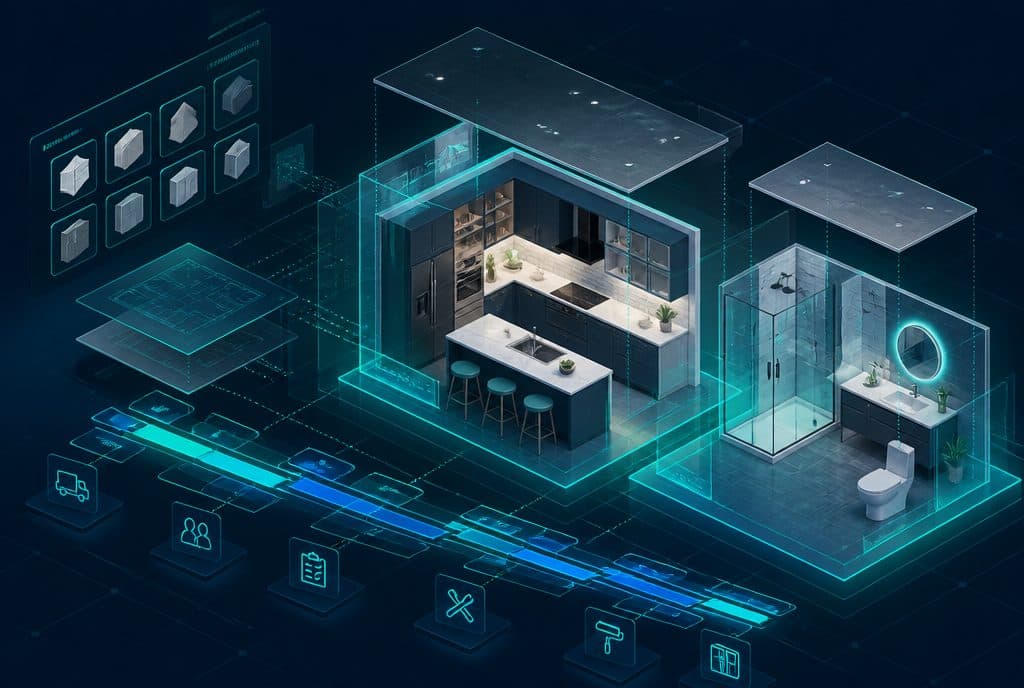
Kitchen, bathroom, and carpentry businesses face clients who arrive with many questions: what style, how much does it cost, when can they visit the studio, how long will it take. An AI agent answers all of these instantly, filters by style and budget, schedules studio visits, sends initial price quotes, and follows up on the sales process — so the team receives warmed-up leads ready for a conversation, not raw inquiries waiting for a response.
How does automation help a kitchen business?
An AI agent for a kitchen, bathroom, and carpentry business receives every inquiry on WhatsApp or the website, asks qualifying questions (style, area, budget), schedules a studio visit in the calendar, sends a follow-up after the visit, and reminders ahead of installation — all without manual intervention. The team receives a filtered and warmed-up lead; the system handles the rest.
What happens when a client reaches out and doesn't get an immediate answer?
Kitchen and bathroom businesses work in cycles: a client decides to replace a kitchen, searches, reaches out to three places simultaneously, and books the first appointment offered to them. Those who do not answer within hours — not days — usually do not get the opportunity.
In practice, a large portion of inquiries arrive during hours when the team is busy in the studio, on an installation, or has finished the workday. A lead who wrote on Friday afternoon waits until Sunday — and by then, they have already closed with someone else.
An AI agent does not sleep and is never busy. It answers every inquiry within seconds, 24/7, leaving the team to handle things that require a human touch.
Capabilities Table: What an AI Agent Does in a Kitchen and Carpentry Business
| Process Stage | Without Automation | With AI Agent |
|---|---|---|
| Initial Inquiry Response | Hours to days | Seconds, 24/7 |
| Filtering by Budget and Style | Manual phone call | Targeted questions on WhatsApp |
| Scheduling Studio Visit | Back-and-forth on the phone | Agent proposes times, client chooses |
| Reminder Before Visit | Depends on team memory | Automatic, 24 hours in advance |
| Sending Initial Quote | Waiting for a meeting | Sent automatically after the visit |
| Follow-up After Meeting | Often forgotten | Structured and pre-defined |
| Installation Reminder | Manual | Automatic based on schedule |
| CRM Logging | Manual typing | Updated at every stage |
Four Real-World Scenarios
Scenario 1 — Weekend Inquiry from Website or Instagram
A client saw a kitchen in a post on Friday. They wrote "How much does a kitchen like this cost?" on WhatsApp. The agent responds immediately, asks about the area, style, and budget, proposes two times for a studio visit next week, and sends a link to inspiration photos. On Sunday, the team arrives at the studio with a scheduled meeting and a prepared client profile document.
Scenario 2 — Budget Filtering for a Bathroom
A client asks about a "small bathroom renovation." The agent asks about the area, whether it includes tiling, if the plumber is separate, and what the budget range is. If the budget is below the minimum range, the agent responds politely, explains what can be achieved with the current budget, and asks if they would like to save details for a future inquiry. If it fits — it schedules a visit. This way, the team does not waste time on meetings that won't close.
Scenario 3 — Follow-up After a Studio Visit
A client came to the studio, saw samples, and took time to think. The day after, the agent sends a message: "We were glad you visited — attached is an initial price quote based on what we discussed. Any questions?" A week later, if there is no response, the agent sends another short message. Everything is pre-defined, without the team needing to remember.
Scenario 4 — Scheduling and Installation Reminder
After signing a contract, the agent sends a reminder three days before the installation date, confirms the client is available, and sends preparation instructions (clearing the old kitchen, access for the electrician). On the day of installation, it sends "We are arriving today — see you soon." After installation, it sends a quick question to ask if everything is okay. A process that would have required multiple phone calls happens automatically.
How to Get Started — Four Steps
1. Mapping the Sales Process Before any technology, we map out the stages together: what questions are asked, which questions filter, what happens after a visit, and when a quote is sent. This is the most important stage — the agent will only be as good as the process is well-defined.
2. Connecting the Main Inquiry Channel For most kitchen businesses, this is WhatsApp — we connect a WhatsApp Agent that receives inquiries, answers, and filters. In parallel, a website form can be connected to the same process.
3. Connecting Calendar and CRM The agent proposes available times and registers the visits directly in the calendar. All lead details — name, phone, area, budget, style, stage — enter the CRM automatically. See Automated Lead Management for details.
4. Setting Up Follow-ups and Reminders We define the sequence of messages after each stage: after a visit, after sending a quote, before installation, and after installation. All of this is built once and works on its own.
Important to Know: Data and Privacy
Any information a client provides — name, phone, project details — is subject to the Israeli Privacy Protection Law. The agent is configured to collect only what is necessary, not to save conversations after the sales process without consent, and to allow the client to request data deletion. As part of the mapping process, we define the retention policy in accordance with legal requirements.
Relevant Links
- Automated Lead Management — How every lead enters the CRM and receives an immediate response
- Smart WhatsApp Agent — The central platform for kitchen inquiries
- Automation for Construction and Renovation Businesses — A related article for the neighboring industry
How much does it cost?
| Component | Price (one-time setup, ex-VAT) |
|---|---|
| WhatsApp AI sales agent | ILS 9,000 |
| Automatic quoting engine | ILS 6,500 |
| Calendar link and meeting booking | ILS 2,000 |
| Automatic follow-up sequence | ILS 2,500 |
| WhatsApp Business API setup | ILS 700 |
A complete starting point — a WhatsApp AI agent including the business number, server and agent control room — is from ILS 10,200; an agent with a management system (CRM) from ILS 18,200, a multi-agent system from ILS 25,350. There is no monthly fee; third-party costs (server, messages, AI) of about ILS 100–500 a month are paid directly to the providers. The full component price list: pricing page.
Summary
Kitchen, bathroom, and carpentry businesses work with long purchasing cycles, design and budget considerations, and clients who close with whoever answers first. An AI agent does not replace the team — it handles all the stages that require immediacy and consistency: initial response, filtering, scheduling, follow-up, and reminders. The team steps in only when the lead is ripe and ready for a conversation.
Want to build such a process for your business? Talk to us on WhatsApp or leave details — we will build an initial scenario together and see where it's best to start.