

A landscaper who gets a message from a client at 21:30 on a Thursday night — "What is the price for hedge trimming and developing a front garden, first floor in Haifa?" — what happens? If there is no one to answer right now, the chances that the client will also message competitors are high. A WhatsApp bot answers immediately, asks the necessary questions, and records the details — so that in the morning you have a ready lead to schedule a visit, not just a forgotten message.
How does automation help a landscaper?
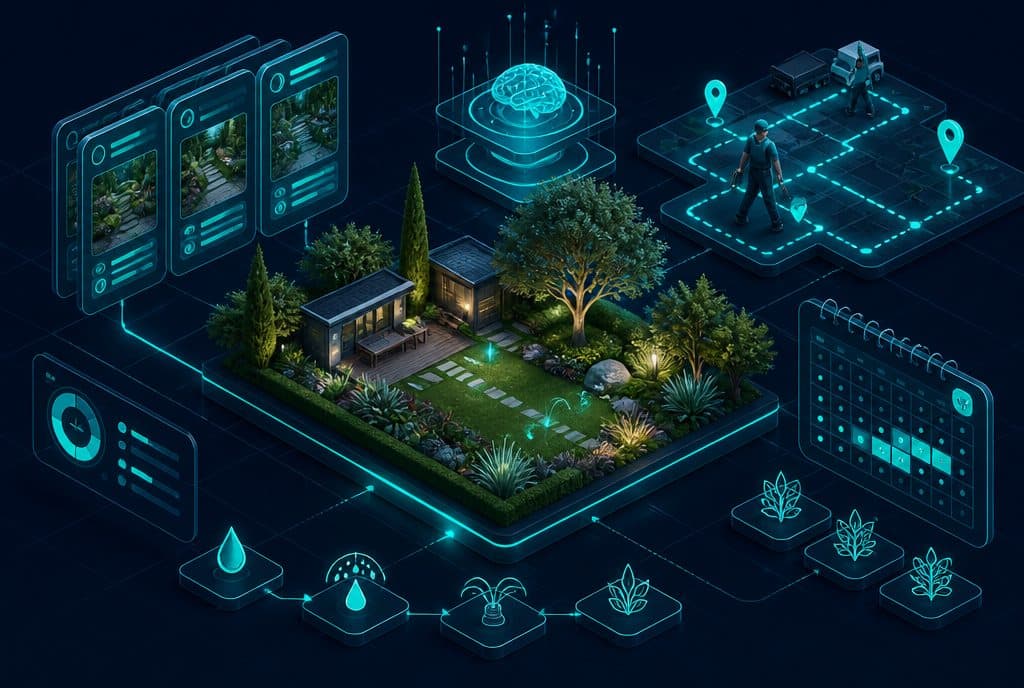
Automation for a landscaper helps in four key areas: immediate response to new inquiries (even outside working hours), initial lead qualification (job size, area, budget), scheduling evaluation visits in the calendar without back-and-forth phone calls, and sending automatic reminders to clients with recurring maintenance contracts. The result: fewer leads falling between the cracks and less time wasted on logistics.
Why do landscapers and garden designers lose leads?
The typical landscaper works in the field most of the day — not next to the phone. Inquiries come in via WhatsApp, Facebook, the website, and neighborhood groups. By the time they get back to them in the evening, some of the clients have already received a quote from a competitor who answered faster.
In addition, the landscaper simultaneously functions as a business manager: pricing, coordinating, reminding, backing up invoices, and answering questions about the selected plants. All of this takes time that could go into actual work.
What automation can actually do: Capabilities table
| Scenario | Without Automation | With Automation |
|---|---|---|
| Incoming WhatsApp inquiry | Manual reply — hours to a day | Reply within seconds, 24/7 |
| Qualifying lead details | Back-and-forth phone call | Automated questions in the chat |
| Scheduling evaluation visit | Call attempts until a free slot is found | The client chooses a free slot themselves |
| Reminder for recurring maintenance | "I didn't forget, just didn't get around to writing" | Message sent automatically according to schedule |
| Follow-up on a quote | Sometimes happens, sometimes forgotten | Sent automatically after a day or two |
| Summarizing visit in CRM | Documented on mobile or not documented at all | Automatically entered into the record |
Real-world scenarios in the Israeli market
Scenario 1: A new lead for a front garden
A client writes on WhatsApp: "I want to redesign my front garden, do you have time for a visit?"
The bot answers within seconds:
- Asks: City? Estimated size? What is she looking for — design, planting, paving?
- Sends an initial price range based on the data
- Offers three available times for an evaluation visit
- Writes the details to the record
The landscaper arrives for the visit already having the basic details — not starting from scratch.
Scenario 2: Recurring maintenance client
A landscaper has 30 clients with a monthly or seasonal trimming contract. Until now, he sent reminders manually — when he remembered. With automation, each client receives an automatic message a week before the next treatment date: "Your upcoming garden maintenance is scheduled for next week, please confirm?" — the answer is automatically updated in the calendar.
Scenario 3: A quote left unanswered
A landscaper sent a quote and didn't hear back. Without automation — he might send a follow-up after two weeks, or maybe not. With automation, two days after sending the quote, a short message is sent: "Hi, I wanted to check if you have any questions about the quote you received — happy to chat." It's not aggressive, and it brings back many leads who simply didn't get around to responding.
Scenario 4: FAQs at unusual hours
"Which trees are suitable for a hedge in the north?" / "How many times a year do they need to be trimmed?" / "Do you have a warranty on the plants planted?"
An AI-based bot knows how to answer such questions from the database the landscaper defines in advance — without ringing the landscaper at six in the morning.
What about the Privacy Protection Law?
When working with client data (name, phone, address, transaction details), the Israeli Privacy Protection Law applies. The key requirements relevant to a landscaper are: consent to receive marketing messages, the option to opt-out of reminder lists, and storing data securely. The systems we build include consent and opt-out mechanisms as an integral part of the process.
How to get started?
The right approach is not "automation for everything in one day" — but starting from the biggest pain point.
Step 1 — Specification: Gather the common types of inquiries, define what the bot answers and what goes to human handling, and set the rules for scheduling visits.
Step 2 — Initial bot: A WhatsApp bot that answers new inquiries, asks qualifying questions, and documents them. This alone significantly reduces the number of leads lost due to response time.
Step 3 — Automated scheduling: Connecting a scheduling system that allows the client to choose a time directly, in a calendar synchronized with the landscaper's work schedule.
Step 4 — Reminders and recurring contracts: Automating reminders for seasonal treatments and follow-ups on quotes — the two things that are easiest to forget manually.
Each step works on its own and brings value; there is no obligation to build everything at once.
What remains human?
It is important to say explicitly: the evaluation visit — human. The garden design, the plant suggestions, the recommendations regarding paving types — human. The relationship with the client throughout the project — human. Automation deals with logistics and repetitive communication, not with the professional judgment that is the core of the business.
In addition, any conversation that ends with "not relevant to me" or a question the bot doesn't know how to answer — is transferred to the landscaper with a summary of the conversation so far, so you can continue manually without the client having to repeat themselves.
Want to understand what fits your landscaping business? Chat with us on WhatsApp or leave your details — we will build an initial scenario together and look at the full pricing before you decide on anything.
Related Links
- WhatsApp Bot for Businesses — How the bot functions and what it can do
- Automated Scheduling — Calendar management and reminders without lifting a finger
- Automation for Service Businesses — A general guide for businesses working in the field
How much does it cost?
| Component | Price (one-time setup, ex-VAT) |
|---|---|
| WhatsApp AI sales agent | ILS 9,000 |
| Automatic quoting engine | ILS 6,500 |
| Calendar link and meeting booking | ILS 2,000 |
| Automatic follow-up sequence | ILS 2,500 |
| WhatsApp Business API setup | ILS 700 |
A complete starting point — a WhatsApp AI agent including the business number, server and agent control room — is from ILS 10,200; an agent with a management system (CRM) from ILS 18,200, a multi-agent system from ILS 25,350. There is no monthly fee; third-party costs (server, messages, AI) of about ILS 100–500 a month are paid directly to the providers. The full component price list: pricing page.
Summary
A landscaper or garden designer does not have to choose between working in the field and managing inquiries. A WhatsApp bot that answers immediately, qualifies, schedules, and reminds — does the logistical part automatically, leaving the landscaper free to do what they are good at: planning and building gardens. The right starting point is one clear scenario — usually responding to new inquiries — and from there, expanding gradually.