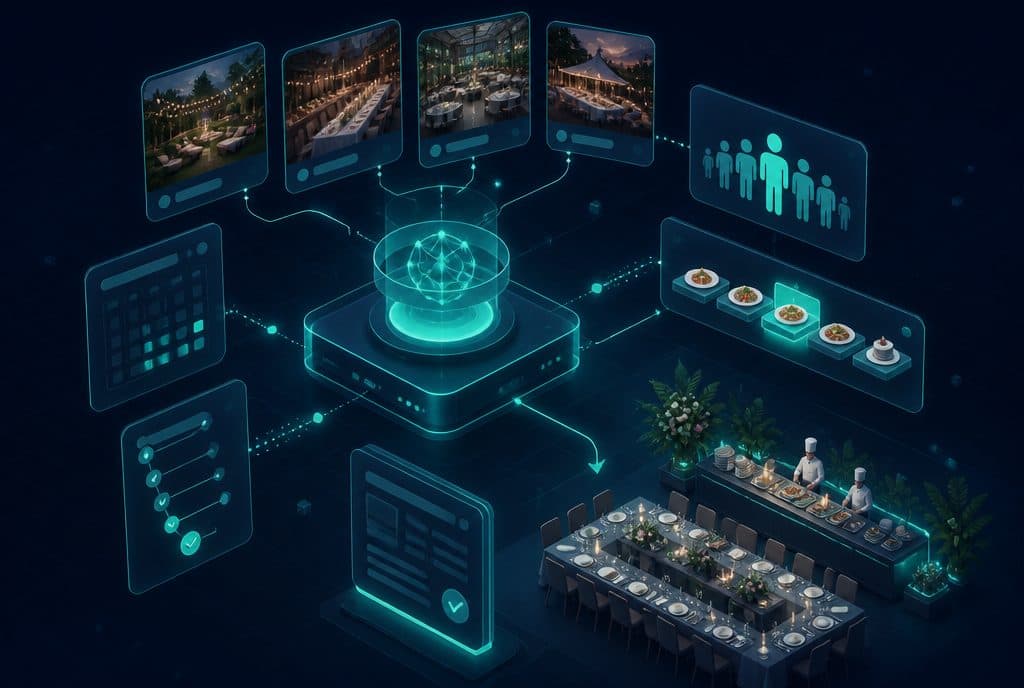

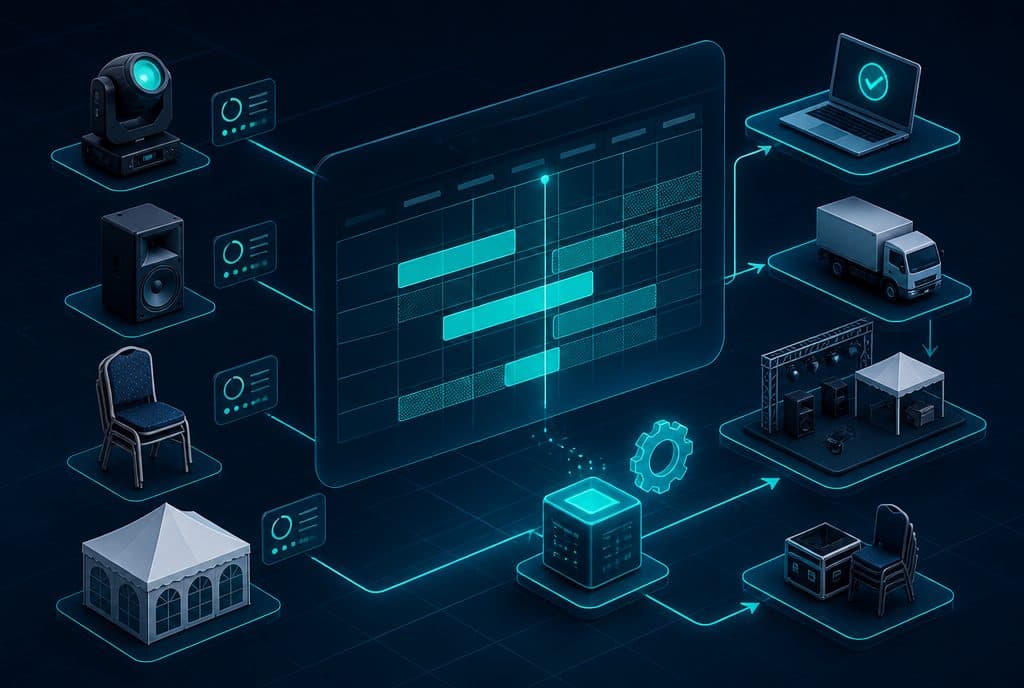
An event equipment rental business receives the same questions over and over again: "Do you have 50 chairs for next Friday?", "How much does a sound system cost for 3 hours?", "What is the deposit?", "What time do you deliver?". When the answers to these questions are handled manually — from a mobile phone, between deliveries — inquiries fall between the cracks, bookings go to the competitor who sent the quote first, and the delivery schedule turns into chaos. An AI bot answers inquiries from any channel 24/7, checks date availability in real time, sends a quote, collects a deposit, and schedules the delivery — without interrupting the team on the ground.
How Automation Helps an Equipment Rental Business
An AI bot for an event equipment rental company answers inquiries 24/7 on WhatsApp and social media, checks equipment availability for the requested date directly from your spreadsheet, calculates a quote based on quantity and delivery distance, sends it to the customer and gets approval, routes them to digital deposit payment, and registers the booking in the delivery schedule — all without the team having to handle each step manually.
What Makes This Business Unique for Automation?
Event equipment rental has several characteristics that make automation far more critical than for most other service businesses:
Equipment is a physical product with limited availability. You cannot "duplicate" a sound system. If 3 customers ask about the same equipment for the same Friday — whoever confirms first gets it. Manual management of availability checks leads to chaos: equipment double-booked to two customers, embarrassing cancellation calls, and angry clients.
The booking lives or dies within hours. An event is planned weeks in advance, but the decision on the equipment supplier is usually made within 24 to 72 hours before the competitor closes the deal. An inquiry that doesn't get a response within an hour or two on a business day — the customer has already called someone else.
Inquiries come in at all hours, across all channels. WhatsApp, Instagram, Facebook, phone — customers planning an event think about it on Friday afternoon, Saturday night, and during any time window when the team doesn't have a free hand.
Capabilities Table: What Automation Can Do
| Task | Manual Today | With Automation |
|---|---|---|
| Answering availability questions | Business owner checks manually | The bot checks in real time and answers instantly |
| Sending a quote | Calculated and sent manually via WhatsApp | Quote is calculated and sent within minutes |
| Booking confirmation & deposit collection | Phone call + manual bank transfer | Digital payment link, automatic confirmation |
| Updating the delivery schedule | Manual list in Google Sheets | Automatic registration with address details and delivery time |
| Customer reminder before the event | Manual call / manual SMS | Automatic WhatsApp the day before |
| Receiving equipment back — confirmation | Manual call | Automatic confirmation message with a feedback request |
| Follow-up for unconverted leads | Usually doesn't happen | The bot prioritizes and reaches out automatically |
Three Practical Scenarios
Scenario A: A WhatsApp Inquiry on Friday Night
A customer writes: "Hi, do you have 80 chairs for the 15th of the month? It's for a Bat Mitzvah in Yavne, how much will it cost with delivery?"
Without automation — the inquiry waits until Sunday. By then, she might have already canceled or booked with a competitor.
With an AI bot: The bot responds within seconds — confirms that 80 chairs are available for the 15th of the month, sends a quote detailing delivery to the Yavne area, explains the deposit terms, and attaches a link for confirmation and payment. If she doesn't respond within 24 hours — the bot sends a quick follow-up.
Scenario B: Availability Check for Rare Equipment
A customer asks about a large inflatable bounce house for a Friday-Saturday event. The business owner is in the field and cannot check right now.
The bot checks the availability records — if the inflatable is already booked for that Friday, the bot suggests an alternative (a smaller inflatable, or a different date). If available — it confirms and moves to the quoting stage.
Scenario C: Managing a High-Pressure Day Before the Event
Friday morning. The team is on the road with 4 trucks heading to 4 different events. 3 customers are asking on WhatsApp about arrival times, 2 new inquiries come in for events next week.
The bot handles the arrival time questions (pulling details from the registered booking), confirms availability for the new customers, and leaves only the inquiries requiring human decision-making for the team — last-minute booking changes or price disputes.
What the Bot Does Not Do
It is just as important to understand what automation does not replace:
- Judgment on exceptional equipment: Equipment that is damaged, partially booked, or in a special condition — this remains for a human to handle.
- Complex negotiations: A VIP customer who wants a discount on a large order — the bot detects this and routes them to a representative.
- Real-time logistics issues: Address changes on the day of the event, delays due to traffic — handled by the team on the ground, not the bot.
- Returning customer relations: A customer who rents every two weeks and wants to speak with the owner — handled manually.
Prerequisites and Integrations
For automation to work for an equipment rental company, a few foundations are needed:
Equipment and availability table — in Google Sheets, Airtable, or an order management system. This is what the bot relies on to check availability. If you still manage availability in your head — this is the first step before any automation.
WhatsApp Business API — the primary communication channel in the Israeli market. Different from the regular WhatsApp app — it requires prior setup.
Digital payment system — so the bot can send a payment link for the deposit (Tranzila, CardCom, PayBox, etc.).
Defined pricing rules — how much a chair costs per day, how much an inflatable costs for Friday-Saturday, what the delivery cost is by region. The clearer the rules, the more accurate the quotes will be.
How to Get Started — 4 Steps
Step 1 — Scenario Mapping: What are the recurring questions? What is the full booking process from inquiry to delivery? Where are you missing inquiries the most right now? This step costs nothing — it happens during a discovery call.
Step 2 — Organizing Equipment Inventory: Before connecting a bot to availability, you need an organized data source. If you already have one — excellent. If not — this involves building a Google Sheet or setting up the tool that synchronizes the equipment.
Step 3 — Running a Pilot: Activate the bot on one channel (for example, WhatsApp only) with a limited scenario — only checking availability + sending a quote. No automatic payment collection at this stage. Measure for 2-3 weeks.
Step 4 — Expansion: Once you see that the bot is responding correctly — add payment collection, the delivery schedule, follow-ups, and integration with existing tools.
Want to know where to start in your business? Automated Lead Management and Automated Scheduling are the two most common entry points — talk to us and we will build the scenario map together.
Legal and Privacy Considerations
According to the Israeli Privacy Protection Law, customer data (name, phone, event address) collected through the bot is personal information that requires appropriate protection. In practice, this means defining who accesses the data, how long it is kept, and how the customer can request its deletion. We build our bots with these principles as part of the design — not as an afterthought.
Relevant Links
- Automated Lead Management — how every inquiry is registered and doesn't fall between the cracks
- Automated Scheduling and Deliveries — managing work schedules and equipment coordination
- Automation for Catering Events — related article on managing bookings in events
How much does it cost?
| Component | Price (one-time setup, ex-VAT) |
|---|---|
| WhatsApp AI sales agent | ILS 9,000 |
| Automatic quoting engine | ILS 6,500 |
| Calendar link and meeting booking | ILS 2,000 |
| Automatic follow-up sequence | ILS 2,500 |
| WhatsApp Business API setup | ILS 700 |
A complete starting point — a WhatsApp AI agent including the business number, server and agent control room — is from ILS 10,200; an agent with a management system (CRM) from ILS 18,200, a multi-agent system from ILS 25,350. There is no monthly fee; third-party costs (server, messages, AI) of about ILS 100–500 a month are paid directly to the providers. The full component price list: pricing page.
Summary
An event equipment rental business benefits from automation because of its business structure: limited physical inventory + inquiries at all hours + competition to respond first. An AI bot connected to your availability table and integrated with your inquiry channels doesn't replace your team — it ensures that no inquiry is left empty-handed and that every booking is properly documented before the team even heads out to the field.
The right starting point: don't try to streamline everything in one day. Choose one scenario — usually availability check + quote — run a pilot, and let the results guide your expansion.
Talk to us — we will review your inquiry scenarios together and suggest the right entry point for your business.