

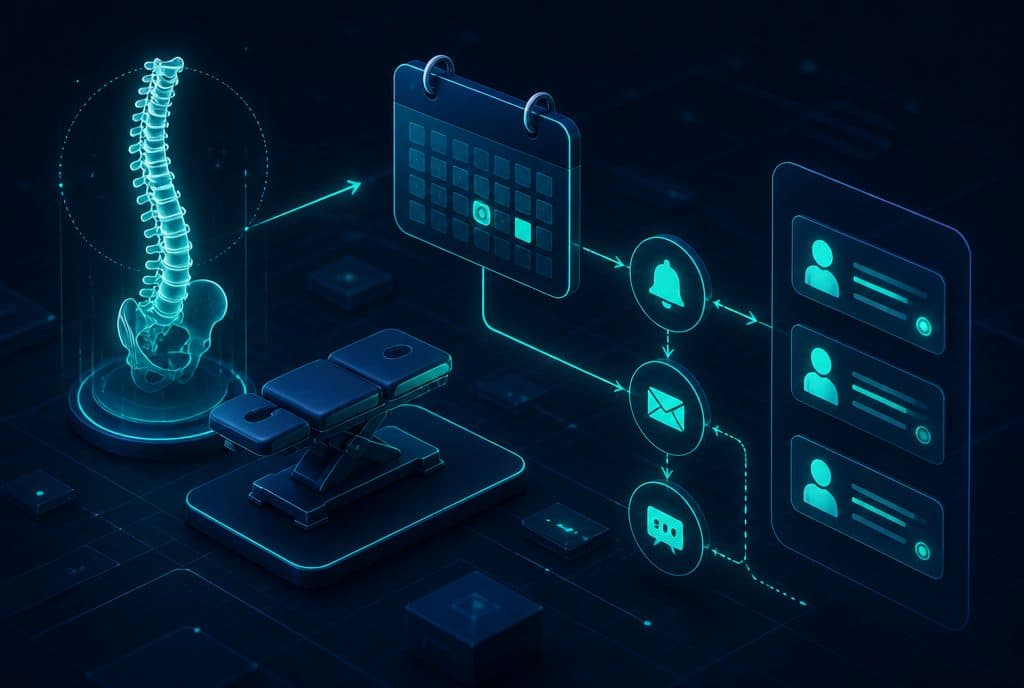
A private chiropractor or physical therapist running an independent clinic faces the same logistical chain every day: WhatsApp messages waiting for a response, appointments booked and canceled at the last minute, clients who need to remember to show up for their second, third, or fifth treatment, and intake forms filled out manually. A WhatsApp bot and automation handle all of this on a logistical level—without touching the clinical content and while maintaining confidentiality, in accordance with the Israeli Privacy Protection Law.
At Automaziot AI, we build automation systems for Israeli service businesses, including private clinics. This guide explains exactly what can be automated, what cannot—and how to get started.
How Does Automation Help a Chiropractor or Physical Therapist?
Automation for a private chiropractor or physical therapist connects to WhatsApp and the calendar, handling the entire logistical side: scheduling available appointments, automated confirmations and reminders before the visit, reminders for the next treatment in a series, sending intake forms before the first session, and managing cancellations and no-shows—all without manual intervention and without providing medical advice.
What the Automation Handles—and What It Doesn't Do
First and foremost, the most important distinction:
| What the Automation Does | What the Automation Does NOT Do |
|---|---|
| Scheduling appointments and handling cancellations | Medical advice of any kind |
| Reminders for appointments and treatment series | Diagnosis, findings, treatment recommendations |
| Sending intake forms (logistical) | Information about health status |
| Answering logistical questions (price, hours, address) | Any question requiring professional judgment |
| Transferring to a professional with a conversation summary | Deciding on the suitability of treatment for the client |
The rule of thumb: The bot manages the schedule—not the treatment.
Common Automation Scenarios for a Private Clinic
1. Scheduling an Initial Appointment
A client writes on WhatsApp, "I'd like to schedule an appointment." The bot asks a few logistical questions (requested treatment type, city, general availability), checks availability in the calendar, presents two or three time slots, and confirms the selection—all within minutes, even at night or on Friday afternoon. After booking, a confirmation message is sent with the address and basic preparation details (logistical only).
2. Pre-Appointment Reminders
24-48 hours before each appointment, an automated reminder is sent via WhatsApp with the name, time, and address. The client can confirm with a click, request to reschedule, or cancel—any response automatically updates the calendar. A cancellation made 24 hours in advance can immediately offer an alternative slot, ensuring the slot does not remain empty.
3. Managing a Treatment Series
Physical therapy and chiropractic care usually work in series. After each visit, the bot can send a reminder to schedule the next visit in the series—not a marketing-style "have you booked yet?", but a simple message: "Your next visit is planned for the series—when is convenient?". This does not require the therapist to manually track every client, nor does it ask questions about the client's condition.
4. Intake Form Before the First Session
Sending a link to a digital form before the first appointment (contact details, medical insurance information, administrative questions) saves valuable time at the start of the session. Important: The clinical-medical content of the form is determined entirely by the therapist; the bot sends and collects the form—it does not create it or interpret its content.
5. Managing No-Shows
A client who has not confirmed an appointment 24 hours before the visit receives an additional reminder. A client who did not show up and did not cancel receives a short message: "We missed you—when can you reschedule?"—a respectful approach that helps retain the client without manual management.
Privacy and Confidentiality Aspects Under the Israeli Privacy Protection Law
Information generated in a medical context is considered sensitive information under the Israeli Privacy Protection Law. Building the automation correctly involves several principles:
- Minimum Information: The bot stores name, phone number, and appointment date—not health status information.
- Limited Access: Only the therapist and authorized assistants access client data.
- Secure Channel: Conversations on the WhatsApp Business API are end-to-end encrypted.
- Transparency to the Client: At the beginning of the conversation, the bot identifies itself as an automated system.
- Deletion Mechanism: A mechanism is in place to respond to a client's request to remove their details.
We build the systems so that the bot never holds information beyond what is required for logistical coordination. All clinical information remains solely within the therapist's management systems.
How to Get Started?
- Characterization: Mapping the types of inquiries that arrive today—initial appointments, returning clients, cancellations, pricing questions. Usually, 3-5 types of inquiries make up 80% of the volume.
- Calendar Connection: Integration with Google Calendar or an existing appointment scheduling system.
- Defining Boundary Rules: What the bot answers and what it transfers to a human—this is the most critical stage in a clinic.
- Controlled Run: A week of use with eyes on every conversation before stopping hand-in-hand monitoring.
- Gradual Expansion: Adding reminders for the series, intake forms, no-show management—step by step.
More on automated appointment scheduling: Appointment Scheduling Service. More on a WhatsApp agent for business: WhatsApp Bot for Business.
See also: Automation for Clinics—Introduction.
What to Expect—Without Overpromising
Logistical automation for a private clinic can reduce the time spent on manual appointment management and decrease no-shows—but results depend on the volume of inquiries, the type of clients, and how the bot is configured. A client coming from a personal recommendation will behave differently than a client coming from a search. We do not promise numbers—we build a system, track the results, and adjust accordingly.
Want to know if automation is right for your clinic? Chat with us on WhatsApp and we will build a practical characterization together—with no obligation.
How much does it cost?
| Component | Price (one-time setup, ex-VAT) |
|---|---|
| AI booking agent — simple | ILS 8,000 |
| Calendar link and meeting booking | ILS 2,000 |
| Appointment reminders and confirmations | ILS 1,750 |
| Automatic follow-up sequence | ILS 2,500 |
| WhatsApp Business API setup | ILS 700 |
A complete starting point — a WhatsApp AI agent including the business number, server and agent control room — is from ILS 10,200; an agent with a management system (CRM) from ILS 18,200, a multi-agent system from ILS 25,350. There is no monthly fee; third-party costs (server, messages, AI) of about ILS 100–500 a month are paid directly to the providers. The full component price list: pricing page.
Summary
A private chiropractor or physical therapist running an independent clinic dedicates part of the day to logistical management that can be largely automated: scheduling appointments, confirmations, reminders, and managing cancellations. A WhatsApp bot connected to the calendar handles all of this—24/7, in natural Hebrew, without touching the clinical side. The correct definition of what the bot answers and what it transfers to a human is what makes the system professional and safe. The right starting point: characterizing the three or four most common inquiry types, connecting to the calendar, and running a controlled pilot.