
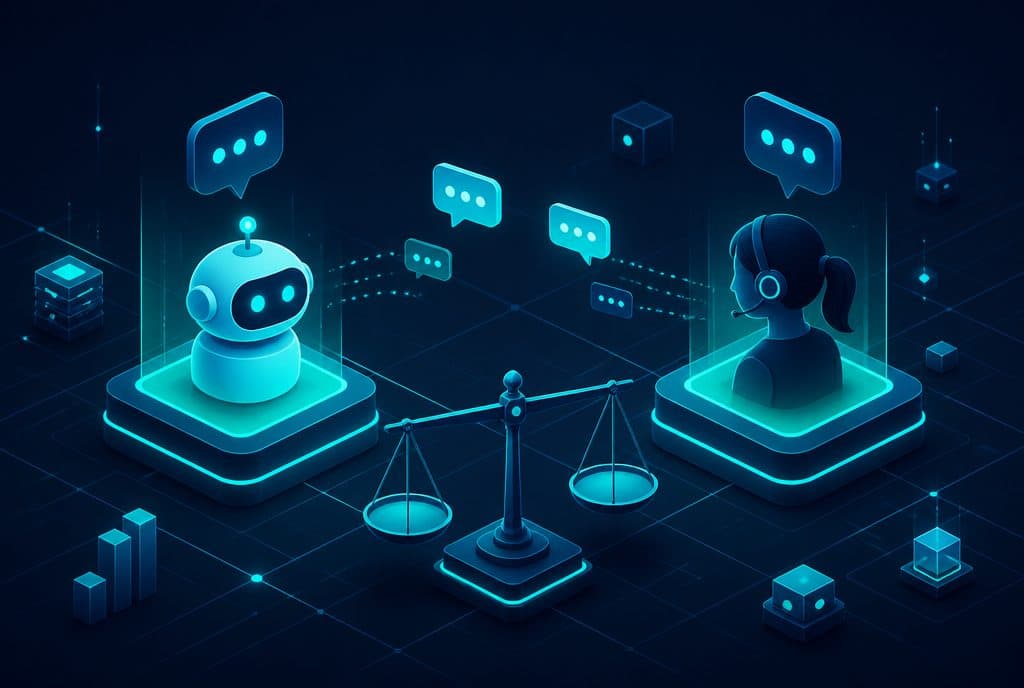
An AI agent does not replace a customer service representative — it changes what the human representative needs to do. AI excels at providing immediate 24/7 responses, handling repetitive questions, and filtering inquiries before they reach a human. A human representative excels in complex conversations, resolving complaints that require judgment, and building trust in high-value deals. The model that works in 2026 is hybrid: the AI agent handles the broad, repetitive layer, while the human representative handles the deep layer that truly requires a human presence.
Does an AI Agent Replace a Human Representative?
No — but it changes the job description. AI replaces the mechanical part: answering repetitive questions, confirming orders, checking availability, scheduling appointments, and sending documents. The human representative remains for the parts that require empathy, judgment, and closing complex deals. It is not a question of "who will win" — it is a question of smart division of labor.
Why is This Question Even Coming Up in 2026?
Over the past year, more and more small and medium-sized Israeli businesses — stores, clinics, consultants, real estate — are starting to use AI agents to answer customers on WhatsApp, email, and chat. As a result, the question "Will AI replace my employees?" comes up in every initial consultation call.
The honest answer is: in some cases — yes, AI will handle inquiries that previously required a human. But "replace" is the wrong word. What is actually happening is liberation: the representative is freed from trivial inquiries and can focus on the interactions where they truly bring value.
AI vs. Human — Who is Good at What
| Inquiry / Situation | AI Agent | Human Representative |
|---|---|---|
| Repetitive question (hours, price, process) | Excellent — fast, consistent, 24/7 | Waste of time, human errors |
| Scheduling an appointment / booking | Excellent — connected to the calendar, no delays | Only available during working hours |
| Lead qualification and CRM logging | Excellent — writes automatically, never forgets | Overloaded, forgets, delays |
| Organized follow-up on leads | Excellent — consistent, on time, never gives up | Depends on personal discipline |
| Sensitive complaint / angry customer | Weak — lacks genuine empathy | Excellent — can de-escalate and resolve |
| Complex sale, large deal | Weak — difficult to apply judgment | Excellent — builds trust, tailors solutions |
| Question not predefined | Limiting — hands over to representative | Flexible — improvises |
| Inquiry at 2 AM | Excellent — always available | Not available |
The common mistake we see businesses make: choosing between "AI only" or "Human only" — and both sides lose. Human only = congestion, delays, missed opportunities during off-hours. AI only = frustration with complex inquiries, customer feels like they are talking to a machine.
The Right Model: Hybrid
The model that works is: AI agent at the front, human representative in the background.
In practice, it looks like this:
- Receiving an inquiry — A customer writes on WhatsApp on Friday afternoon. The agent responds immediately.
- Filtering and diagnosis — The agent understands the topic, asks qualifying questions, and decides: is this for self-service, or should it be transferred to a representative?
- Self-service handling — FAQs, scheduling an appointment, sending a catalog, order confirmation — the agent completes it independently, logs it in the CRM, and closes the ticket.
- Seamless handoff to representative — If the inquiry is complex or emotional: the agent transfers it with a full summary — what the customer wanted, what was said, and what the next step is. The representative continues from the exact point the agent stopped — the customer doesn't have to repeat themselves.
- Representative finishes — Complex conversation, complaint, large deal — the human representative takes charge.
The result: Representatives deal with inquiries that truly require a human, and do not waste 60-70% of their time on questions that repeat every single day.
The Risk of Moving Too Fast — and What to Check First
Before deploying an AI agent in customer service, there are three important things to lock down:
1. Mapping incoming inquiries. What percentage of inquiries are repetitive questions? If it is below 40%, the agent will free up very little time and cause more frustration. If it is above 60% — the impact will be immediate.
2. Defining transfer rules. When does the agent transfer to a representative? What does the agent not answer? These boundaries are the DNA of the agent — without them, it might try to handle things that should go to a human.
3. Defining the agent's "voice". The agent must reflect the style of the business. A clinic will want a warm and human tone; a law firm will prefer a professional and formal tone. A stylistic mismatch between the agent and the representative is one of the most common causes of a poor customer experience.
Frequently Asked Questions — and Direct Answers
"Our customers prefer to talk to a human" — True for some inquiries. But a customer who writes on Friday night and gets an immediate response — prefers an AI response over silence until Sunday. Field research shows that resistance to AI in customer service is much lower than managers expect, as long as the transfer to a representative is seamless.
"We are a small company, is this suitable for us?" — Small businesses actually benefit the most. When you have two employees and a business owner trying to answer everyone, every inquiry the agent closes saves dozens of minutes a day and prevents a lead from going cold.
"What if the agent says something incorrect?" — A properly built AI agent model operates within defined boundaries. It only answers what it has been configured to answer, and transfers to a representative when it goes outside its knowledge base. This is not an open ChatGPT — it is a digital representative with clear guidelines.
What Does This Mean in Terms of the Privacy Protection Law?
In Israel, inquiries processed by an AI agent are still subject to the rules of the Privacy Protection Law. In practice: customer data collected in conversation (name, phone, request details) must be stored securely and not transferred to external services without consent and an appropriate legal basis. When building an AI agent, it is important to ensure that the system operates within the correct architecture — usually by connecting directly to the internal CRM, without transferring data to unnecessary third parties.
First Steps: How to Start
Don't start with "how much does it cost" — start with "what is the pain point."
The right questions to ask:
- What kind of repetitive inquiries do we answer every day?
- What are the peak hours when we fail to answer quickly?
- How many leads "go cold" because we didn't answer within an hour?
- What is the first action we want the agent to complete on its own?
From these answers, build one clear scenario, deploy, measure, and expand. This is the modular approach we recommend — at Automaziot AI, we start with a short characterization of the first phase, rather than developing "everything at once."
Summary
An AI agent in 2026 is not the competition for the human representative — it is the filter that allows the human representative to work better. A business that runs a correct hybrid model gets: immediate 24/7 response to common inquiries, leads that don't go cold, representatives who focus on real deals, and a customer experience that is perceived as both fast and human at the same time.
The challenge is not "whether AI" — but "which part AI and which part human." Those who divide it correctly — win.
Want to see what a hybrid model looks like in your business? Talk to us for an initial consultation at no cost, or read more about our WhatsApp AI Agent — the most common starting point.