
AI for demand forecasting is a tool that analyzes your historical sales data — by product, season, days of the week, and holidays — and generates a numerical forecast of how much will be sold in the near future. Its goal is to help small and medium-sized businesses in Israel plan inventory and staffing in advance, reducing losses from both stockouts (customers going to a competitor) and excess inventory sitting on the shelf. It is a planning tool, not a guarantee — and its real advantage lies in saving time and making data-driven decisions.
What is Demand Forecasting with AI?
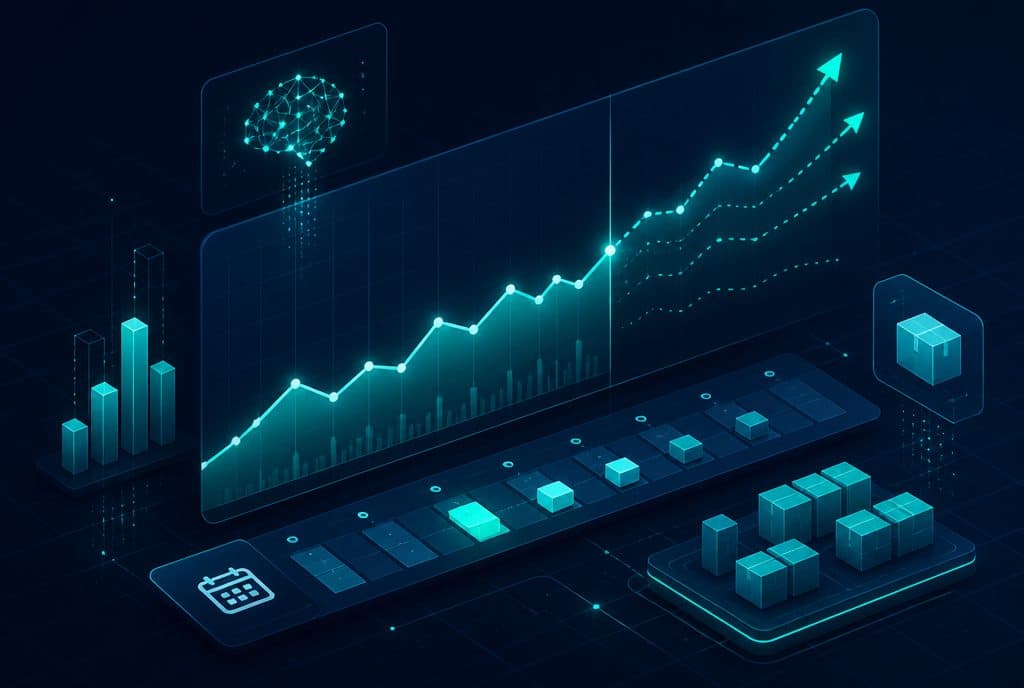
Demand forecasting with AI is a process where a computerized system analyzes a business's existing sales data — history, seasonality, holidays, promotions, and external events — and generates a quantitative forecast: how many units of each product are expected to sell in the near future, when, and through which channel. The output is not "magic" — it is a fast, consistent statistical weighting of information that already exists in the business, allowing you to plan purchasing, staffing, and logistics in advance rather than in retrospect.
Why is Manual Inventory Management So Difficult?
A clothing store owner in Tel Aviv, an e-commerce warehouse manager, or a restaurant manager — all face the same problem: demand is uneven. There are days, weeks, and seasons when sales spike, alongside quiet periods. Manual planning relies on experienced guessing, memory of "what happened last Passover," and sometimes gut feeling.
The result: over-ordering during quiet periods which freezes capital, and conversely, stockouts during peaks which loses sales. In both scenarios — real financial damage.
What AI Can Do — and What It Can't
| Capability | What AI Does | What is Left for Humans |
|---|---|---|
| History Analysis | Identifies seasonal patterns and trends in the data | Deciding if the product strategy has changed |
| Demand Forecasting | Generates a quantitative forecast by SKU and date | Approving and adjusting based on business knowledge |
| Early Warnings | Alerts when stock is likely to run out before the next order | Negotiating with suppliers |
| Ongoing Updates | Automatically updates the forecast as new data comes in | Acting based on the alert |
| Unexpected Events | No — AI does not predict supply chain disruptions | Managing exceptions and maintaining safety stock |
It is important to be honest: AI for demand forecasting is not a guarantee of zero stockouts. It is a tool that improves the decision-making foundation, not one that eliminates uncertainty.
How It Works in Practice?
Step 1: Collecting Existing Data
The system connects to the data sources you already have: sales data from the POS system, WooCommerce, Shopify, Google Sheets, or any ERP/POS system. There is no need to build a new infrastructure from scratch — most businesses are already sitting on a pile of unused data.
Step 2: Pattern Analysis
The AI identifies:
- Annual seasonality — Which products rise before Rosh Hashanah? What sells more in winter?
- Weekly patterns — Is Friday different from Monday in order volume?
- Impact of promotions — How much did the previous 20% discount double the demand for product X?
- Long-term trends — Is product Y growing consistently? Is Z declining?
Step 3: Forecasting and Planning
The output is a quantitative forecast — for example, "In the week before Rosh Hashanah, demand is expected for 340 units of product A, 120 of B" — which is automatically connected to the reorder point: when stock falls below a certain level, the automation sends an alert to purchasing, and an automatic order to the supplier can also be triggered.
Step 4: Continuous Learning
As new sales data comes in — actual vs. forecast — the system updates. Next month's forecast is already better than last month's.
At Automaziot AI, we build this flow primarily with n8n and the APIs of the relevant platforms, connecting to the data sources that already exist in the business.
Which Businesses is This Suitable For?
Retail and Online Stores — Clothing, footwear, home goods, or gadget stores that experience clear seasonal peaks (holidays, back-to-school, winter/summer) — can plan purchasing with higher accuracy and reduce excess inventory at the end of the season. See also E-commerce Automation.
E-commerce — Stores selling through multiple channels (their website, Amazon, eBay) can get a unified forecast that prevents a situation where a product runs out on one channel while excess stock sits on another.
Restaurants and Food — Planning the purchase quantity of raw materials based on the forecast of covers for the coming week, taking into account the season and events. Less waste, fewer shortages.
Businesses that benefit less: A business with a single product and uniform sales throughout the year, or a business without at least 6-12 months of data history — will not see enough benefit to justify the investment.
Limitations You Should Know
Before getting started, a few honest points:
- Historical data is required — At least 6-12 months of consistent sales data. A new business operating for 3 months will not be able to build a reliable model.
- AI does not predict external disruptions — A supplier strike, a global shortage of raw materials, or a one-off news event — these are outside the scope of any forecasting model.
- Ongoing maintenance is required — The model needs updating when the business changes (new products, strategy shift, opening a new sales channel).
- Does not replace human judgment — The forecast is an input, not a ruling. The manager who knows the supplier delayed a shipment must override it.
How to Get Started?
Step 1 — Map what you have: Where does your sales data live? (POS, Excel, WooCommerce, ERP system?). How many months are there? How many SKUs do you have?
Step 2 — Define the business question: What do you want to answer? "How much to order from the supplier before Rosh Hashanah?" is different from "How to plan staffing for the store on weekends?". A focused starting point yields fast results.
Step 3 — Automate the flow: Once you have a working model, connect it to existing purchasing processes — an automatic alert to the purchasing team, or an automatic order to the supplier with human approval before execution.
Step 4 — Measure and improve: Compare forecast to actuals after each period, and refine the model. Over time, accuracy increases.
Interested in understanding if a demand forecasting system is right for your business? Talk to us — we will look at your data together and build a practical direction.
Related Articles
- AI Inventory Management — The Complete Guide
- Automation for Online Stores and E-commerce
- Business Automation — Building Smart Workflows
Summary
Demand forecasting with AI is a planning tool that has become accessible to small and medium-sized businesses in Israel as well. It does not guarantee there won't be surprises, but it replaces manual guessing with a data-driven forecast — and connects it to purchasing and inventory processes automatically. For retail, e-commerce, and restaurant businesses with clear seasonality and broad inventory, the benefit is tangible: less capital frozen in excess stock, fewer lost sales due to shortages, and fewer hours managers spend on manual inventory counts. Our recommendation: start with one clear business question, and let the system prove itself over one period before expanding.